Nearly 1 in 3 Atlanta renters spend over half their income on housing


Add Axios as your preferred source to
see more of our stories on Google.
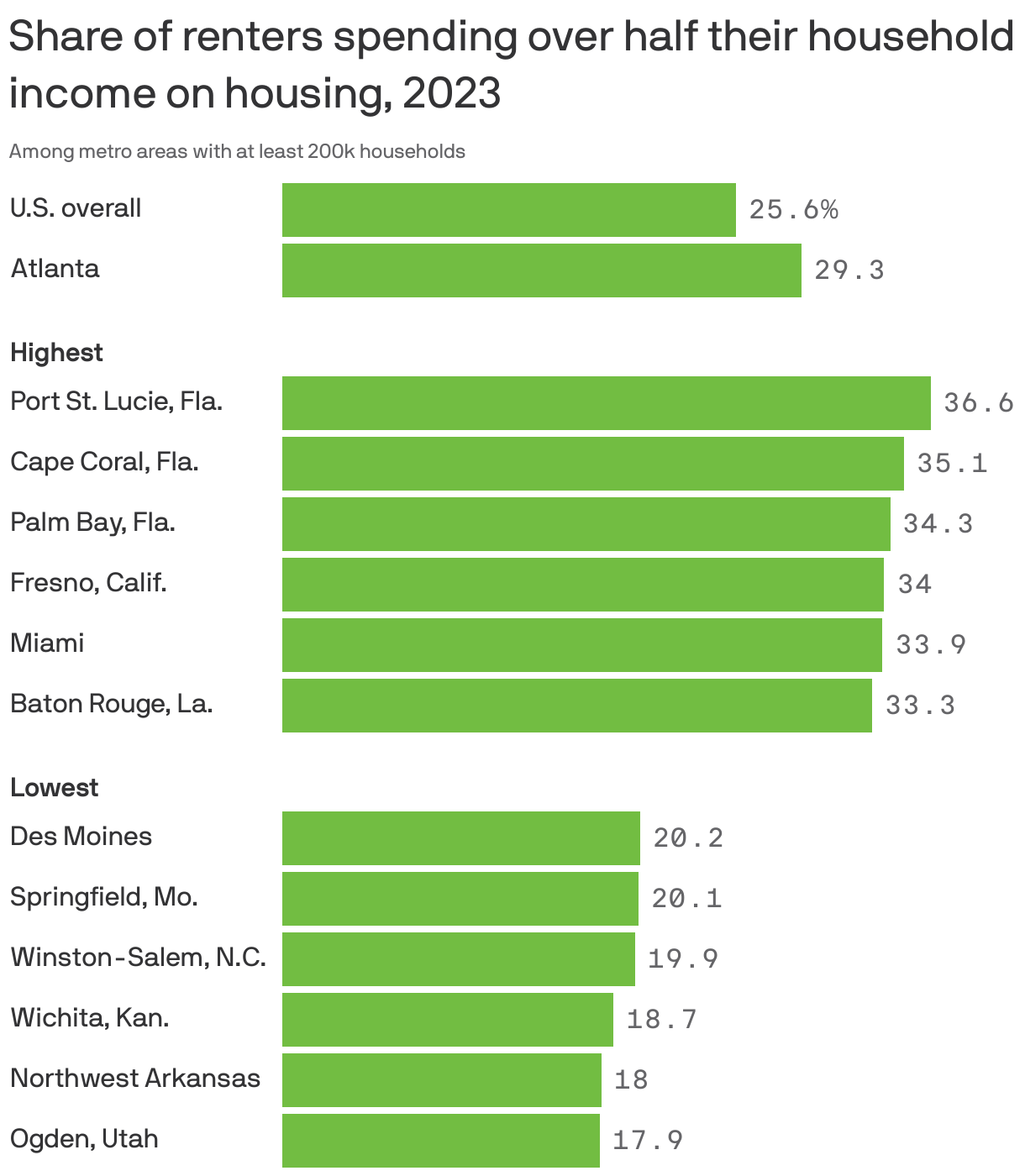
Nearly a third of metro Atlanta renters now spend more than half of their household income on housing, according to new data from the Census Bureau.
Why it matters: An excessive rent burden can make it harder to afford other basic needs, like groceries and transportation — or to save for a down payment that can turn rent checks to a landlord into mortgage payments towards home equity.
By the numbers: Atlanta renters are faring worse than the average renter nationwide, with 29.3% using more than half of their income to make payments.
- That's higher than the national average of 25.6%
Zoom out: Florida is home to several especially rent-burdened metros, including Port St. Lucie where 36.6% of renters are spending more than half their income on rent. It's followed by Cape Coral (35.1%) and Palm Bay (34.3%).
- That could be due to the state's large number of retirees, who may have relatively less current income.
- On the other side are Ogden, Utah (17.9%), Northwest Arkansas (18%) and Wichita, Kansas (18.7%).
- That's according to the 2023 1-year American Community Survey, and among metros with at least 200,000 households.
Between the lines: Geography is only part of the equation here — racial disparities play a role, too.
- 30.6% of Black renters are spending more than half their income on rent, compared to 23.4% of white renters.
Stunning stat: The real median gross cost of renting — that's rent plus utility/energy costs — grew faster annually (+3.8%) than real median home values (+1.8%) last year for the first time in a decade, the Census Bureau points out.