Should we kill coyotes? No way, experts say

Add Axios as your preferred source to
see more of our stories on Google.
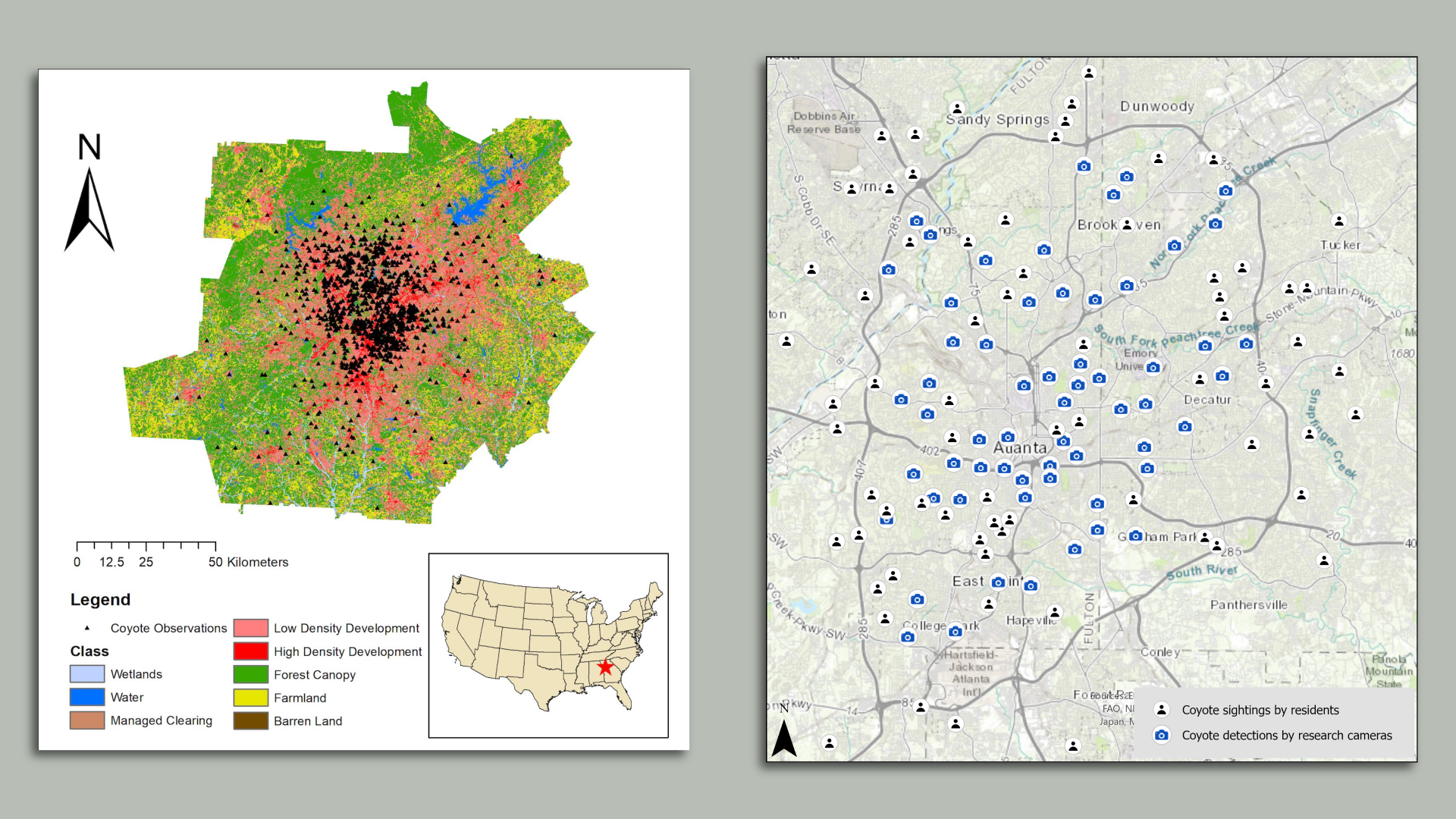
The map to the left is from the Atlanta Coyote Project, and it displays Georgia's reported coyote sightings from 2015 to 2018. The map to the right is from Wildlife Atlanta, and it displays coyote sightings from stationary cameras and residents from 2022 to now.
Coyotes get a lot of bad press — but the danger they pose to humans and our pets may not be as big as you think.
Why it matters: Chris Mowry, a Berry College biology professor and co-founder of the Atlanta Coyote Project, says coyotes serve as natural pest control agents by eating rats, squirrels, and chipmunks that might be carrying diseases.
- Summer Fink, a University of Georgia doctoral student and lead researcher with Wildlife Atlanta, said coyotes are the biggest predator in the Southeast after bears.
- "I have a field next to my house, so the mice always get into my house and I'm always like, 'where's the coyote to come eat these mice for me,'" Fink said.
Catch up fast: Local reports of coyote sightings started this February amid coyote mating season. By November, residents in North Buckhead and east Cobb County shared concerns with WSB-TV about coyotes eating their cats or stalking people as they walked their pets.
The intrigue: Last year, a Great Pyrenees from Decatur made national headlines after he killed eight coyotes to defend his pregnant partner and his sheep flock. Casper survived his wounds and is running for Farm Dog of the Year.
- Yes, but: Mowry called the sheepdog incident "a very fishy story" because coyotes typically only travel in pairs, and there's no "evidence, carcasses, or anything that verifies this story."
What's happening: Fink said "strong emotions," a lack of information and a growing "nature-deficit disorder" have fueled biased headlines about coyotes.
- Coyotes mainly eat plants, rodents, snakes, bird eggs, and possums, said Mowry and Fink.
By the numbers: According to Georgia's Department of Natural Resources, there have been more than 1,200 coyote sightings across the state since 2019.
- The Atlanta Coyote Project has received about 1,672 reports of coyote sightings since 2015. Mowry says they get reports twice a day, amounting to nearly 600 annual sightings.
What they're saying: Georgia's wildlife officials deem coyotes a non-native species that can be killed legally on private property if you can't keep them away with non-lethal methods.
- But Mowry said killing them could lead to more births among "subordinate" coyotes trying to reproduce at an earlier age.
Of note: Both experts told Axios there's a "big debate" over whether coyotes are non-native to the Southeast.
- Fink said the story is that coyotes are from the Great Plains states.
- But Mowry said fossils from roughly 12,000 years ago show coyotes were previously found in the eastern half of North America.
- Humanity in the Southeast persecuted wild red and gray wolves to the brink of extinction, Mowry said, allowing coyotes to move in.
Threat level: Although we're not overrun with coyotes, wildlife experts say they live everywhere, including Piedmont Park.
- Still, coyote-human interactions are very rare because coyotes are risk-averse.
- Mowry said there's only two reported cases where a coyote bit a dog owner, and those two coyotes were infected by rabid raccoons. The coyotes later died from rabies.
- Fink said coyotes are on average 30 pounds, which means a large dog or deer could easily scare one away.
Meanwhile, Fink's research with wildlife cameras and GPS-enabled collars on coyotes showed that Georgia's urban coyotes are nocturnal, whereas coyotes traditionally get active at sunrise and sunset.
- "They're trying to avoid humans strongly so they're using that time difference to take advantage of less human activity," Fink said. "People aren't recreating at night, so then coyotes are able to use those spaces and avoid conflicts with humans."
The intrigue: Both Fink and Mowry told Axios that coyotes are very similar to humans.
- Mowry said they live in family groups with devoted parents in a wide variety of habitats, and they have a very broad diet.
- Fink said her favorite trait in coyotes is their tendency to look both ways before crossing the street.
Be smart: Report coyotes or get coyote advice at GeorgiaWildlife.com or 1-800-366-2661.
- Don't let pets run freely outdoors, and avoid feeding pets outside. Don't overfill bird feeders.
- Seal garbage and fallen fruit from fruit trees. Don't throw food scraps into the yard, and clean outdoor grill racks.
- Secure your tool shed and porch to prevent the rare chance of coyotes nesting under these spaces during the spring.
- If you see a coyote, don't run at it. Instead, make a loud noise to scare it away. Pick up your pet and walk away.
If you're interested in learning more about coyotes, Mowry will be giving a talk on the Atlanta Coyote Project on Jan. 18 at 7pm at 825 Warner Street, the headquarters for Trees Atlanta.
- Fink's research team is going to present their work at the Georgia Institute of Technology's natural resource symposium on March 10.
💭 Wil's thought bubble: A few years ago, I wrote some articles about a coyote that wandered into the "Dat Dog" restaurant on Frenchman Street in New Orleans' French Quarter.
- Animal trappers removed it and state officials ultimately "humanely euthanized" it, which actually upset the president of the "Dat Dog" business. Classic NOLA, ya heard me?