The U.S. military conducted a strike on Friday against a vessel that was allegedly transferring drugs, President Trump said.
Why it matters: This was the fourth such strike in recent weeks as part of a broader Trump administration military campaign against drug traffickers off the coasts of Venezuela.
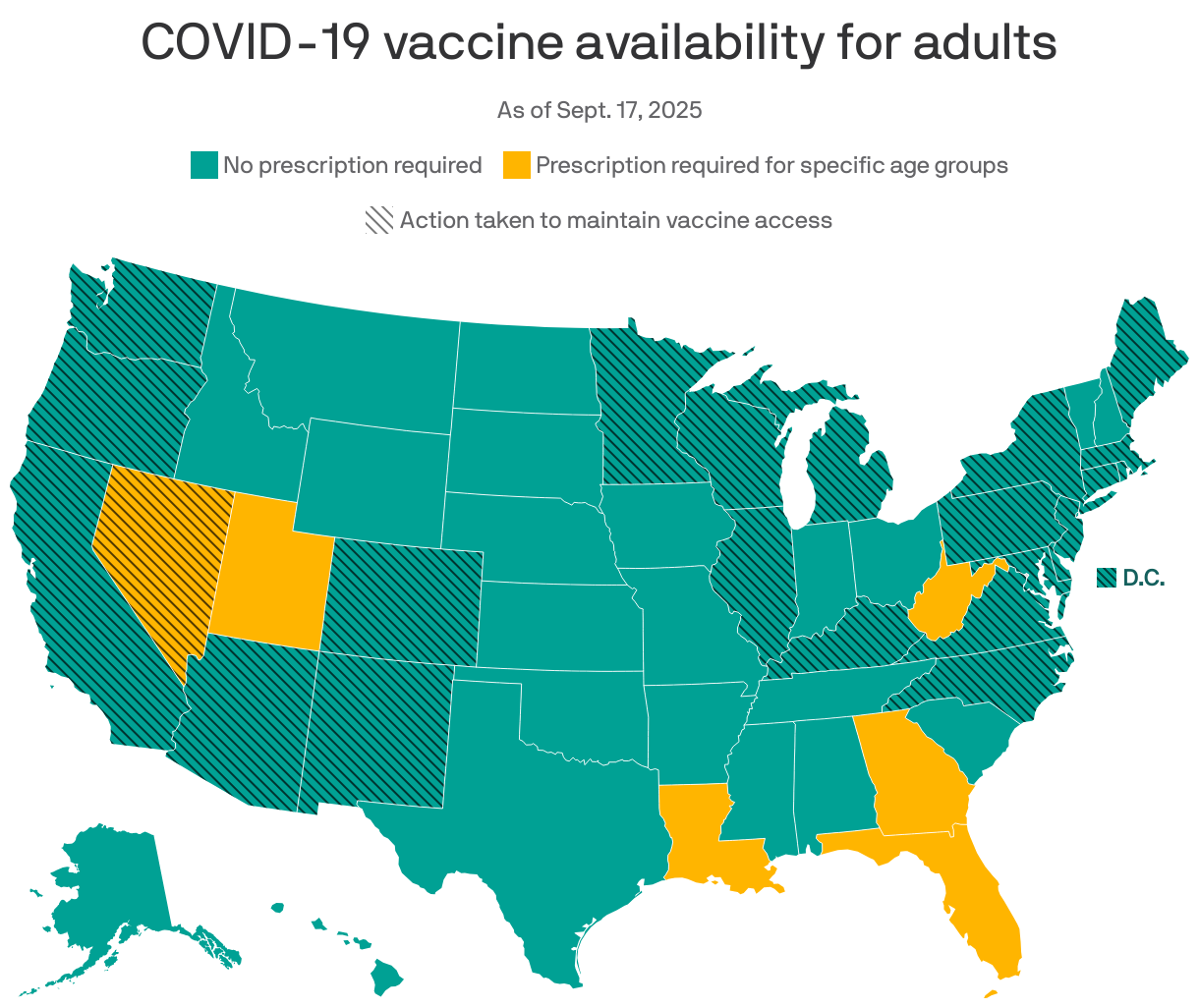
Data: Common Health Coalition and Your Local Epidemiologist; Note: Actions include legislative changes, executive orders and pharmacy board directives; Map: Axios Visual
COVID vaccine eligibility could depend on where you live.
Zoom out: Some states are making their own vaccine rules to bypass Health Secretary Robert F. Kennedy's vaccine restrictions.
Health Secretary Robert F. Kennedy Jr.'s vaccine advisers on Friday unanimously endorsed scrapping a recommendation that Americans age 65 and older get a COVID-19 vaccine — but stopped short of saying they needed a prescription for the shot.
Why it matters: The change, if endorsed by the Centers for Disease Control and Prevention, would signal an official lack of confidence in the safety and efficacy of the vaccines. But it would have the effect of keeping the vaccines covered by health insurers.
Driving the news: The 12-member Advisory Committee on Immunization Practices unanimously recommended that older Americans only be vaccinated after consulting with a health provider.
The panel also voted to recommend that individuals six months to 64 years old should have discussions with a provider that should emphasize the risks and benefits of vaccination.
The panel's positions emphasizing personal choice are sure to add confusion for people wondering whether to get a COVID-19 vaccine this year.
During an at-times disorganized daylong meeting,ACIP members also voted to call on the CDC to promote what members called a more comprehensive informed consent processes that describes to patients "at least the six risks and uncertainties" the panel says are associated with the shots.
Friction point: Vaccine advisors deadlocked 6-6 on whether to adopt a recommendation that cities and states require a prescription for updated COVID-19 vaccines.
ACIP Chair Martin Kulldorf cast the tiebreaking vote against the recommendation.
The decision would have add extra barriers to getting a COVID-19 booster, since about 90% of people who were vaccinated last year got the shots at a pharmacy, according to the CDC.
But some panel members said requiring a prescription would better ensure that patients understand the risks.
Evelyn Griffin, an OB-GYN and one of the five new members Kennedy appointed to the panel this week, likened the requirement to getting blood pressure medication refilled or started.
What's next: The CDC — currently led by Kennedy's second in command, Jim O'Neill — would need to approve the recommendations before they become official government policy.
States have already started to craft their own COVID-19 vaccination guidelines after the FDA in August approved boosters only for people over 65 and those with a set of underlying health conditions.
A group of seven Northeastern states on Thursday formed an alliance to make its own recommendations, in response to changes Kennedy has made to national vaccine policy.
Zoom in: ACIP member Retsef Levi, a professor of operations management at MIT with no health care background, presented conclusions from the committee's COVID-19 vaccine working group.
They asserted that serious safety concerns about mRNA vaccines are not being appropriately addressed, and that current assessments of COVID-19 vaccine protection are based on "low-quality" data.
Pfizer and Moderna's mRNA COVID-19 vaccines have been cleared for use by the FDA based on clinical studies involving tens of thousands of volunteer patients each. Hundreds of millions of doses were administered during the pandemic and its aftermath.
The studies and real world evidence show that the vaccines are effective against serious illness from COVID-19 and safe for patients, with rare side effects.
Some medical professionals on the COVID-19 working group disputed the conclusions Levi presented.
"COVID-19 vaccines are highly safe and effective," said Henry Bernstein, a professor of pediatrics at Hofstra University. "The need for a provider prescription create unnecessary steps to receiving a vaccine and do not effectively target those that are at high risk."
This story has been updated with additional reporting.
Health Secretary Robert F. Kennedy Jr.'s vaccine advisers on Thursday postponed a vote on whether all newborns should receive the Hepatitis B vaccine, saying they needed more time and information to consider the issue.
Why it matters: The Advisory Committee on Immunization Practices' deliberations during a two-day meeting have at times been marked with confusion over what members are voting on, and whether there's sufficient data.
Local health facilities will be ground zero for the sweeping Medicaid changes that the GOP budget law unleashed.
Why it matters: The $1 trillion in cuts to federal Medicaid funding will quickly translate into lower reimbursements for facilities that are already grappling with higher labor costs and inflationary pressures.
Republicans' sweeping Medicaid overhaul has left a lot of the heavy lifting to governors and state health officials as the program launches the biggest package of changes in its 60-year history.
Why it matters: States working with hospitals, clinics and other providers willhave to do more with less as they face about $1 trillion in program cuts and the likelihood of 10 million or more newly uninsured people from new work rules and other changes.