When President-elect Trumptook office the first time, his choices to lead agencies like HHS, CMS and the FDA sent clear signals to the health care industry that he'd enact a pretty orthodox GOP health agenda.
Why it matters: Trump's nominations for top health care positions so far signal a starkly different — and likely unpredictable — agenda for his second term.
This time around, he's started with a group of nominees — Robert F. Kennedy Jr. and Mehmet Oz — new to Trumpworld and unfamiliar with government bureaucracy. Their views and resumes are nearly the exact opposite of their predecessors.
The remaining wild card is whom Trump chooses to staff the agencies around those people, assuming they get confirmed by the Senate, which could make a huge difference given their government inexperience.
Flashback: Trump's first HHS secretary was former Rep. Tom Price, who chaired multiple influential House committees during his tenure, including the Republican Policy Committee.
After Price resigned due to a scandal around his use of private jets, Trump appointed Alex Azar to lead the agency. Azar was formerly an Eli Lilly executive and deputy HHS secretary.
Price was criticized by Democrats for both his ethics and his policy views, especially relevant as he'd be helming the agency during Republicans' attempt to repeal and replace the Affordable Care Act. Azar was criticized for being too friendly with the pharmaceutical industry.
Those complaints are a far cry from the objections to Kennedy's nomination, which include his history of criticizing vaccines and his conspiratorial ideas about Big Pharma's role in America's chronic health issues.
And Kennedy's focus on upending the health care agencies and addressing rising rates of chronic disease in America has just about nothing in common with the first Trump administration's focus on insurance reforms.
Kennedy's interest in cracking down on America's food supply also wasn't a priority for the first Trump administration.
Sexual misconduct allegations have tanked one of President-elect Trump's most high-profile Cabinet picks, Matt Gaetz, but other choices to staff his administration have also been accused of participating or overlooking sexual misconduct.
Why it matters: While the first Trump administration's staff also included members who faced sexual misconduct allegations, Trump's picks the second time around are set to fill much more prominent and influential roles.
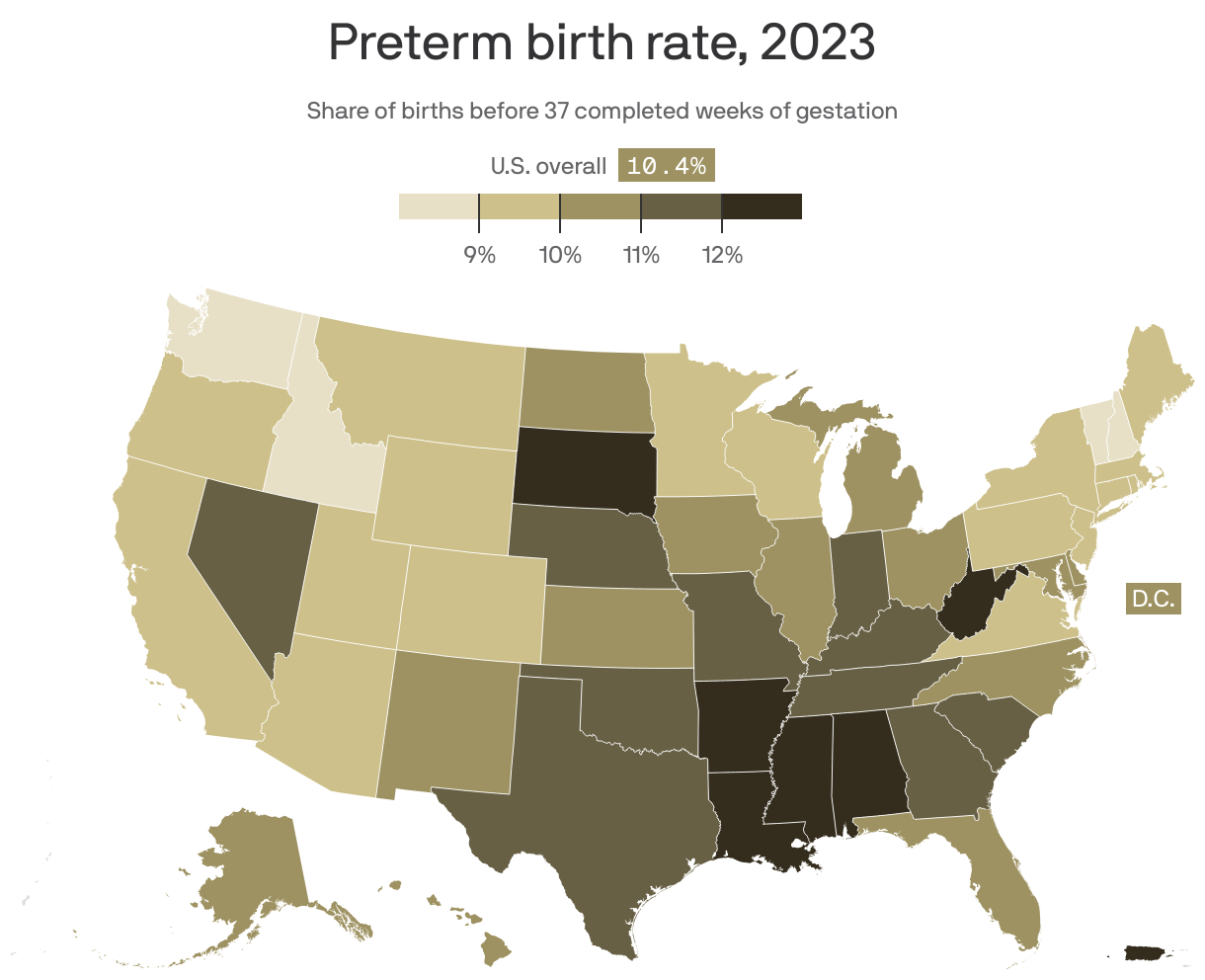
Data: National Center for Health Statistics via March of Dimes; Map: Axios Visuals
For the third yearin a row, high preterm birth rates earned the U.S. only a D+ in a March of Dimes report on the state of maternal and infant health.
The big picture: Black, Latina, Native American and Pacific Islander women experience disproportionate rates of preterm births, infant mortality and maternal deaths.
Three out of four U.S. adults want their primary care provider to discuss their mental health during routine checkups, but roughly a third say they've never been asked about it, according to a new Gallup survey.
Why it matters: The poll shows a disconnect between patient expectations and provider behavior at a time when the country is in the midst of a mental health crisis and more health officials are looking at integrating behavioral health into primary care settings.
Roughly a quarter of Americans say they suffer from chronic pain and nearly 1 in 10 say it's bad enough to regularly limit their life or work, according to new data from the Centers for Disease Control and Prevention.
Why it matters: Chronic pain is the most common reason people seek medical care and beyond causing physical limitations can lead toincreased anxiety and depression as well as opioid misuse.
Why it matters: The confirmation process will test how willing GOP senators are to let his disproven vaccine claims and pro-abortion stance go unchallenged, either in the belief it's important to get an outsider-provocateur running federal health care or in deference to President-elect Trump.