Actor Bruce Willis has been diagnosed with frontotemporal dementia, his family said in a statement Thursday.
Driving the news: Willis' "condition has progressed" and FTD was the "more specific diagnosis," the statement added. It came nearly a year after the actor's family said he would step away from acting due to an aphasia diagnosis.
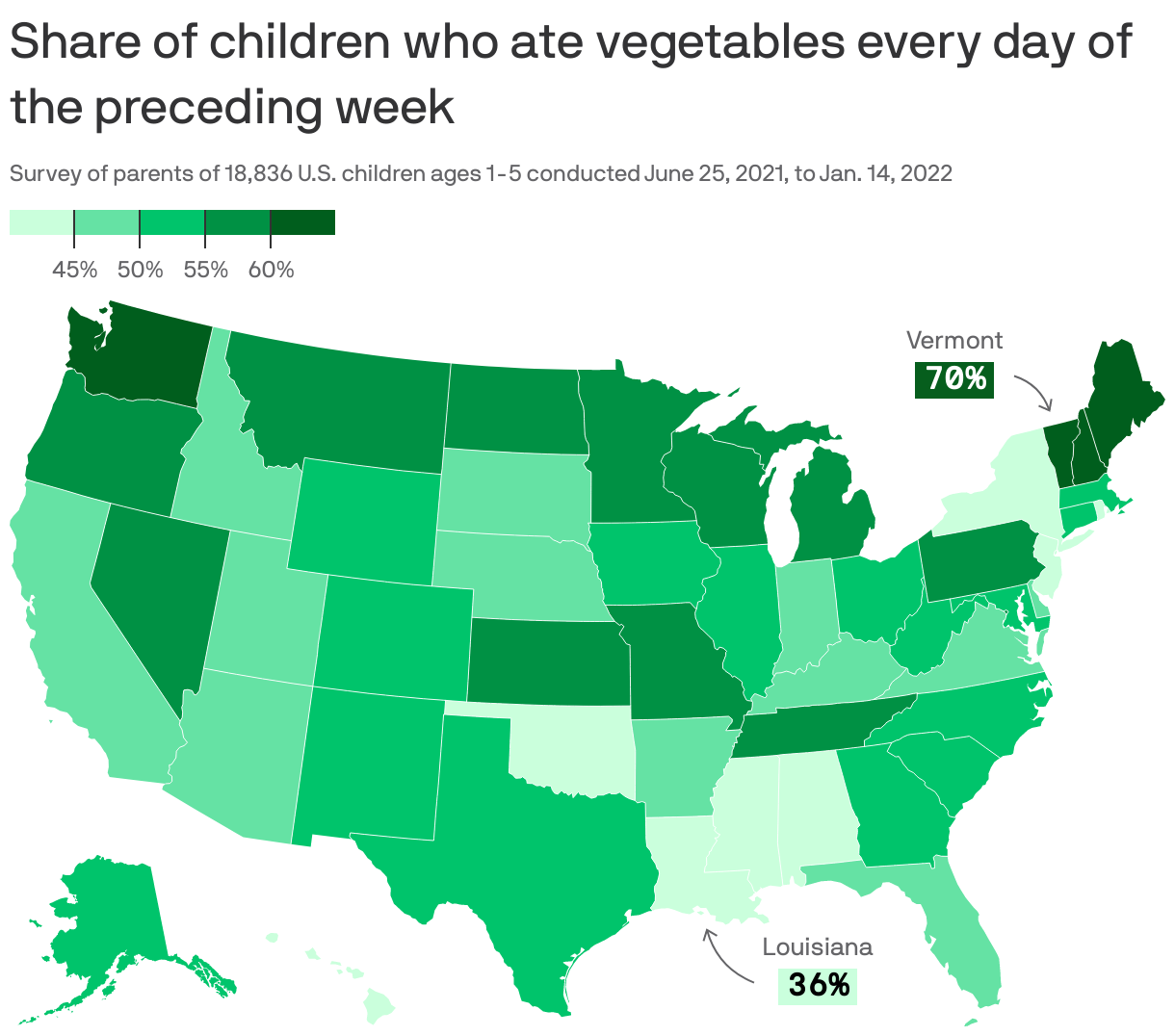
Data: Hamner, et. al, 2023, Fruit, Vegetable, and Sugar-Sweetened Beverage Intake Among Young Children, by State; Map: Axios Visuals
Nearly half of young kids aren't eating a daily vegetable and one in three kids aren't getting at least one daily fruit in their diets, the CDC reported Thursday.
Why it matters: While this data is only a snapshot in time, it offers a glimpse at the quality of kids' diets — which impacts their growth and development — at a time of increased interest in addressing childhood nutrition, as well as concerns about the pending loss of pandemic-era food benefits.
After years of trying to squash the expansion of government-funded health care and preserve business from private payers, the health care industry is suddenly facing new threats to the revenue it receives from the Medicare.
Why it matters: Behind all of the political posturing around sustaining the program is a cold, hard fact — the program's trust fund is expected to go bankrupt as soon as 2028. To prevent that from happening, lawmakers have three options: raise taxes, cut benefits, or cut payments to the health care industry.
Medicare Advantage and Medicare drug plans told the Centers for Medicaid and Medicare Services that too much regulation at once could drive up costs and result in increased premiums or fewer benefits.
Driving the news: Public comment closed this week on on a proposal to crack down on Medicare Advantage marketing practices, impose other standards on Medicare drug plans and create requirements to increase access to behavioral health and culturally competent care.
Food and Drug Administration advisers on Wednesday unanimously endorsed making a nasal spray antidote for opioid overdoses available for over-the-counter use, setting up an agency decision on whether to make it available for national distribution.
Why it matters: This is the closest any opioid reversal drug in the U.S. has gotten to not requiring a provider’s signoff, which public health experts and advocates have said will be critical in ending the overdose crisis that has killed more than 100,000 Americans in the past year.
Catch up quick: The FDA fast-tracked the application for a nonprescription version of Emergent BioSolutions' Narcan in December after pushing drugmakers to submit applications for one last fall.
Most states already have a standing order that allows people to bypass the prescription requirement.
But Jody Green, deputy director of safety in the FDA's division of nonprescription drugs, said that some pharmacists find the orders complicated and not all stock the drug, known as naloxone.
Stigma around drug use can also inhibit people from purchasing the nasal spray if it means interacting with a pharmacist.
Zoom in: Discussion among panelmembers mostly focused on whether the instruction labels were clear enough for anyone to use the product without risk, and pointed to the greater issue of limited public health messaging regarding naloxone.
Yes, but: “Much of that is beyond what you can put on a drug label,” said Theresa Michele, the director of FDA’s nonprescription drugs office.
The FDA also doesn’t have the authority to require post-marketing safety monitoring for nonprescription drugs, Michele added.
Bonnie Milas, a cardiac anesthesiologist at the University of Pennsylvania, recalled how her husband , who has no medical training, was able to rescue their sons with naloxone. Her sons later died from unrelated accidental fentanyl overdoses.
“After having lost my sons, you might say ‘Why would I argue to have naloxone over the counter?’” Milas said. “It’s because naloxone gave them a chance at recovery ... it was a chance to live a full life.”
Conditions to be met for nonprescription drugs include adequate labeling that allows consumers to self-treat without a health care provider present, low potential for misuse and a benefit that outweighs risk.
What they’re saying: Labeling delays shouldn't stymie the approval process, said Stephen Clement, a voting committee member and University of Virginia professor of medical education, “because this drug needs to get out to patients.”
What’s next: The FDA is expected to make a decision by the end of March, and it's unlikely the agency will hold up Narcan's application due to labeling questions, Brian Malkin, an attorney who specializes in FDA drug regulation, told Axios.
The cost of the drug hasn’t been publicly disclosed, but Emergent BioSolutions plans to "maintain affordability," said company spokesperson Matt Hartwig.
Some outside estimates range from $32 to $176 — a price tag that could prohibit those most in-need from obtaining it.
The Biden administration unveiled three drug payment programs Tuesday aimed at helping reduce patients' out-of-pocket costs, including one that would potentially lower Medicare payments for promising treatments approved by the FDA before clinical trials are complete.
Why it matters: The models wade into some of the most timely drug pricing issues of the day, and could boost President Biden's political arsenal for 2024.
Top doctors groups are pressing Congress to overhaul the way Medicare pays physicians just as lawmakers are getting pulled into the politically charged debate over possible cuts to entitlement programs.
Why it matters: The new appeals serve notice that there's political risk if provider cuts become part of conservative-led efforts to balance the federal budget or a deal on raising the debt limit.