Why it matters: The law, which was signed in March and set to go into effect on April 22, will not be enforced while the court considers the case. The legislation was modeled after Texas' six-week abortion ban, which encourages private citizens to sue any health professional who has provided an abortion.
Democratic Kentucky Gov. Andy Beshear vetoed on Friday a bill that would ban abortions after 15 weeks of pregnancy with no exceptions for rape or incest.
Why it matters: The sweeping measure is modeled after Mississippi's abortion law, which is currently under review by the Supreme Court, AP notes. Kentucky currently bans abortions after 20 weeks.
Why it matters: The news follows a recent trend of Republican-led state legislatures across the country introducing and passing bills that target transgender youth and restrict discussion about sexual orientation and gender identity in the classroom.
Aclarity, a Hadley, Mass.-based solution for eliminating PFAS (aka forever chemicals) from drinking water and wastewater, raised $3.3 million in seed funding.
Why it matters: PFAS have been tied to numerous forms of cancer, which is why the federal government has devoted increased spend and attention on cleanup. Right now that means filtering the chemicals and then disposing of them elsewhere, like in landfills or deep-injection wells, but Aclarity claims its tech can actually destroy PFAS.
A federal appeals court on Thursday revived President Biden's COVID-19 vaccine mandate for federal executive branch employees.
Driving the news: The 5th U.S. Circuit Court of Appeals ruled that a federal judge in Texas lacked jurisdiction to block the Biden administration from enforcing the mandate, according to court filings.
Black Americans are emerging from the pandemic with relatively high confidence in the U.S. medical establishment, but with lingering concerns that they’re underrepresented in health care and STEM jobs.
Driving the news: A Pew Research Center survey of 3,456 Black adults found trust in medical scientists is greater than for other groups and institutions, including the military, religious leaders or public school principals.
The average U.S. life expectancy has fallen by more than two years in 2020 and 2021, according to a new study, not yet peer-reviewed.
By the numbers: There was a historically high drop in estimated life expectancy in 2020, from about 78.9 years in 2019 to 77 years in 2020, a fall of 1.9 years, the study led by the University of Colorado Boulder found.
The Biden administration's decision Thursday to offer limited Medicare coverage for Biogen's controversial Alzheimer's drug Aduhelm raises questions about what's ahead for other new and costly drugs.
Driving the news: The Biden administration announced Medicare will cover Aduhelm, but will limit the coverage to patients enrolled in a clinical trial in order to access the drug.
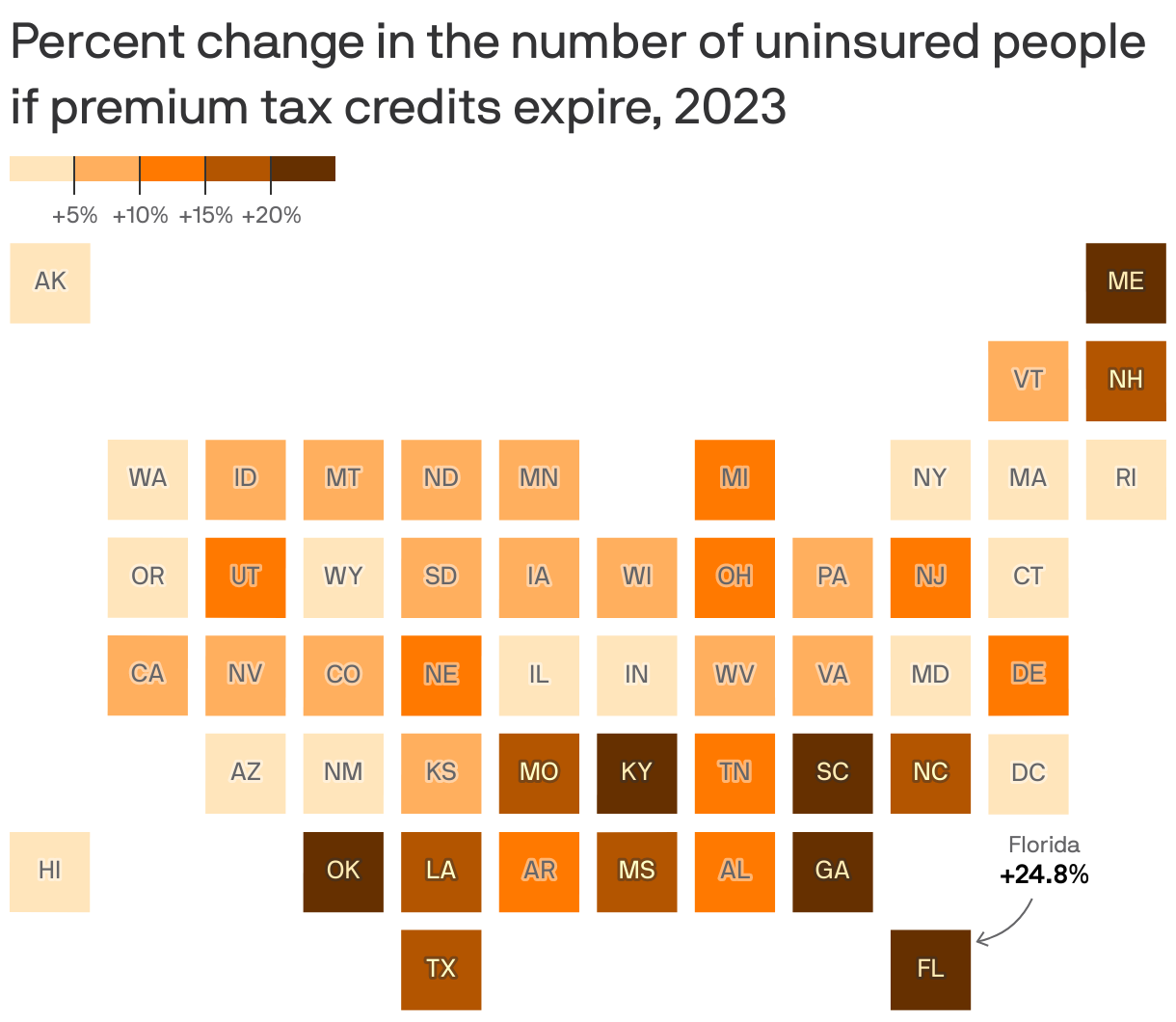
Data: Urban Institute Health Insurance Policy Simulation Model 2022; Cartogram: Jacque Schrag/Axios
Adisproportionate share of young adults, low-income, Black Americans and residents of Southern states will lose health coverage if Congress doesn't extend enhanced Affordable Care Act subsidies, according to a new analysis by the Robert Wood Johnson Foundation.
Why it matters: The analysis estimates that 3.1 million Americans would become uninsured when the subsidies expire beginning next year, and millions more would face much higher premiums than they currently pay. But those effects wouldn't be felt evenly across the country.






/2022/04/08/1649426293686.gif?w=3840)