The planet likely briefly exceeded a key warming threshold on Friday and Saturday for the first time since at least the beginning of instrument records, new data shows.
Driving the news: The indication that Friday and Saturday were the first two days on record to have a global average surface temperature above 2°C when compared with preindustrial levels, emerged first from a dataset maintained by the European Center for Medium-Range Weather Forecasts (ECMWF).
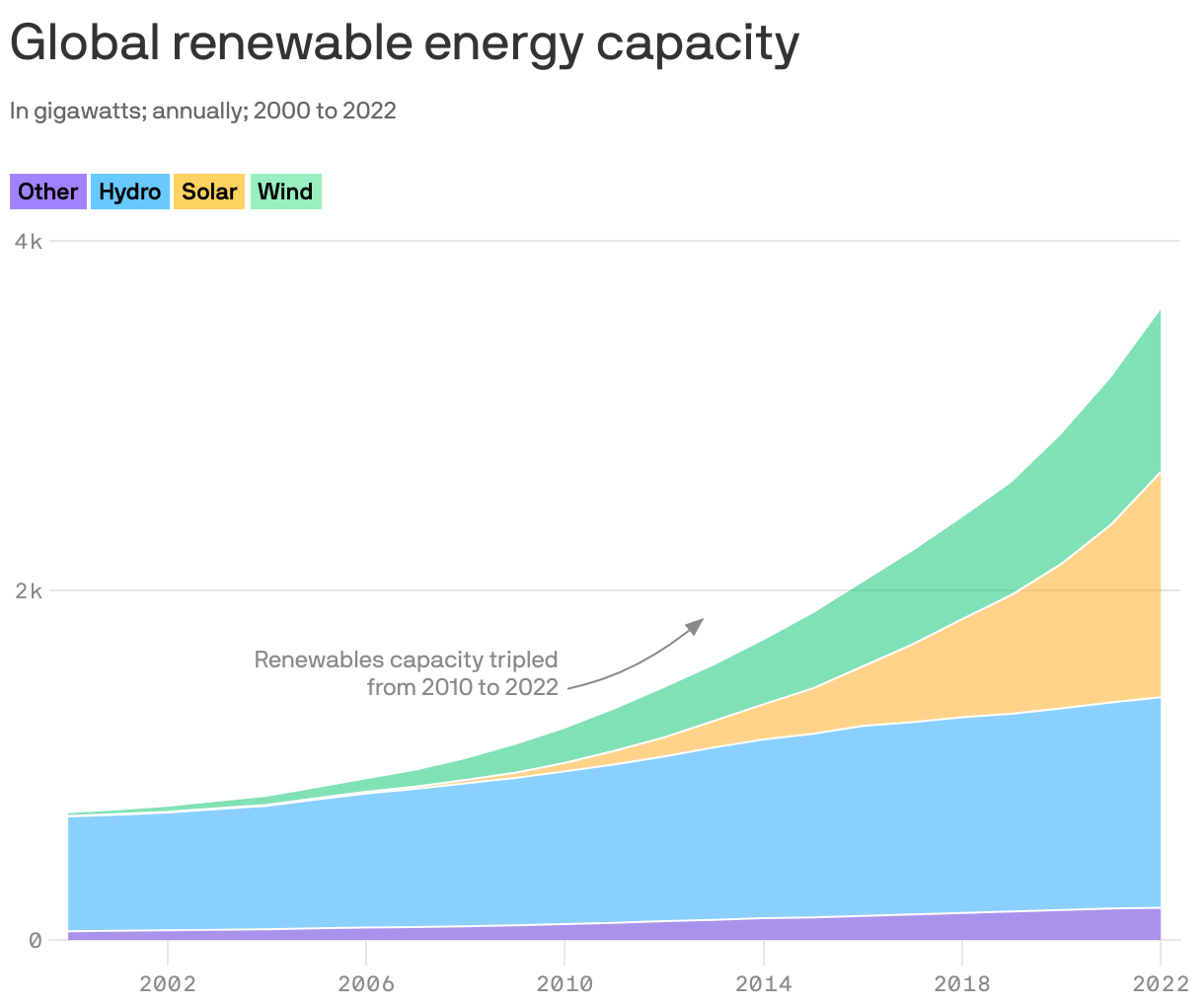
Data: BloombergNEF; Note: Wind generation includes onshore and offshore. Solar generation includes small-scale and utility-scale. Other includes geothermal and bioenergy; Chart: Deena Zaidi/Axios Visuals
Bolstering renewable energy, a goal likely headed for endorsement at COP28, is both consequential and achievable — even in light of previous pie-in-the-sky climate pledges.
Driving the news: Two new analyses find tripling global renewables capacity by 2030 is possible with stronger investment and policy support.
Two pivotal figuresin climate diplomacy are offering more information about what they want from COP28 and beyond.
Driving the news: United Nations Secretary-General António Guterres wants aggressive country plans that "plot a course for ending fossil fuels," he said Monday.
UN Secretary-General António Guterres is embarking on a trip to Antarctica beginning Monday, where he aims to see climate change impacts up close.
Why it matters: Guterres, who favors aggressive emissions cuts to planet-warming greenhouse gases, is likely to use the trip as a springboard to his discussions with world leaders at the COP28 Climate Summit in Dubai.
The globe is headed for nearly 3°C (5.4°F) of warming compared with preindustrial levels through 2100, new data finds, even if current policies to cut planet-warming emissions are met.
Driving the news: The United Nations' 2023 "Emissions Gap Report" details the distance between pledged greenhouse gas emissions cuts made by countries and the reductions needed to be on course to meet Paris targets.
An extreme heat wave that's sweeping Brazil is setting daily and monthly records, and causing spring temperatures to soar to levels that would even be unusually hot during mid-summer in some areas.
The big picture: The death of a woman at a Taylor Swift concert at which firefighters said 1,000 fans fainted in searing Rio de Janeiro heat Friday comes as the National Institute of Meteorology warns that Brazilians face "great danger" from this extreme weather event.




/2023/11/19/1700421587048.gif?w=3840)