Wednesday's energy & climate stories

Former top GM executive joins Exxon to lead climate unit

Exxon has tapped a former top GM executive to lead the climate unit that has recently gained stature within the oil giant.
Driving the news: Dan Ammann, who led GM's autonomous vehicle subsidiary Cruise until he was reportedly ousted in late 2021, will head Exxon's Low Carbon Solutions division. He was GM's president from 2014 to 2018.
Cash infusion for climate tracking startup

Kayrros, an energy and climate-focused data analytics firm, raised $44 million to bolster its emissions detection and tracking work.
Why it matters: There's a growing demand for monitoring climate harms, analyzing whether companies and governments are acting on emissions pledges, and helping them make good.
The energy fallout from Russia's war in Ukraine

President Biden will use meetings with European leaders this week to push new steps to curb the continent's huge reliance on Russian oil and natural gas.
Driving the news: "He will announce joint action on enhancing European energy security and reducing Europe’s dependence on Russian gas at long last," national security adviser Jake Sullivan said at the White House yesterday.

Extreme weather prompts UN early warnings push
/2022/03/23/1648037339682.gif?w=3840)
The United Nation’s weather branch is launching Wednesday an ambitious project to stand up early warning systems in areas increasingly vulnerable to extreme weather and climate events worldwide.
The big picture: In wealthy countries, such as the U.S., much of Europe, Japan, Korea and Australia, citizens have easy access to weather and climate information that can save lives and livelihoods.

Readers weigh in on daylight saving time
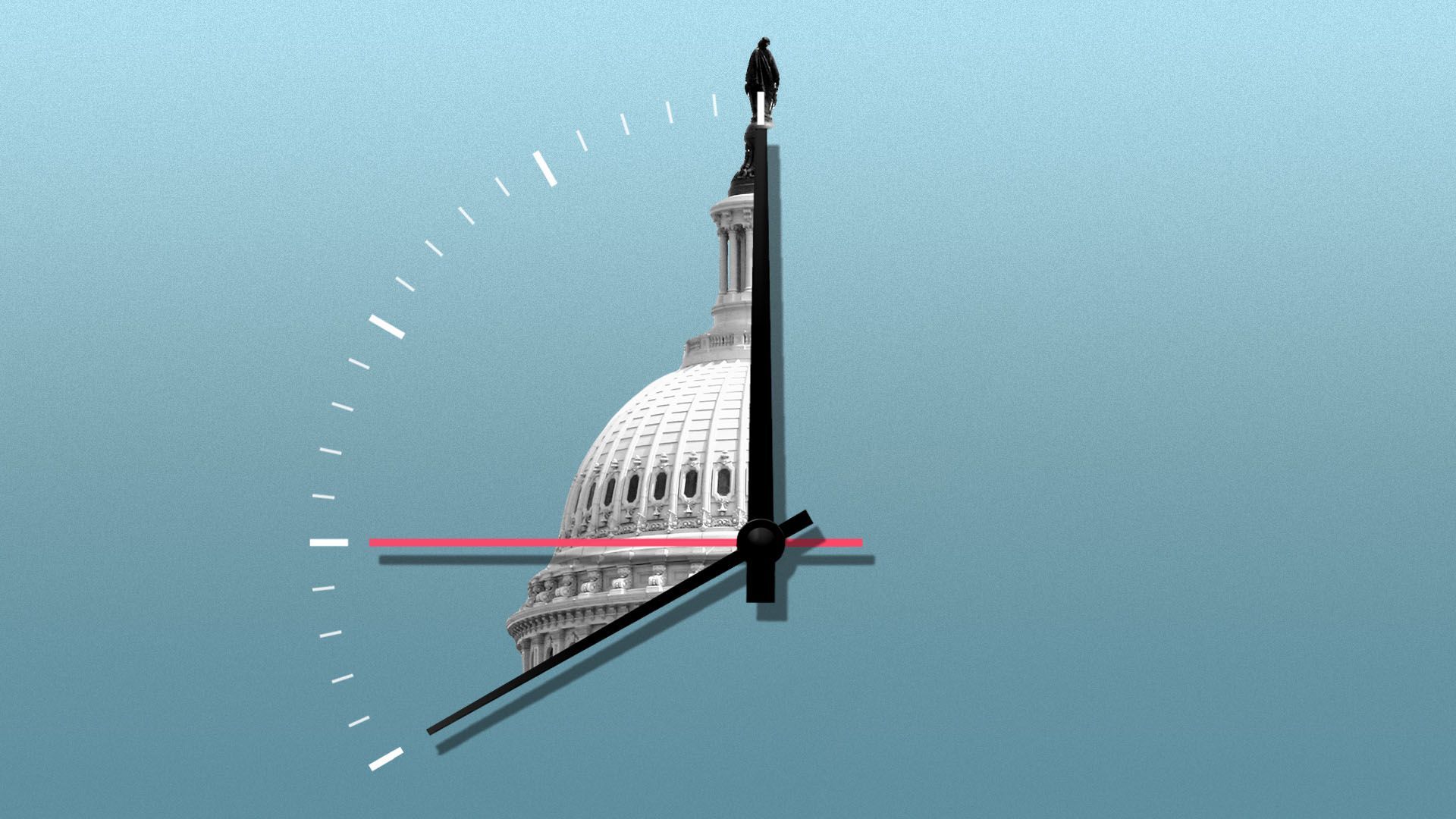
We heard from more than 100 What's Next readers in response to our question: What do you think of the proposal — which passed the Senate this month — to make daylight saving time permanent, starting in 2023?
Your responses fell into four categories, and one was the clear winner:
- By far, the largest number of people who responded said they'd like to stop changing the clocks back and forth — but they'd prefer to keep them permanently set on standard time, not daylight saving time.
- The second-largest number of responses came from people who said, "No to permanent daylight saving time."
- Nearly the same number of respondents — though just slightly fewer — said they'd vote "yes" to permanent daylight saving time.
- A fourth category of reader said, in essence: "Pick one or the other and stick with it."
A handful of readers suggested splitting the difference and changing the clocks back and forth half an hour once or twice a year.
What you're saying:
- "Standard time should be permanent. Let’s fall back now and stay there." — Mike Head
- "Let’s make daylight savings permanent and get rid of this annoying and anachronistic clock change twice a year!" — Alex Kemp
- "Permanent daylight savings time was tried during the Nixon administration. It sounded like a great idea, but in the end, was a miserable flop. The simple reason was that parents voiced concerns about their children standing more and more in the dark waiting for the school bus." — Jon F. Gasper
- "I live in Texas. The sun doesn't come up until 8 a.m. now. Kids are going to school in the dark now. Permanent DST would be particularly horrible in the winter months for us. I understand the East coast has the opposite problem." — Myrna Grigsby
- "Current surveys are missing the point. The vast majority of people want to stop changing our clocks twice a year. Some may prefer Daylight Savings Time and some may prefer Standard Time depending on whether they prefer more sun in the morning or evening. But the majority agrees that we should stop changing our clocks." — Jonathan Coon
- "If you think about it, there are only two days a year people bitch about it and they get over it within a week or so. If a switch is made to permanent DST, people will be complaining about it for two months and still have nothing to look forward to in the spring." — Chuck Goonan
- "I would prefer that we were on Standard time all year long. However, if Congress goes with permanent daylight savings, that is better than changing twice each year." — David Lias
- "NO! NO! NO! NO! NO! NO! NO! Don’t mess with Mother Nature and the natural order! How presumptuous of us. We should adapt to the rhythms of nature and physics, not the reverse." — Dave Stoller
- "As a kid, I loved Daylight Savings because it meant spring was around the corner, and another sign that my beloved Phillies would be in first place (until they actually started playing real games). As an adult I grew weary of it. My first choice would be to stick with Standard Time." — Mark Israel

Kore Power acquires storage developer
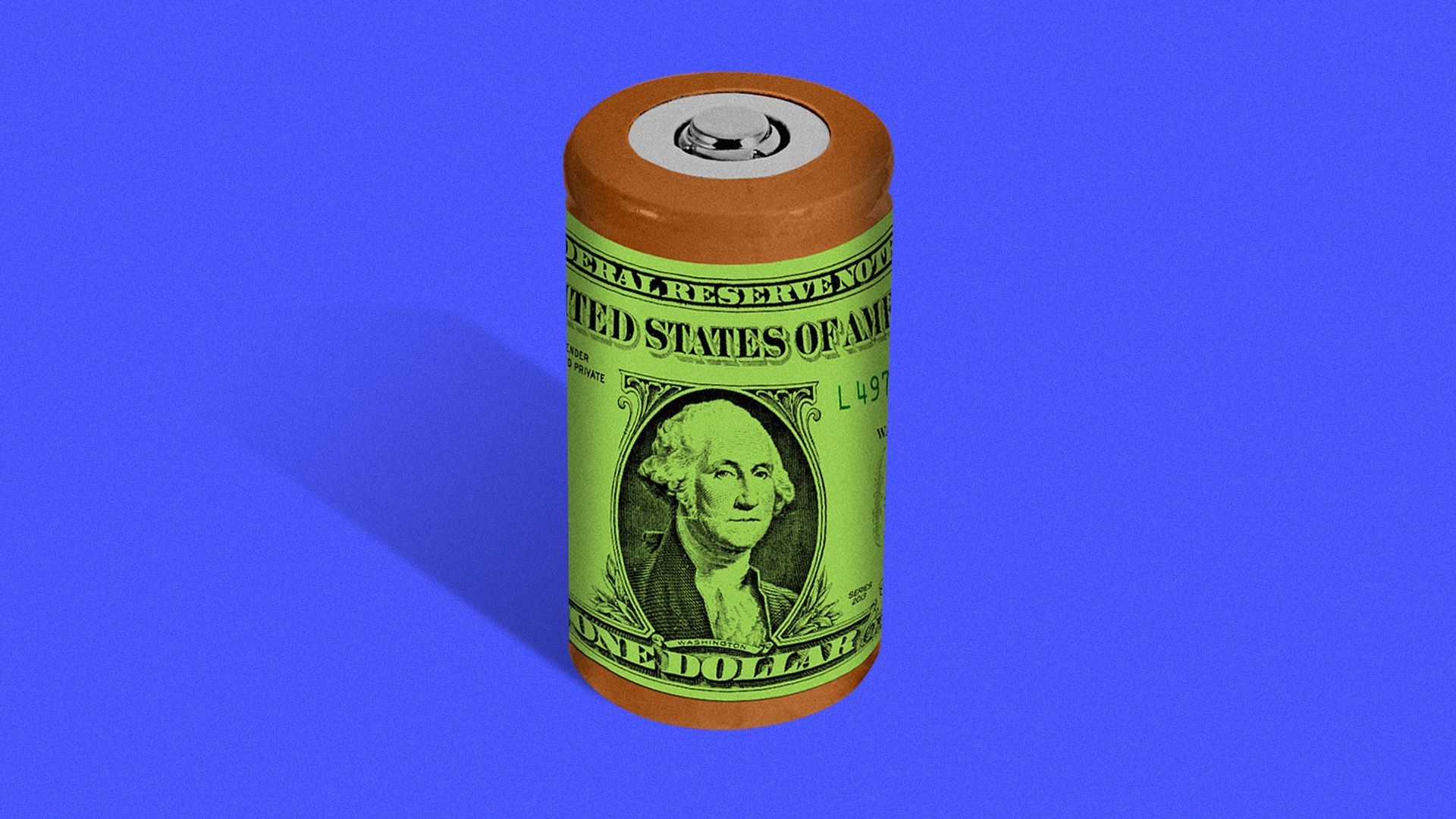
The U.S. battery cell developer Kore Power has acquired Vermont-based storage developer Northern Reliability.
Why it matters: The U.S. is among the world's top battery producers, with 59 GWh of commissioned production capacity in 2020 vs. China's 568 GWh, according to the U.S. Department of Energy.

Charging an electric car at home isn't easy for many
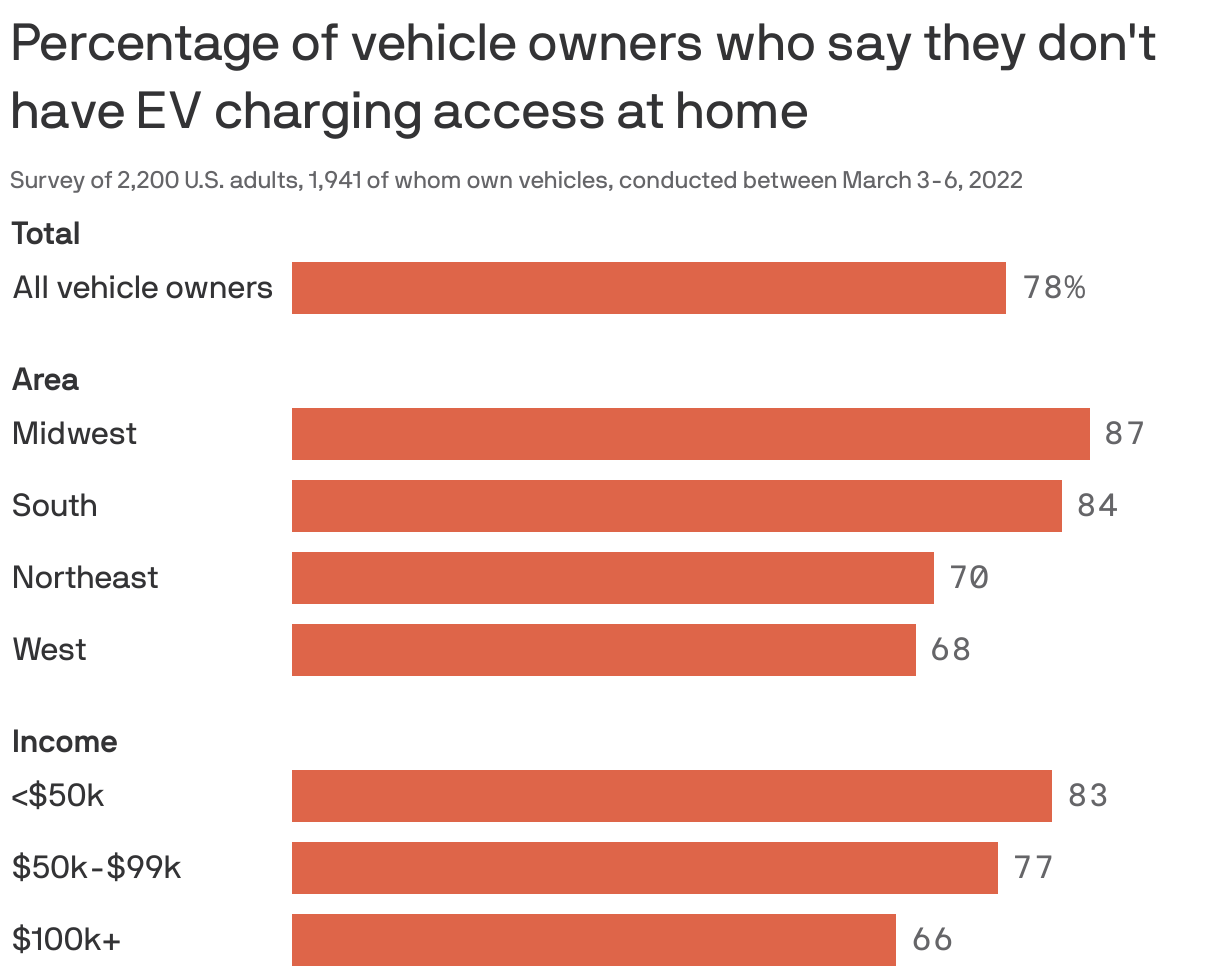
Potential electric vehicle buyers are told not to worry so much about access to public charging stations because most people will charge their EVs at home.
- But many people say they don't have EV charging available at home.
Driving the news: 78% of U.S. adults surveyed by Morning Consult said there is no EV charging access at home where their vehicles are parked.
- Worth noting: 48% said they park their cars in the driveway, and 36% said they park in a garage.
Yes, but: Respondents weren't asked whether they have an ordinary electrical outlet in their garage or near their driveway, which is all that's needed to plug in an EV. (A dedicated charger is faster, but isn't necessary.)
- That was by design, explains mobility analyst Lisa Whalen, who authored the Morning Consult’s State of Automotive and Mobility report.
- "It just shows the disconnect in the education of the public" about charging, she said.
What they found: Only 11% of adults report that charging access is always available at home.
- Access was higher on the East and West Coasts (19% for each) and among higher-income households.
- 26% of people earning over $100,000 said they have a place to charge their vehicle at home.
The bottom line: If you don't have a garage or a dedicated parking spot, your access to charging is likely limited, which could potentially stunt growth of the EV industry.
- "You're excluding a certain part of the population just because of the way they park," says Whalen.
What's needed: Manufacturers, tech providers and policymakers need to make home charging easier for consumers.
Editor's note: The chart accompanying this story has been corrected to note that it represents the percentage of all vehicle owners without charging access, not the percentage of EV owners.
Summer forecast: Fewer weather delays at the airport

National Weather Service meteorologists can now predict minute-by-minute weather conditions for individual arrival and departure routes at the nation's 30 busiest airports — which should translate to fewer delays for travelers.
Why it matters: Better weather data synced with actual flight routes will help air traffic controllers as they direct planes to dodge potentially dangerous storms.

Thousands without power after deadly tornado strikes New Orleans area
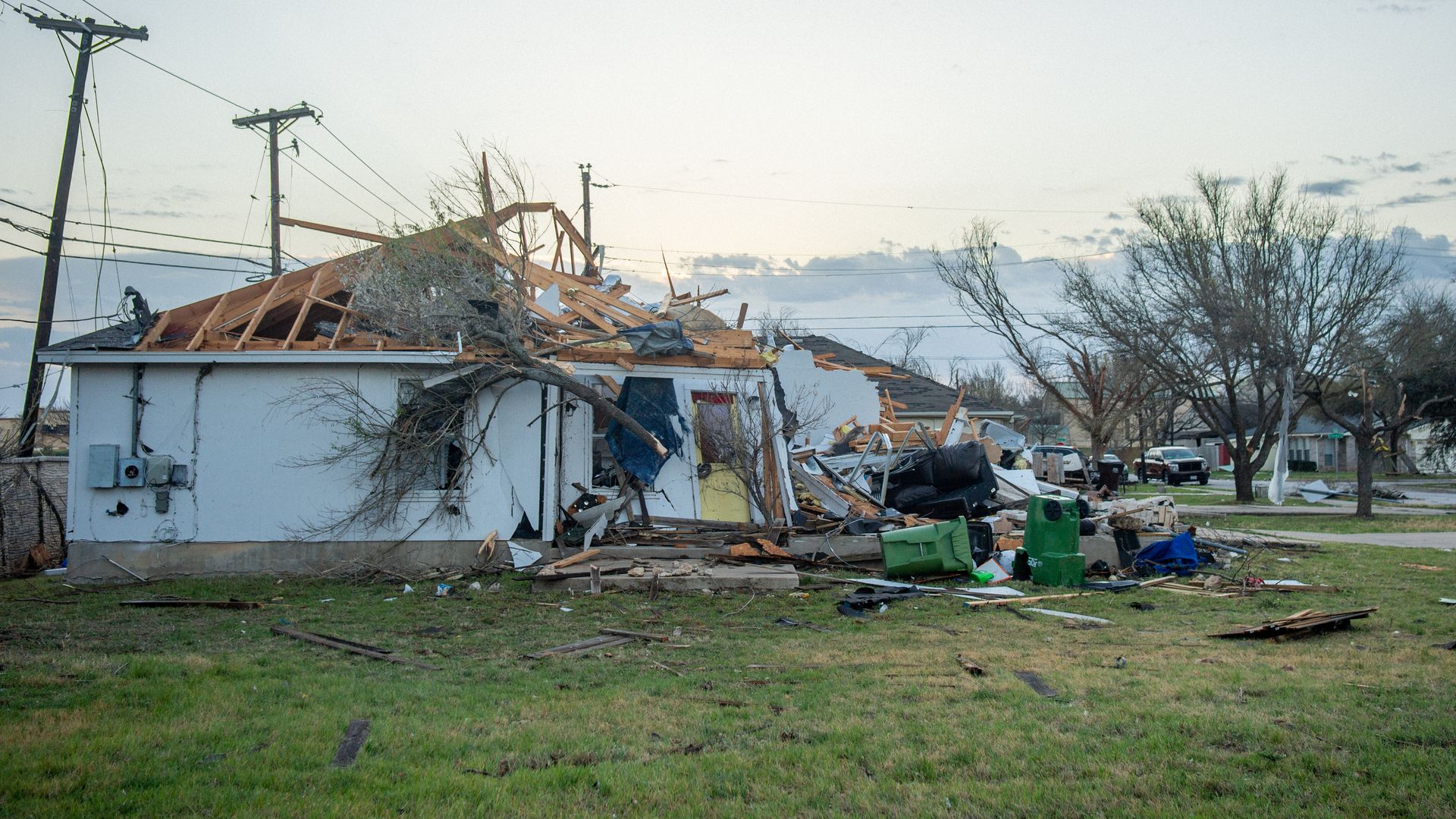
A powerful tornado struck the New Orleans area Tuesday evening, knocking out power to thousands of customers and causing extensive damage.
The latest: Authorities in St. Bernard Parish, which borders New Orleans to the southeast, told reporters late Tuesday that at least one person had been killed after the tornado touched down in the area. There were reports of people trapped in the parish.