Scientists said Friday that an ice shelf the size of New York City has collapsed in East Antarctica after record high temperatures.
Why it matters: This marks the first time in human history that an ice shelf collapsed in the region, which had long been considered stable and less vulnerable to climate change. If the water frozen in East Antarctica melts, it would raise sea levels more than 160 feet around the world, according to AP.
Chick-fil-A and Restaurant Brands International (RBI), the owner of Burger King, Tim Hortons and Popeyes, pledged this week to eliminate the use of "forever chemicals" in food packaging.
Why it matters: These extremely durable synthetic chemicals, which can last for hundreds of years without breaking down, are used in hundreds of consumer goods and have been linked to adverse health effects in humans and animals by the Centers for Disease Control and Prevention and the Environmental Protection Agency.
The White House is looking to thread a policy needle by embracing more U.S. liquefied natural gas shipments to Europe while insisting it's not backing off its commitment to fighting climate change.
Driving the news: On Friday, U.S. and European leaders announced a task force focused on helping to cut the EU's heavy reliance on Russian fossil fuels and boosting clean energy.
The "smart home" of the future may be fully or partially energy self-sufficient, equipped with a charging station that not only powers your electric vehicle, but could serve as a backup generator if the electricity goes out.
Why it matters: One of the great promises of smart home technology is resilience — the idea that we might wean our dependence on the power grid by building in solar capabilities and relying more on stored battery power.
Dutch banking giant ING has pledged to cease "dedicated financing" for new oil-and-gas fields.
Why it matters: It's the "biggest bank yet to commit to such a step in the fight against climate change" and could raise pressure on peers, Reuters notes.
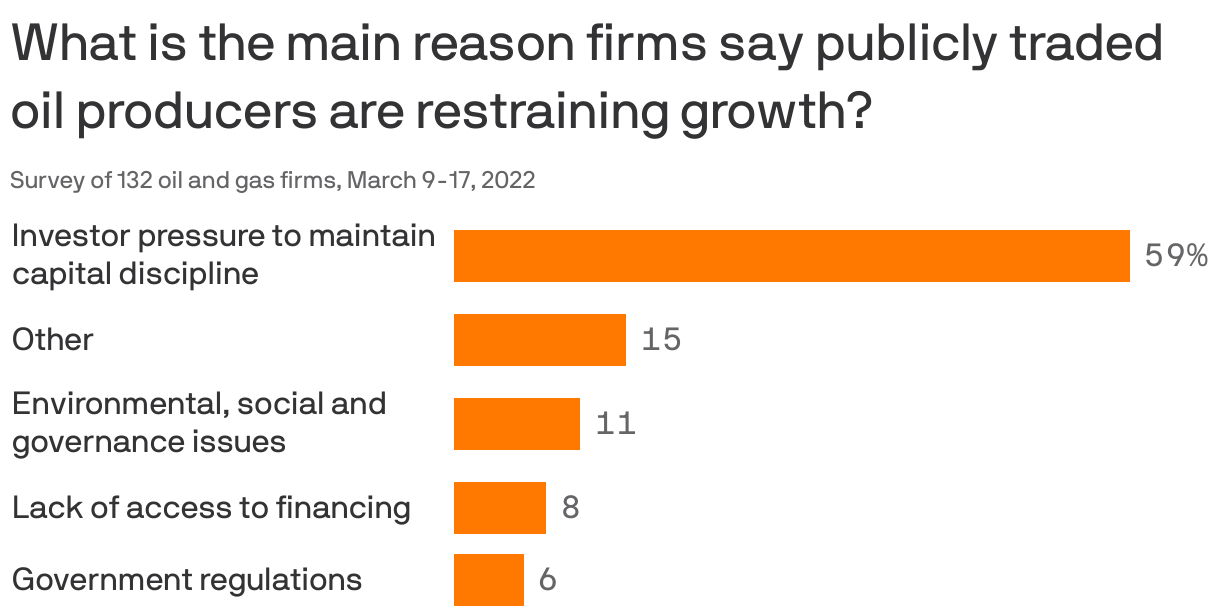
Data: Federal Reserve Bank of Dallas; Chart: Thomas Oide/Axios
Investor pressure is by far the biggest reason oil companies are restraining U.S. production growth, companies told the Federal Reserve Bank of Dallas.
Driving the news: The chart above comes from the quarterly survey of oil-and-gas firms in the bank's region, which includes Texas, the biggest producing state.
Boosting U.S. liquefied natural gas shipments will play a key role in emerging plans to help Europe curb reliance on Russia, U.S. and European officials said Wednesday.
Why it matters: Coming days should bring more specifics on White House plans for LNG's role in the wider response to Russia's attack on Ukraine.
The SEC's climate disclosuremandates are shaping up as a big global warming policy fight, and some of the reasons go beyond what the rule directly requires.
Why it matters: Support for the SEC's new draft plan and the pushback is the latest flare-up in a wider battle over the role of financial regulators in fighting climate change.