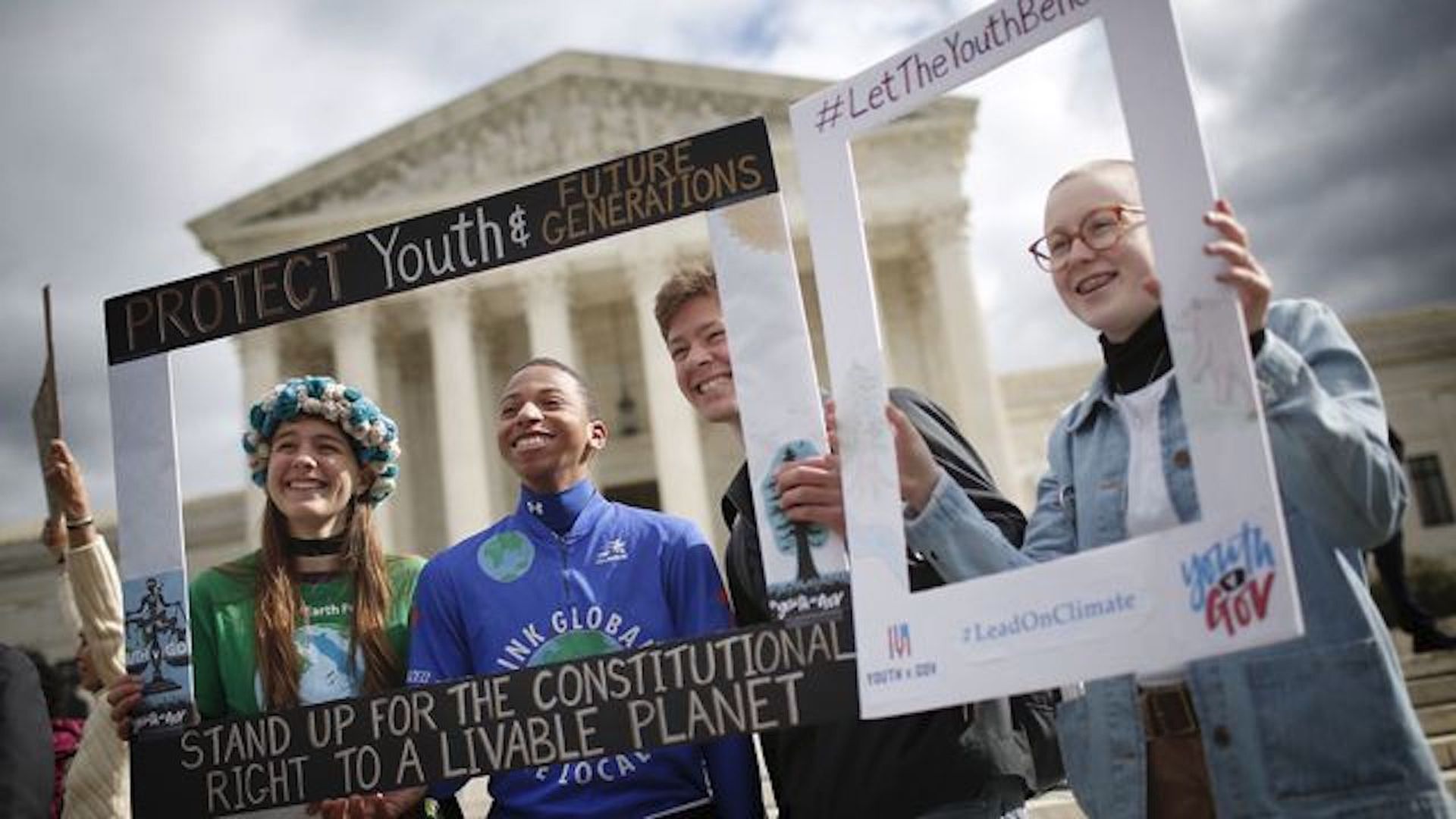
A federal appeals court on Friday threw out a lawsuit brought by 21 young people intended to force the U.S. government to act more aggressively to confront climate change.
Why it matters: The case, first brought in 2015, has been among the higher-profile pieces of climate litigation and underscores the challenges of using the court system to tackle global warming.
It’s big. It’s bold. It’s maybe impossible. And Microsoft is hedging a bit when it comes to the politics of its vow to become "carbon negative" by 2030. Dan digs in with Axios' Amy Harder.
Michael Bloomberg's presidential campaign unveiled plans this morning to cut carbon from transportation, the nation's biggest source of greenhouse gas emissions.
The big picture: It's the latest of several climate and energy plans from Bloomberg, including proposals this week around wildfires, climate resilience, and emissions from buildings.
Transportation is a top contributor to greenhouse gas emissions, but the worst offenders aren't congested cities like New York and San Francisco. Instead, it's sprawling, car-dependent metros like Dallas and Houston, a new analysis finds.
Why it matters: Even dense, traffic-choked cities can offset their carbon output with better urban planning and other, cleaner forms of transportation, says StreetLight Data, which studied mobility behavior in 100 cities to create its new U.S. Transportation Climate Impact Index.
The planet faces a collective action problem of existential proportions. No one country or company can prevent catastrophic global warming; all of them need to work in conjunction with one another.
Why it matters: That kind of cooperation flies in the face of the standard capitalist mode, which is competition. If shareholders were to unite and force companies to cooperate on carbon reduction, that could prevent the death and displacement of millions of people.
The Gulf Coast industrial facilities built to use surging oil and natural gas production from shale formations could become a very large source of greenhouse gas emissions, a peer-reviewed study concludes.
Why it matters: The paper in Environmental Research Letters bolsters understanding of shale's potential climate effects by looking closely at petrochemical plants, LNG terminals and other facilities (much of it in the planning stages).
A new analysis finds that California is not on track to meet its 2030 greenhouse gas reduction targets absent new and toughened clean energy policies.
Why it matters: California has many of the nation's most aggressive programs, so the results shows the difficulty of achieving steep state-level cuts in that state and others adopting ambitious climate targets.
It's official: Last year was the world's second hottest on record, and 2010-2019 was the hottest decade ever recorded.
Why it matters: The findings, published in two separate reports by NOAA and the British weather service the Met Office Wednesday, are in line with those of research group Berkeley Earth, revealed at the start of the year. It's yet more evidence of the long-term warming trend that stems from human-induced greenhouse gas emissions.