President Trump's tariffs are roasting coffee sellers.
Why it matters: American companies have few domestic options for raw, unroasted coffee beans — known as green coffee — so they can't do much to limit their exposure to import duties.
Two of the witnesses called by Democrats to Friday's minority hearing of the House financial services committee are advocating for a new approach to updating financial-asset regulations with digital assets in mind.
Why it matters: Without some Democrats, market structure legislation cannot get through Congress.
Friction point: Market structure legislation will define the turf in the digital asset industry for the SEC and CFTC.
Zooming in, one thing it does is create a legal pathway for projects that want to raise money by selling tokens.
🥊 And that puts it squarely in the crosshairs of a thorny fight in Washington: The profits made by the Trump family off the crypto industry make it politically difficult for Democrats to support legislation defining how to supervise cryptocurrency.
A vote — but not THE vote —on GENIUS is coming tomorrow.
Why it matters: It's one of the Trump administration's two big legislative priorities for 2025.
Between the lines: The crypto community had feared GENIUS would be derailed by an attempt to attach a more controversial measure to the bill, around competition in the credit card market.
State of play: Congress.gov shows that S. 1582 from Sen. Bill Hagerty (R-Tenn.), the current version of the legislation, has been sent back to the Senate banking committee "with instructions to report back forthwith with the following amendment (SA 2312)."
Regulators and policy makers have struggled to agree on a definition of decentralized finance, but regulating this area of the crypto industry is far from impossible, panelists said at the SEC's latest crypto roundtable.
The big picture: The SEC's challenge in regulating DeFi is applying current rules aimed at intermediaries — like broker-dealers and exchanges — to a system designed to operate without them, SEC chair Paul Atkins noted.
Panelists at the fifth crypto roundtable yesterday, titled "DeFi and the American Spirit," suggested three target areas for regulation: common activities, disclosure rules and risk identification.
The World Bank estimates the global economy is on track for the slowest growth of any non-recessionary year since 2008, according to forecasts released on Tuesday.
Why it matters: The group says tariff policies and the associated economic uncertainty crushed prospects of a "soft landing" that looked possible just months ago.
It's a high-anxiety moment for entry-level workers — a report from Glassdoor out Tuesday morning shows they have record-low confidence in their employers.
Why it matters: The hiring market has slowed considerably from a few years ago, and that's especially troubling for those at the start of their careers.
Infants may soon be the newest stock market investors if President Trump gets his way.
Why it matters: The president Monday gathered a roomful of high-profile CEOs to tout his proposal to place $1,000 into an investment account for every U.S. baby.
Negotiations usually boil down to leverage — specifically, who has more of it. In the U.S.-China talks underway Monday in London, the question of who has the upper hand boils down to macro- versus micro-economics.
The big picture: A slew of data out of China shows the massive cost that U.S. tariffs impose on the Chinese economy, reflecting both underlying economic weakness and what the nation stands to lose if no trade peace is reached.
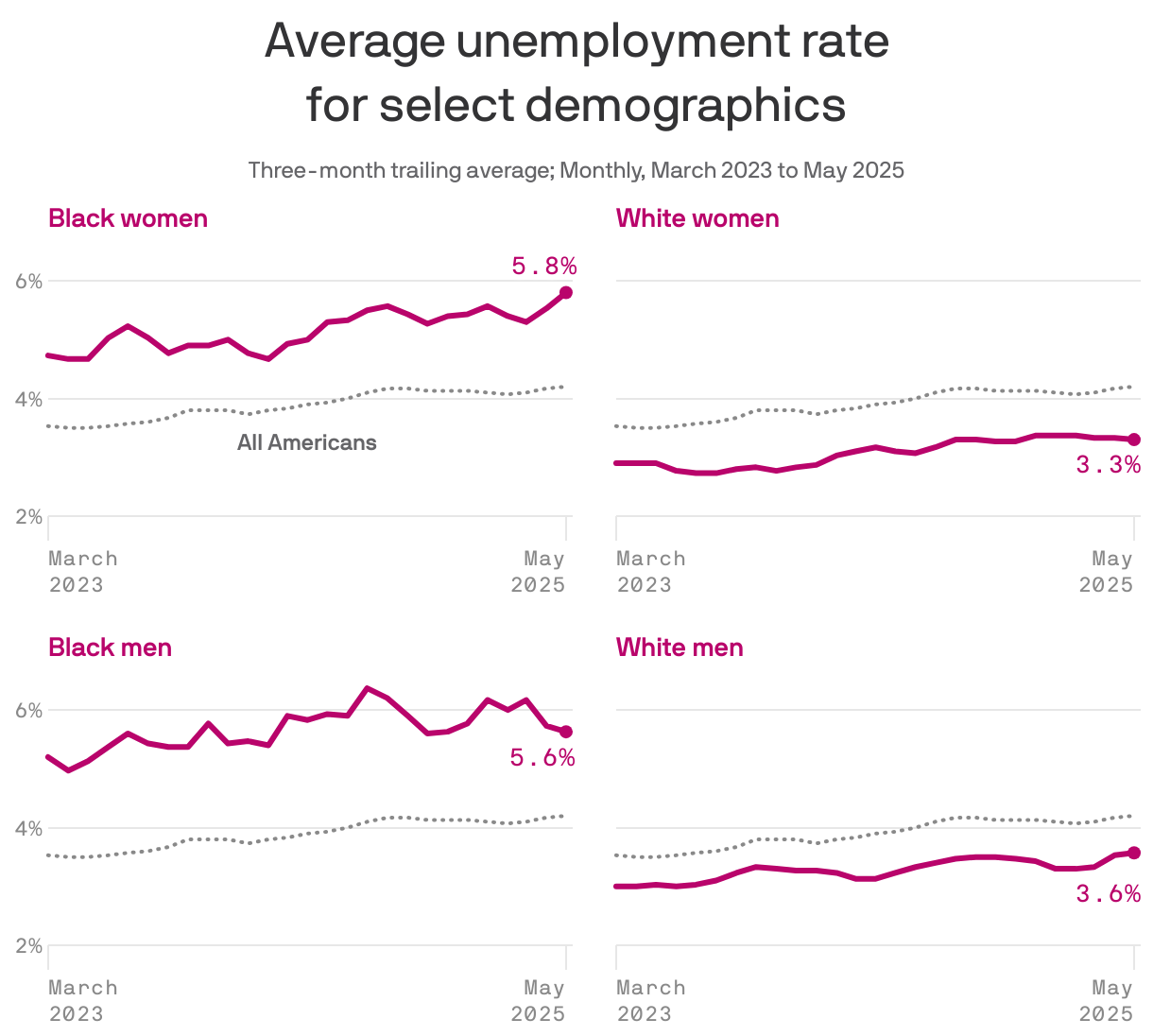
Data: Bureau of Labor Statistics. Chart: Kavya Beheraj/Axios
The jobless rate for Black women has been creeping higher all year.
Why it matters: This could be a sign of weakness in the overall job market, economists say, though others point to the Trump administration's purge of the federal workforce and its push to eliminate DEI efforts.
It's a brutal time for women executives and others who don't neatly fit the stereotypical ideal of a leader.
Why it matters: Not only has the zeal for diversity that's defined the past decade faded, but backlash from the White House has made firms even less willing to take risks on "nontraditional" candidates, including women, people of color and LGBTQ+ people.





/2025/06/10/1749572004825.gif?w=3840)