Friday's economy stories


Roku files for IPO
Roku, an over-the-top (OTT) streaming player service, has filed for a $100 million IPO (though that's likely a placeholder), according to an SEC filing. Rumors of its plans to go public emerged earlier this year, and it considered an IPO back in 2014.
Offering details: The Silicon Valley-based company plans to trade on the NASDAQ under ticker symbol "ROKU," with Morgan Stanley listed as left lead underwriter.
Financials: Roku is unprofitable. It reported $24.2 million in net loss on $199.7 million in revenue for the six moths ending in June 2017. In the fiscal year 2016, it reported a net loss of $42.8 million on $398.6 million in revenue. Its revenue comes from sales of streaming devices as well as through advertising and subscriptions. In the first six months of 2017, devices accounted for 59% of total revenue. In fiscal 2016, they made up 74%.
Backers: The company has raised over $200 million in VC funding, and is valued at almost $1 billion according to Pitchbook. Its investors include Netflix, Menlo Ventures, News Corp, Sky UK's venture arm, and Viacom, among others.

The job market is strong, but wage growth still lags
The U.S. economy added 156,000 jobs in August, while the unemployment rate ticked up slightly to 4.4% — missing economists' expectations. Taken in context, companies still can't find enough workers to fill their open slots, but this hasn't translated into faster wage growth, as average hourly earnings were up just 2.5% year-over-year — little more than the rate of inflation. Economists had expected 180,000 new jobs and an unemployment rate of 4.3%.
Turmoil in the "information" sector: Here we look at the information sector, which shed 8,000 jobs in August. Jed Kolko, chief economist at Indeed, emails Axios to say that the sector "includes tech, so people typically assume that it's booming. But several job-losing industries are in the information sector as well, like broadcasting, motion pictures production, and telecommunications."
Data: Bureau of Labor Statistics; Graphic: Chris Canipe / Axios


Energy Secretary tapping emergency crude reserves to ease gas prices
Energy Secretary Rick Perry announced Thursday he will be releasing 500,000 barrels of crude oil from an emergency reserve to ease gas price spikes in light of disruptions to energy infrastructure due to Hurricane Harvey, per the AP.
- The EPA has also expanded emergency gasoline waivers to include 38 states and D.C. to avoid disruptions related to the storm, per the AP.
- The Department of Transportation is waiving operator qualifications to "expedite the engagement of pipeline" personnel to help with response and recovery S&P Global Platts reports.
Hollywood's worst summer in 25 years
"The number of movie tickets sold in the U.S. this summer (425 million) is likely to be the lowest level since 1992," the L.A. Times' Ryan Faughnder writes in a front-pager, "Theaters, studios hit by summer box-office blues."
- Short-term factors: "Too many bad movies, including sequels, reboots and aging franchises that no one wanted to see. Some point to rising ticket prices, which hit a record high in the second quarter."
- Long-term factors: "competition from streaming services such as Netflix and the influence of the movie review site Rotten Tomatoes, [which is part of] an unforgiving social media environment in which bad movies are immediately punished by online word of mouth."
- How studios are trying to adapt: "discussing ways to make movies available for streaming earlier after their theatrical releases through iTunes and video-on-demand services, despite resistance from theater chains."

Expert doubles down: robots still threaten 47% of U.S. jobs
A leading authority on robotization has doubled down on his most controversial forecast — that automation threatens 47% of American jobs. And he belittles critics who say technological upheaval seems scary but always generates sufficient new work.
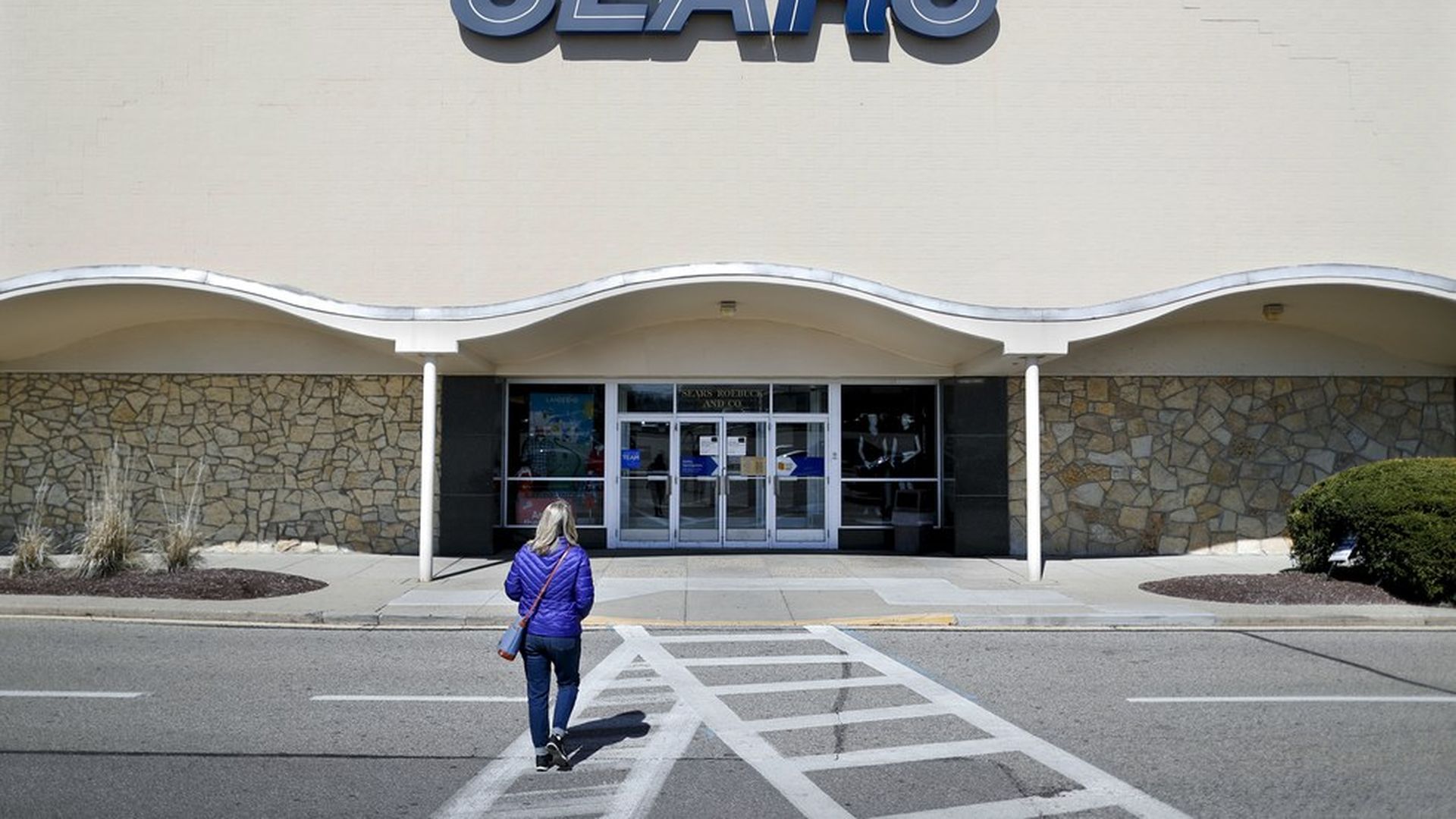
Why it matters: In a new report by Citi, Carl Frey, a professor at Oxford University, also forecasts the demise of American retail work. If he is right, it is an outcome that will reach further than the decimation of manufacturing because it will involve a different, large set of cities.
Frey writes in the Citi report:
- Retail work is likely to vanish in the coming decades, leading to a long, unknowable period of adjustment before retail workers find new employment.
- "Groups that have lost out to automation since the computer revolution are still struggling to find new and better-paid jobs," and retail workers will find it just as hard "to find solid footing in the labor market."
More than anyone, Frey and artificial intelligence expert Michael Osborne ignited the current fear of a robot apocalypse with a joint 2013 paper that introduced their famous 47% forecast. Critics have attacked the core of their work. The most frequent pitch I receive is from PR agents offering yet another expert rejecting robot-induced mass unemployment. Their scorn has two main assertions:
- The theory of "technological unemployment," conceived by John Maynard Keynes in the 1930s, has been proven wrong. Keynes said tech was advancing so fast that the economy would fail to replace jobs that were destroyed. But, just as they have been through repeated technological disruptions since the start of the Industrial Age in the early 19th century, Keynes' fears of mass joblessness were not borne out.
- The robot age will turn out the same — normal economic churn will replace destroyed jobs with mostly unforeseeable new ones.
In the Citi report, Frey quotes his critics and rejects their arguments. He writes:
- Keynes was not wrong about the destruction of jobs, which happened, but about the number of jobs that would arise to replace them.
- This time, the scale on which jobs will be replaced — whether this technological upheaval will turn out the same as the past — is ultimately unknowable at this stage.
- "What we do know is that the potential scope of automation has expanded rapidly and that many of today's jobs will change or disappear."
- And the robust spread of automation suggests that "historical rates of productivity growth are likely to be a poor guide to the future."
Other highlights:
- Despite appearances, brick-and-mortar still accounts for the overwhelming percentage of sales — 92%, according to Citi. But e-commerce is up from a 2% share a decade ago, and the number is rising by 20% a year. The cost of automation is falling, making retailers more willing to use it to lay off more costly workers.80% of the jobs in transportation, warehousing and logistics are vulnerable to automation.63% of sales jobs are vulnerable.The average number of robots in fulfillment centers like Amazon warehouses was 461 in 2013. But now it is 3,200."The disruption is very much at its infancy," Martin Wilkie, the lead author of the report, tells Axios. He said that, in the coming decades, "the premise is that stores are bypassed in their entirety."
- E-commerce's reach is patchy across the globe:In big U.S. and European cities, it's possible to order and receive a product in one or two hours. In Brazil, the average promised delivery time is 9 days.South Koreans do 10% of their grocery purchases on-line, along with 7.2% in Japan and 5.3% in France. The U.S. is among the lowest, with only 1.4%.