Sens. Elizabeth Warren (D-Mass.) and Chris Van Hollen (D-Md.) sent a letter to federal regulatory agencies on Monday asking them to investigate whether there was insider trading stemming from President Trump telling guests at his Mar-a-Lago club to expect a “big” response to Iran’s killing of an American contractor in Iraq, as The Daily Beast first reported.
Why it matters: The letter, sent to the Securities and Exchange Commission (SEC) and the Commodity Futures Trading Commission (CFTC), says the report "raises a number of troubling national security questions regarding President Trump's handling of classified and other sensitive national security information."
Over the last decade, transactional video on-demand (TVOD), which are services that sell or rent content on a one-time basis, have largely been challenged by the rise of subscription and advertising-based streaming services that allow users to access hundreds of titles for a monthly or yearly fee.
Case-in-point: Companies like Apple and Amazon, which still sell and rent content to users, have both invested heavily over the past year in building up their own subscription streaming platforms (SVODs).
A whopping 532 original scripted television series were created last year, according to the latest data from FX Networks Research, up 7% from the year before.
Why it matters: The new data suggests that "peak TV" hasn't happened yet.
The HBO Max team is looking at ways to make the streaming service more mobile-friendly than some of its subscription video competitors.
Why it matters: If AT&T can build an app that can successfully leans into mobile, it may be able to capture an audience that Netflix and Hulu have intentionally been less focused on, at least to date.
In the next 12–18 months, States Newsroom, a nonprofit company that supports a group of state capital-based, independent newsrooms, will expand to cover up to 20 more states, executives tell Axios.
Why it matters: Its efforts are the latest in a string of investments into revitalizing coverage of state governments across the country.
With just weeks to the Iowa caucuses, social media platforms have finalized their rules governing political speech — and fired a starting pistol for political strategists to find ways to exploit them from now till Election Day.
Why it matters: "One opportunity that has arisen from all these changes is how people are trying to get around them," says Keegan Goudiss, director of digital advertising for Bernie Sanders' 2016 campaign and now a partner at the progressive digital firm Revolution Messaging.
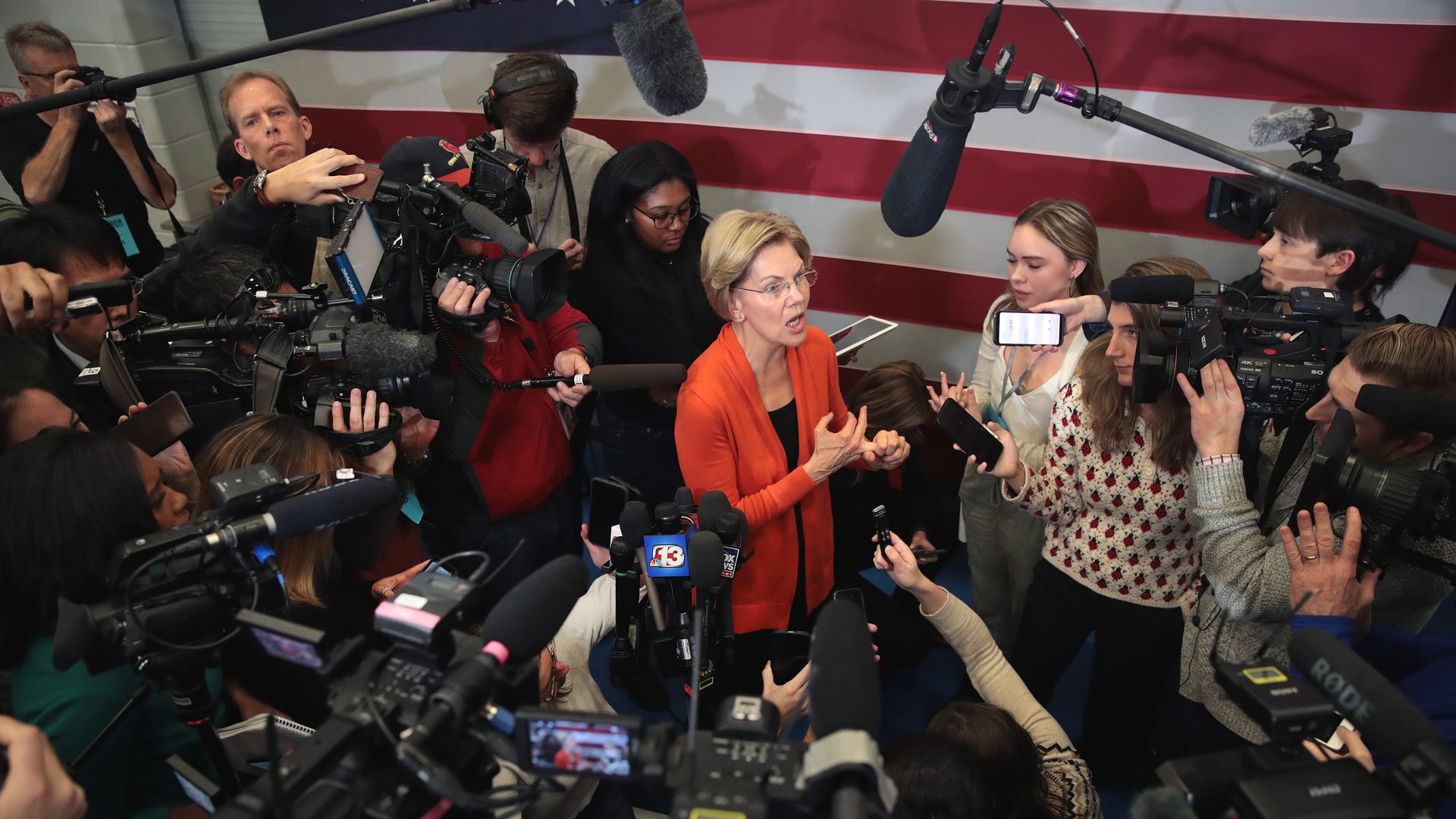
Bernie Sanders told Elizabeth Warren during a private 2018 meeting that a woman couldn't win the 2020 presidential election, CNN reported Monday.
The state of play: The report comes two days after the Sanders campaign distributed scripts for volunteers that argued that Warren is "bringing no new bases into the Democratic Party," and that "people who support her are highly-educated, more affluent people who are going to show up and vote Democratic no matter what."
Friday's jobs report missed expectations, but still delivered solid numbers, showing the U.S. economy added well over 100,000 jobs and the unemployment rate remained near a 50-year low.
The big picture: BLS reported that the number of people who were employed part time but would rather be full-time employees declined by 507,000 over the year.
"Joker" led the way among Academy Award nominees on Monday, nabbing 11 nods, including Best Picture.
The big picture: The awards ceremony — like last year's — is set to be a showdown between traditional Hollywood studios and new streaming giants. Netflix's "The Irishman" and "Marriage Story" both got a nomination for Best Picture and nabbed a number of top acting nominations as well.
High-tech mattress company Casper made clear it plans to go public on Friday by filing an S-1 with the SEC, which was full of interesting tidbits, including its plan to harness the "Sleep Economy" with the help of its “Sleep Arc.”
What's happening: Casper has helped open up a booming industry and raked in $312 million in the first nine months of 2019. However, its S-1 filing is raising some eyebrows.
California has two new laws on the books aimed at reining in tech giants. Some of the biggest companies they're aimed at plan to dodge them.
Why it matters: Powerful, moneyed tech firms are always going to have the will and the resources to try to evade regulation. That puts the onus on legislators to craft smarter, tighter laws with fewer loopholes.
In a symbolic move, Sen. Mitch McConnell (R-Ky.) last week signed on to be a co-sponsor to a bill that would allow newspapers to collectively negotiate with tech giants like Google and Facebook.
Why it matters: The move represents a truly bipartisan effort to get something done in Washington, for a change. With the Senate majority leader's support, it's much more likely that the bill will pass in both chambers and be signed into law by the president.