What to know about Trump's escalating feud with Venezuela

Add Axios as your preferred source to
see more of our stories on Google.
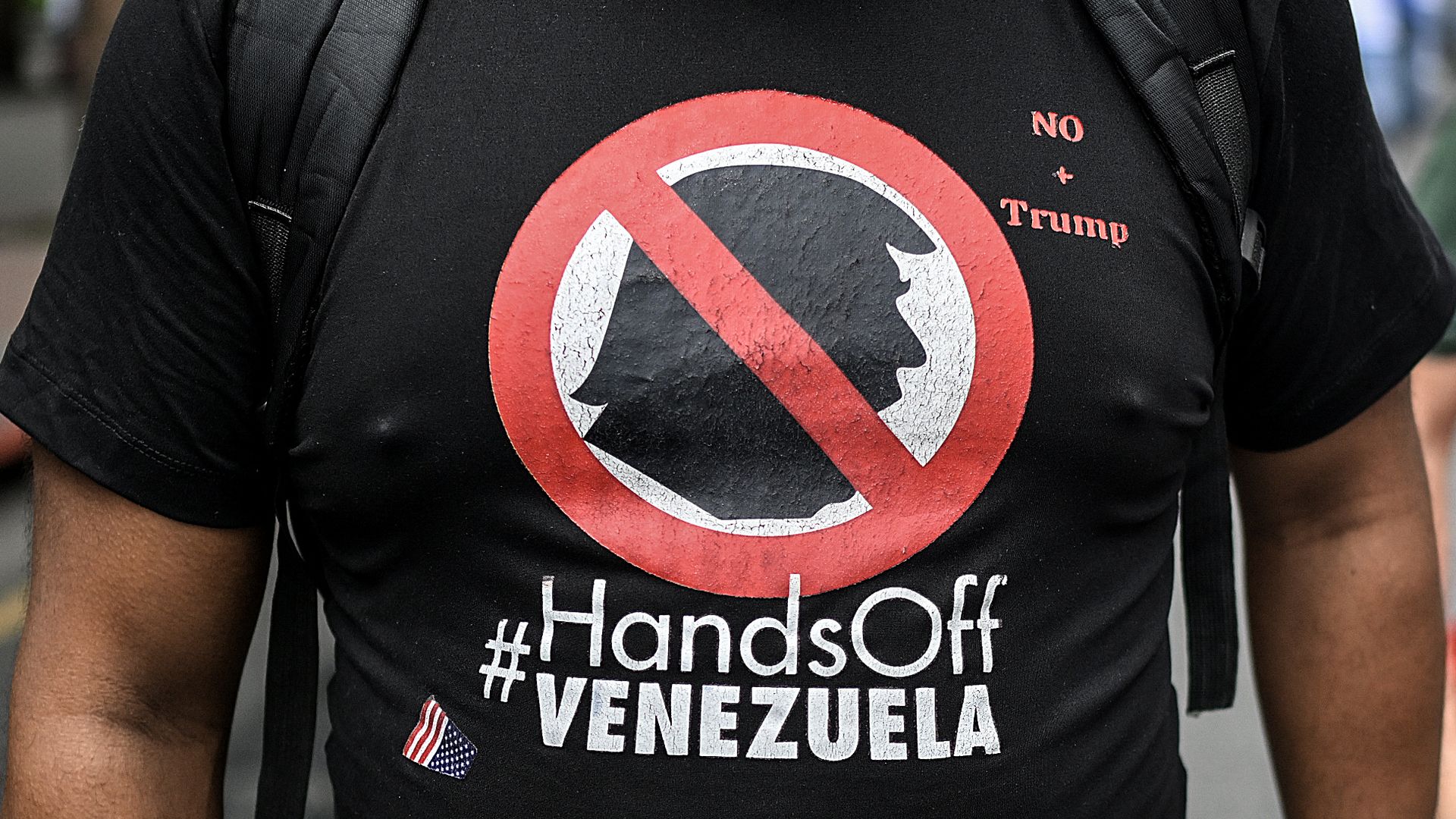
A T-shirt depicting President Trump is visible at a pro-Maduro protest in Caracas, Venezuela, on Aug. 11. Photo: Juan Barreto/AFP via Getty Images
The state of military and diplomatic brinkmanship between the U.S. and Venezuela was cast into fiery new territory Tuesday, when President Trump announced a stunning strike in his militarized war on drugs.
The big picture: The attack came amid an amassing of U.S. ships off Venezuela's shores and escalating tensions between the U.S. government and the regime of Venezuelan President Nicolás Maduro, who the administration has labeled a leader of a drug-trafficking terrorist cartel.
Driving the news: Trump, after describing a strike in vague terms during a press conference, said on Truth Social Tuesday that U.S. military forces had "conducted a kinetic strike against positively identified Tren de Aragua Narcoterrorists."
- In his post, he platformed the disputed claim that Maduro heads TDA, a multinational crime organization that the administration has designated as a Foreign Terrorist Organization.
Between the lines: The operation targeted what the administration has said was a narco-terrorist drug vessel — but the underlying potential to spark regime change is also at play, Axios' Marc Caputo reported late last month.
- Whether the gunboat diplomacy is a drug trafficking mission threaded with the possibility of regime change or a full-on coup operation is yet to be seen, Caputo reports based on conversations with administration officials.
- But the present tension is years in the making. The U.S. and others in the international community have alleged Maduro, now in his third term, has retained power through manipulation and stolen elections.
Why did the U.S. strike a drug boat near Venezuela?
Secretary of State Marco Rubio on Tuesday wrote in an X post that the U.S. military had conducted a strike in the southern Caribbean against a drug vessel he said had departed from Venezuela and was being operated by a "narco-terrorist organization."
- Trump, who previously announced during a Tuesday conference that the U.S. "literally shot out a boat," said on Truth Social that 11 "terrorists" were killed in the action, and no U.S. forces were harmed.
- The president had ordered seven warships with 4,500 personnel to the waters off Venezuela. That deployment includes 2,200 Marines.
The latest: The "deadly serious mission" won't stop "with just this strike," Defense Secretary Pete Hegseth said on Fox News Wednesday.
The other side: Maduro on Monday said his country was at "maximum preparedness" to defend itself amid U.S. pressure, the Associated Press reported, and said he would declare a "republic in arms" if the U.S. attacked.
- Colombian President Gustavo Petro, a Maduro ally, described the strike as a "murder."
How has the Trump administration targeted Maduro?
Threat level: The Trump administration doubled the reward amount for Maduro's arrest to $50 million last month, with Attorney General Pam Bondi accusing him of using criminal gangs "to bring deadly drugs and violence" into the U.S.
- In a statement, Rubio said that Maduro "MUST be brought to justice," accusing him of violating U.S. narcotics laws.
Flashback: Maduro was indicted during Trump's first term and was accused of leading the Cartel de Los Soles, which the Treasury Department sanctioned as a Specially Designated Global Terrorist in July.
- Petro, said on X that "the Cartel of the Suns does not exist; it is the fictitious excuse of the extreme right to overthrow governments that do not obey them," according to a translation.
Zoom out: The administration sought to tie the Maduro regime to criminal gangs as it tried to invoke the wartime authority of the Alien Enemies Act of 1798 to accelerate deportations of Venezuelan migrants the administration suspected of being in gangs.
- But a partially declassified intelligence memo asserted that Maduro's regime was "probably not directing" TDA movement into and operations within the U.S., Axios' Rebecca Falconer and Russell Contreras reported in May. Top National Intelligence Council officials were ousted over the report.
- And an appeals court ruled Tuesday that the administration can't use the centuries-old wartime law for its fast-tracked deportations, saying it would grant a preliminary injunction "to prevent removal because we find no invasion or predatory incursion" had occurred.
Immigrants, oil and Marco Rubio
Hundreds of thousands of Venezuelan migrants have fled to the U.S. after years of political and economic turmoil.
- The U.S. Supreme Court handed the Trump administration a win in May when it green-lit the government to strip temporary deportation protections from some 350,000 Venezuelans while the case continues.
- The Biden administration had previously extended those protections.
- A federal appeals court last month blocked the administration's plans to end protections for some 600,000 Venezuelans, though AP reported it's unclear what that will mean for those whose protections already expired.
Meanwhile, the State Department has reissued an "extreme danger" travel advisory for the country, warning Americans to prepare a will if heading to Venezuela.
Friction point: Oil also plays a major role in U.S. relations with Venezuela.
- Earlier this year, Trump killed a Chevron oil deal in Venezuela to fortify passage of his tax-cut and spending bill, facing a potential revolt from Miami Republicans.
- The choice was also a nod to Rubio, who has long opposed Maduro's dictatorship in Venezuela and is a son of Miami's anti-socialist Cuban exile community, Caputo reported.
"Maduro is NOT the President of Venezuela and his regime is NOT the legitimate government," Rubio wrote in a July social media post.
Go deeper: Venezuela's sham election collides with U.S. campaign
