What to know about the wartime authority Trump invoked for mass deportations

Add Axios as your preferred source to
see more of our stories on Google.
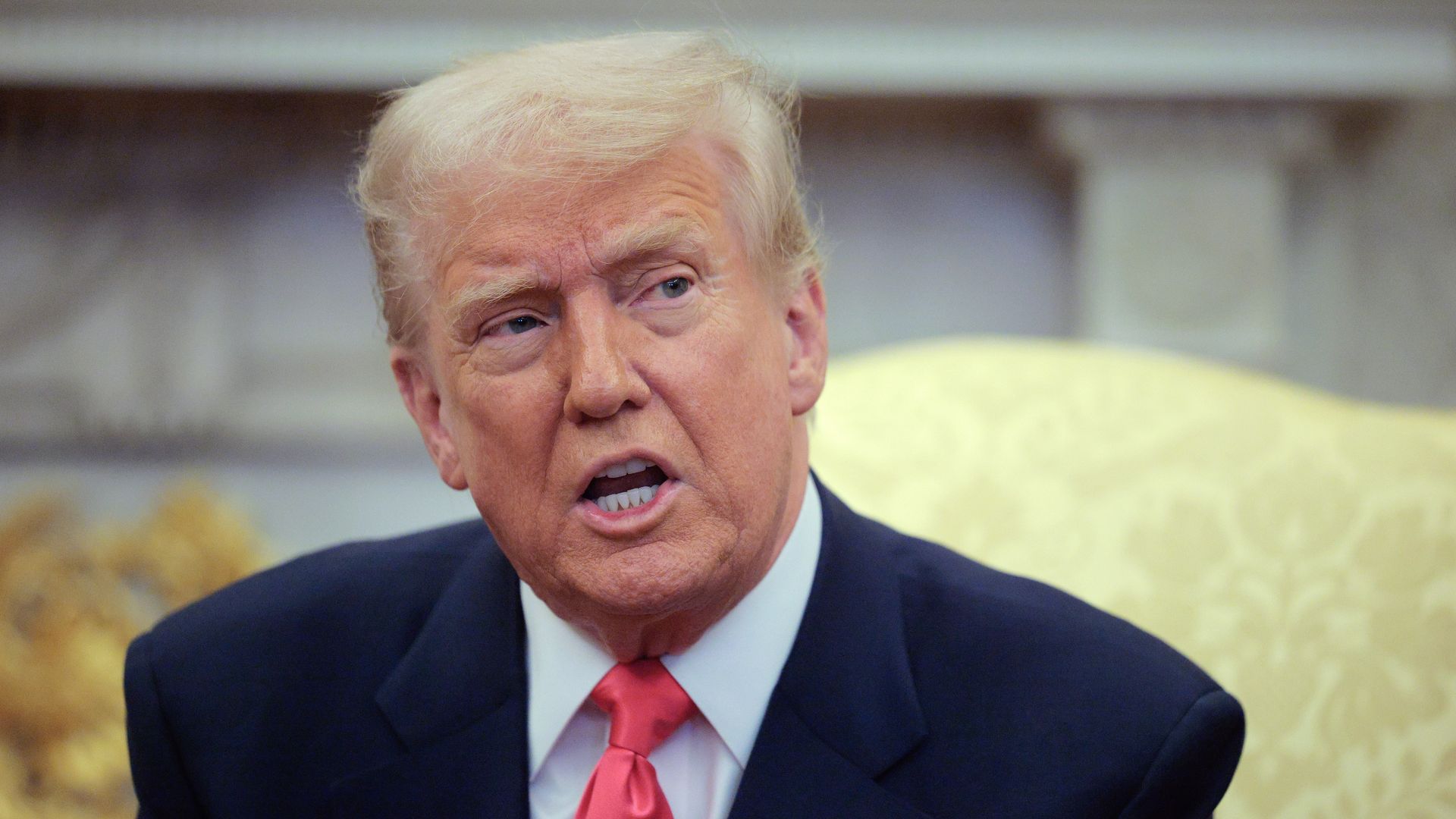
Donald Trump in the Oval Office on March 12. Photo: Chip Somodevilla/Getty Images
President Trump invoked a centuries-old wartime authority Saturday to accelerate mass deportations of Venezuelan migrants suspected of being being gang members with little to no due process.
Why it matters: Shortly after the White House released a proclamation triggering the Alien Enemies Act, a federal judge temporarily blocked the government from deporting any immigrants under the law and ordered planes that had already departed to return.
- Trump floated invoking the law on the campaign trail. Its use comes as some of his administration members have become frustrated with the slower than expected pace of deportations.
- Since the act is not part of immigration law, it would allow the government to detain and deport people without court hearings or asylum interviews.
- Its most infamous use came during World War II, when it was used help justify Japanese internment.
Reality check: The U.S. is not at war with Venezuela or any other country.
The latest: James E. Boasberg, a federal judge in D.C., blocked the government Saturday from carrying out deportations under the law for 14 days after a hastily scheduled hearing.
- The government appealed his decision the same day.
Yes, but: It appears some deportations under the law already took place.
- Secretary of State Marco Rubio wrote in a Sunday social media post that 250 "alien enemy members" of Tren de Aragua were sent to El Salvador.
- President Nayib Bukele of El Salvador shared a screenshot of a news report of Boasberg's order on X Sunday, writing, "Oopsie... Too late" with a laughing emoji.
The big picture: Despite promising to carry out the "largest deportation program" in U.S. history, the pace of arrests of undocumented immigrants under Trump has appeared to lag behind President Biden's.
- The Trump administration has faced funding and infrastructure hurdles, and even looked to hold detainees in Guantanamo Bay — a plan that has also faced legal challenges.
- Legal groups have denounced the idea of Invoking the Alien Enemies Act during peacetime for the purpose of deportations. The Brennan Center for Justice called it a "staggering abuse."
Zoom in: The president has suggested the law it could be used to target immigrants with alleged ties to criminal gangs.
- Less than 1% of immigrants deported last fiscal year were kicked out of the U.S. for crimes other than immigration violations, Axios' Russell Contreras has reported.
What is the Alien Enemies Act of 1798?
The Alien Enemies Act allows the government to detain and remove immigrants when there is "a declared war between the United States and any foreign nation or government."
- It could also apply in cases when a foreign government has "perpetrated, attempted, or threatened" an invasion or "predatory incursion" of the U.S.
- While the law can't be used to detain U.S. citizens, the U.S.-citizen children of immigrants could be affected.
- Trump border czar Tom Homan, when asked how deportations could be carried out without separating families, said in October that families would be deported together.
When has the Alien Enemies Act been used?
Only three times since its passage, during the War of 1812, World War I and World War II.
- In these instances, the act was "wielded against immigrants who have done nothing wrong, have evinced no signs of disloyalty, and are lawfully present in the United States," according to the Brennan Center.
- During both World Wars, Presidents Woodrow Wilson and Harry Truman used it to justify the "detentions, expulsions, and restrictions targeting German, Austro-Hungarian, Japanese, and Italian immigrants based solely on their ancestry," per the center.
How did Trump lay the groundwork for its use?
Trump on his first day in office issued an executive order instructing his administration members to prepare for the act's potential invocation.
- While the Constitution gives Congress the power to declare war, the president has the authority to respond to sudden attacks, like predatory incursions or invasions, per the Brennan Center for Justice.
- Trump has already begun making the case that such an incursion or invasion is already underway.
- His administration has declared some Latin American cartels terrorist organizations, and Trump has baselessly suggested that one of them — Tren de Aragua — has already taken over a Denver suburb.
- Many Republicans have also echoed Trump's language referring to illegal immigration as an "invasion."
Go deeper: Trump plans to use 1798 law in mass deportations
Editor's note: This story was updated after Trump invoked the act, and a judge blocked its usage to deport Venezuelan immigrants.
