Exclusive: How Congress' "Crazy Cubans" pushed Trump to kill oil deal

Add Axios as your preferred source to
see more of our stories on Google.
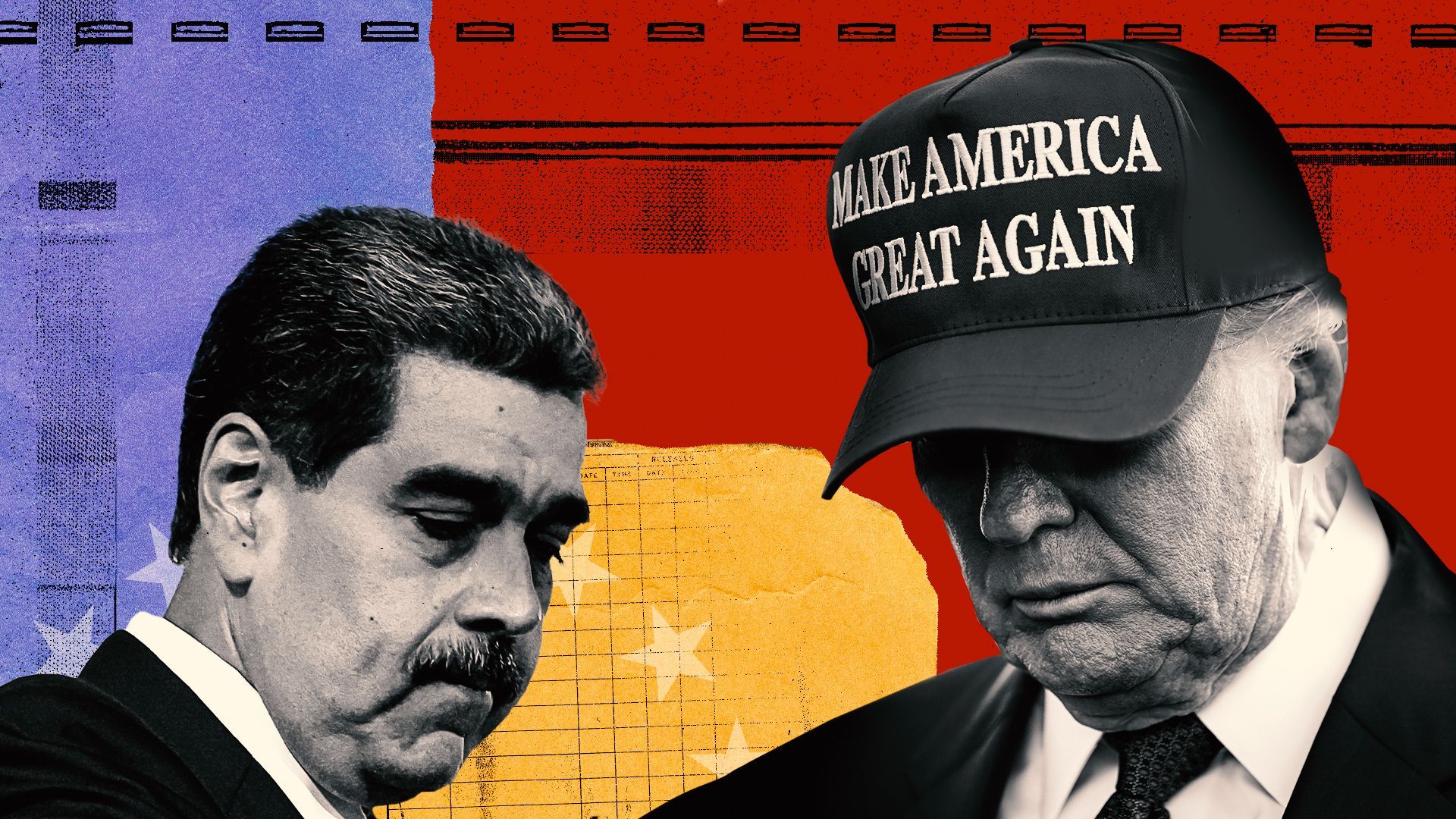
Photo illustration: Aïda Amer/Axios. Photo: Brandon Bell and Jesus Vargas/Getty Images
President Trump's decision to cancel a major oil deal with Venezuela came amid pressure from Miami's three GOP House members who oppose enriching Nicolás Maduro's dictatorship, four sources tell Axios.
Why it matters: To get their way, the three House members suggested — but never explicitly threatened — that they would withhold votes Trump needed for the GOP budget deal that the House narrowly passed last week.
- "They're going crazy and I need their votes," Trump explained to confidants when he privately signaled he would cancel the license allowing Venezuelan oil exports to the U.S.
- Reps. Mario Diaz-Balart, Carlos Gimenez and Maria Elvira Salazar then voted for the budget deal, which passed 217-215.
- Eight hours later, Trump announced on Truth Social that he was canceling the oil deal.
House Speaker Mike Johnson (R-La.) related some of the behind-the-scenes story to a group of Republican donors during a fundraiser Friday at the Miami-area waterfront mansion of local health insurance magnate Ivan Herrera.
- Johnson told the crowd they "should be proud" of Diaz-Balart, Gimenez and Salazar.
- "The three Crazy Cubans, as we affectionately call them," Johnson said, "stood on principle" and delivered for their community, according to two sources at the fundraiser. They said Gimenez and Diaz-Balart chuckled approvingly at the nickname along with the donors, many of whom have Cuban roots.
The big picture: In a more conventional White House, power flows through a more defined process, through "proper channels" that involve careful vetting.
- In Trump's White House, power often circulates instantly, improvisationally and unexpectedly, based on Trump's gut, his needs at the time — or on catching him with the right idea at the right time, with the right words.
This previously untold story helps explain the contradictory positions that Trump's administration sometimes appears to take.
- It also highlights Trump's hands-on involvement in salvaging the House's controversial budget plan — and his familiarity with Florida's unique politics and its international reverberations.
Zoom in: Last Tuesday, the final day of the budget talks, Johnson put Diaz-Balart on the phone with Trump so the Miamian could make his pitch against the Venezuelan oil deal. The week before, Diaz-Balart and Gimenez had met with Trump in the White House to voice their concerns, two sources said.
- During Tuesday's call, Diaz-Balart reminded Trump of his campaign promises to crack down on Maduro, two sources briefed on the call said. Diaz-Balart told Trump that Maduro's dictatorship was "thrown a lifeline" by President Biden when he relaxed sanctions, which Trump had slapped on Venezuela during his previous administration.
- "Mario never threatened their vote or offered a quid pro quo because threatening Trump is just counterproductive," said one of those sources. "They all know that."
- Diaz-Balart, Gimenez and Salazar declined to comment. A Johnson spokesperson confirmed the House members fought to end support to Maduro's government but wouldn't comment further.
Between the lines: Trump already wasn't inclined to continue the Venezuela petroleum deal, partly because Biden had struck it.
- Trump also didn't want to appear to be negotiating an oil-for-migrants deal with Maduro, a White House official and an outside adviser told Axios. The Trump administration is trying to boost deportations of Venezuelan unauthorized immigrants as well as some with pre-existing deportation protections.
- Trump's administration is stocked with Florida Republicans who are anti-Maduro: Secretary of State Marco Rubio, National Security Adviser Mike Waltz, Latin American envoy Mauricio Claver-Carone and Chief of Staff Susie Wiles.
- Trump's special envoy to Venezuela, Richard Grenell, is still in talks with Maduro's regime. Grenell last month secured the release of six U.S. prisoners in Venezuela and persuaded Maduro to accept Venezuelans deported from the U.S.
- Grenell has said the U.S. doesn't want regime change in Venezuela. But other White House officials said regime change is preferred because the socialist dictator has mismanaged his country's finances, destabilizing the region by leading to the Western Hemisphere's biggest mass migration of modern times.
- "The win-win for all of us is to somehow get the dictator to give up power on a glide path of maybe two years," a Trump Latin America adviser said. "So go ahead, keep robbing your country and getting rich off socialism while everyone else gets poor. But ya gotta go."
The backstory: Chevron produces about 220,000 oil barrels daily in Venezuela, about a quarter of the country's production, according to the Miami Herald, which also reported that Palm Beach oil magnate Harry Sargeant III, was closely involved in efforts to broker a deal between Trump and Maduro.
What they're saying: Trump's decision to cancel Biden's 2022 oil deal came as a surprise to Venezuela's government and to Chevron, which under the deal was allowed to pump Venezuelan oil.
- "Chevron lobbied hard and fell hard. So did Harry," said a Republican advising the Trump White House.
- "This is just going to raise the price of oil," said another Trump Republican allied with Sargeant.
- "In reality, damage is being inflicted on the United States, its population and its companies," Delcy Rodríguez, Venezuela's vice president, said in a social media post criticizing Trump's decision.
Zoom out: The Cuban-American community dominates the politics of Miami-Dade County, the most populous in the state.
- Cuban Americans, including those in Congress, have found political common cause in the state with exiles who fled other countries because of leftist violence, oppression or dysfunction. Those include Nicaragua, Colombia and Venezuela, where Cuban intelligence services protect Maduro.
- Cuban Americans are among Trump's strongest supporters; he's frequently boasted about that.
But Trump's decision to end Temporary Protected Status for as many as 300,000 Venezuelans is deeply unpopular in Miami politics. The three Cuban-American House members oppose it, but know it's hard to change Trump's mind.
- "Helping out Maduro and Big Oil was just a bridge too far for them," said a Republican allied with the congressional members. "They're happy Trump kept his promise. At least for now."
