Appeals court blocks Trump deportations under Alien Enemies Act

Add Axios as your preferred source to
see more of our stories on Google.
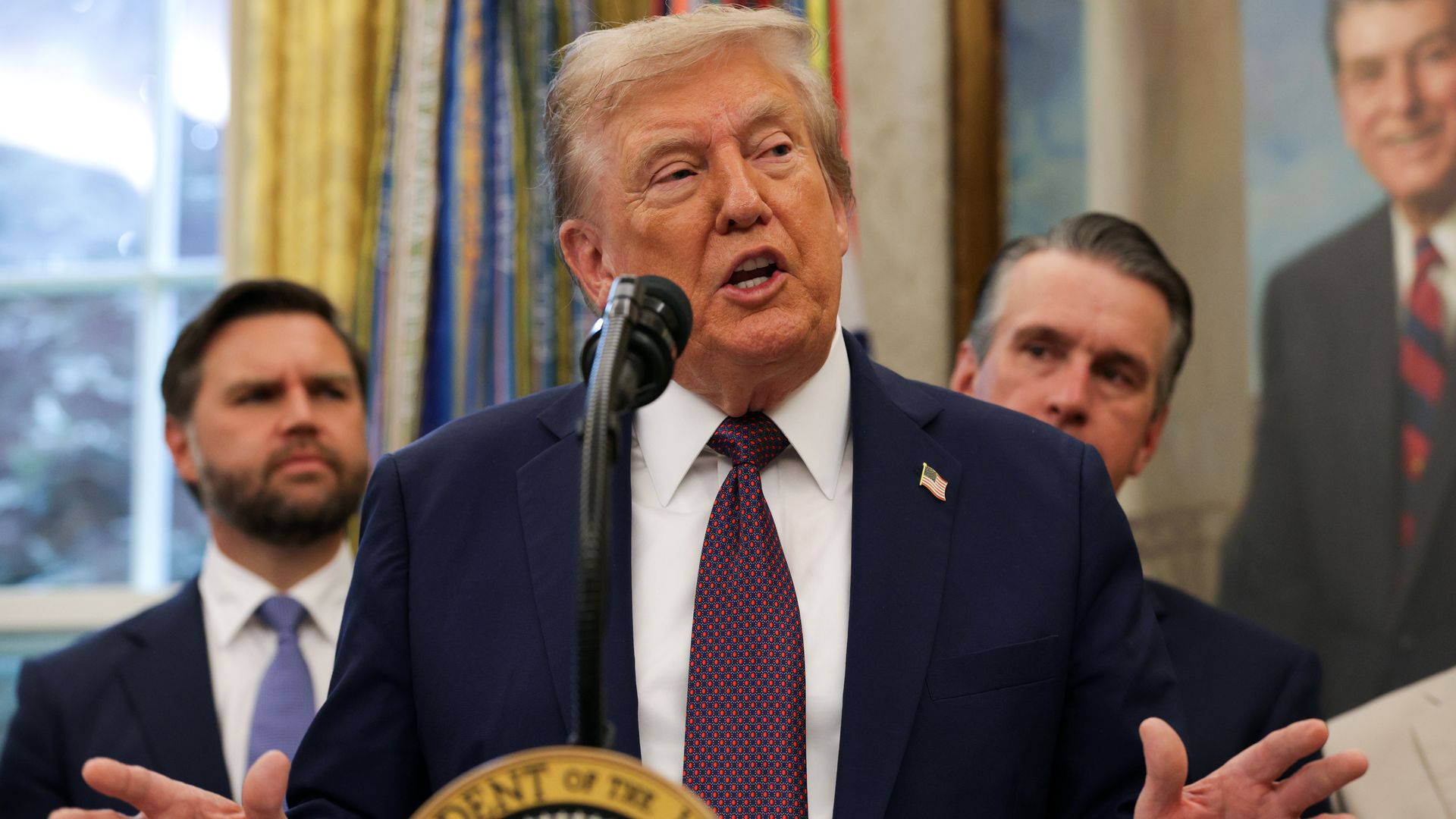
President Trump at the White House on Tuesday. Photo: Alex Wong/Getty Images
The Trump administration can't use a centuries-old wartime law to quickly deport Venezuelans it alleges are suspected gang members, a federal appeals court ruled in a 2-1 decision on Tuesday night.
The big picture: The 5th U.S. Circuit Court of Appeals said in its ruling it would grant a preliminary injunction "to prevent removal because we find no invasion or predatory incursion" had occurred.
Context: President Trump issued a proclamation in March to invoke the Alien Enemies Act of 1798 that allows for the removal of foreign nationals if "any invasion or predatory incursion is perpetrated" to fast-track the deportations process.
Why it matters: The New Orleans-based appellate court is the first federal appeals court to directly rule on the proclamation in a case that's likely to end up in the Supreme Court, per Reuters.
State of play: Trump said in his proclamation it was necessary to invoke the act in cases concerning Venezuelans suspected of being members of Tren de Aragua (TDA) and other gangs due to "mass illegal migration."
- However, the appeals court ruled that a country encouraging its citizens to enter the U.S. illegally "is not the modern-day equivalent of sending an armed, organized force to occupy, to disrupt, or to otherwise harm" the United States.
- "There is no finding that this mass immigration was an armed, organized force or forces," added the ruling, written by the George W. Bush-appointed Judge Leslie Southwick.
Zoom in: The Biden-appointed Judge Irma Carrillo Ramirez concurred, while the Trump-nominated Judge Andrew Oldham dissented.
- "Today the majority holds that President Trump is just an ordinary civil litigant. His declaration of a predatory incursion is not conclusive. Far from it," Oldham wrote in his dissent.
- "Rather, President Trump must plead sufficient facts — as if he were some run-of-the-mill plaintiff in a breach-of-contract case — to convince a federal judge that he is entitled to relief," he added. "That contravenes over 200 years of legal precedent."
What they're saying: "The Trump administration's expansion of fast-track deportations has subjected thousands of people to an unfair, arbitrary, and error-prone system," said Anand Balakrishnan, senior staff attorney with ACLU, which brought the lawsuit against the president, several Trump administration officials and agencies including the Department of Homeland Security.
- "The court's decision reaffirms the fundamental principle that people receive due process when the government seeks to deport them or their families," Balakrishnan added.
The other side: "The authority to conduct national security operations in defense of the United States and to remove terrorists from the United States rests solely with the President," White House spokesperson Abigail Jackson said in an emailed statement Wednesday.
- "President Trump exercised this lawful authority and employed the Alien Enemies Act to remove enemies of the United States, including vicious TdA gang members, from the country. Judge Oldham's dissent provides a careful review of this authority, and we expect to be vindicated on the merits in this case."
- A DHS spokesperson said Wednesday the appeals court ruling would not be the final say on this matter.
- "Unelected judges are undermining the will of the American people," the spokesperson said via email. "We are confident in our position, and we have the law, the facts, and common sense on our side."
Editor's note: This article has been updated with comment from Judge Andrew Oldham, White House spokesperson Abigail Jackson and a DHS spokesperson.
