Trump orders reopening of "enlarged" Alcatraz prison

Add Axios as your preferred source to
see more of our stories on Google.
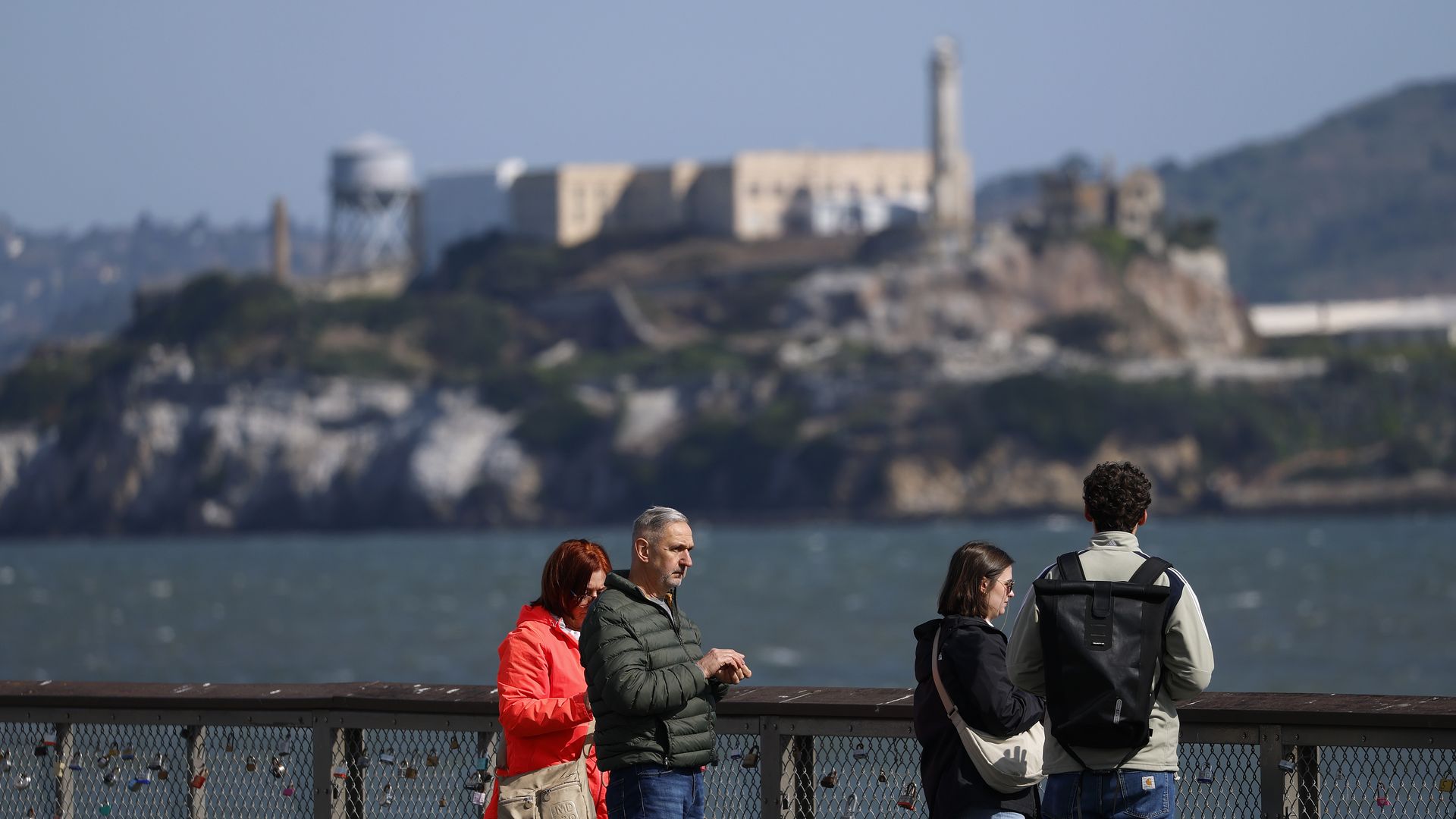
Visitors view Alcatraz Island in San Francisco, California, earlier this month. Photo: Justin Sullivan/Getty Images
President Trump said Sunday he's directed government departments to rebuild and reopen Alcatraz, the notorious California prison-turned-tourist -attraction.
The big picture: Alcatraz housed prisoners including the gangster Al Capone before it closed as a prison in 1963 because it was expensive to run and the U.S. government "found that it was more cost-effective to build a new institution" than keep it open, per a Federal Bureau of Prisons post.

Driving the news: "For too long, America has been plagued by vicious, violent, and repeat Criminal Offenders, the dregs of society, who will never contribute anything other than Misery and Suffering," Trump said on Truth Social.
- "No longer will we tolerate these Serial Offenders who spread filth, bloodshed, and mayhem on our streets," he said.
- "That is why, today, I am directing the Bureau of Prisons, together with the Department of Justice, FBI, and Homeland Security, to reopen a substantially enlarged and rebuilt ALCATRAZ, to house America's most ruthless and violent Offenders," Trump added.
- "We will no longer be held hostage to criminals, thugs, and Judges that are afraid to do their job and allow us to remove criminals, who came into our Country illegally. The reopening of ALCATRAZ will serve as a symbol of Law, Order, and JUSTICE. We will, MAKE AMERICA GREAT AGAIN!"
Background: Alcatraz Island was originally the site of a military fort in the 19th century. The "maximum-security, minimum-privilege penitentiary" opened on the island in San Francisco Bay in 1934, per the FBOP.
- No successful escapes were recorded in its 29 years of operation, though the FBOP notes five prisoners were listed as "missing and presumed drowned."
- The island that's near San Francisco's Golden Gate Bridge now attracts some 1.2 million visitors every year.
- Asked why he's reopening Alcatraz and where he got the idea from, Trump told reporters at the White House Sunday evening: "It's a symbol of law and order."
What they're saying: The Bureau of Prisons "will vigorously pursue all avenues to support and implement the President's agenda," bureau Director William K. Marshall III said in an emailed statement Monday.
- Marshall said he ordered an immediate assessment to determine the bureau's needs and the next steps.
- "USP Alcatraz has a rich history," he added. "We look forward to restoring this powerful symbol of law, order, and justice. We will be actively working with our law enforcement and other federal partners to reinstate this very important mission."
Zoom out: The Trump administration has been involved in several standoffs with the courts over the deportation of undocumented immigrants to El Salvador.
- Trump has also spoken of sending "homegrown criminals" who've been convicted of crimes to foreign prisons to serve sentences despite being U.S. citizens.
- Trump told reporters Sunday evening as he addressed his plans to reopen Alcatraz, "So many of these radicalized judges, they want to have trials for ... every single person that's in our country illegally."
- Representatives for the White House, DOJ, FBI and Homeland Security did not immediately respond to Axios' request for comment Sunday evening on how the administration plans to fund the rebuilding and reopening of Alcatraz, how much it expects it to cost and when it plans to reopen it.
Zoom in: The former prison's crumbling infrastructure poses a huge barrier to any plans to reopen it for incarceration, Alcatraz historian Jolene Babyak told Axios San Francisco.
- "We're three miles from the Pacific Ocean and the winds just whip in there," Babyak said. "When you get a crack in the concrete, the moisture gets in there, and it rusts out the rebar. And so you have a facility that has always been crumbling from the inside."
- She noted that transport costs would be extremely expensive, as all water and food would have to be brought over. Meanwhile, sewage would have to be removed from the island without dumping it into the water surrounding the prison.
- "They used to say that it cost more money to put men in Alcatraz than it did to house them at the Waldorf Astoria, that big hotel in New York," Babyak said. "So you can imagine what the cost would be today."
Go deeper: Remembering the Indigenous occupation of Alcatraz
Editor's note: This article has been updated with further comment from the Federal Bureau of Prisons and reporting from Axios San Francisco.
