Five issues expected to define the Harris-Trump debate

Add Axios as your preferred source to
see more of our stories on Google.
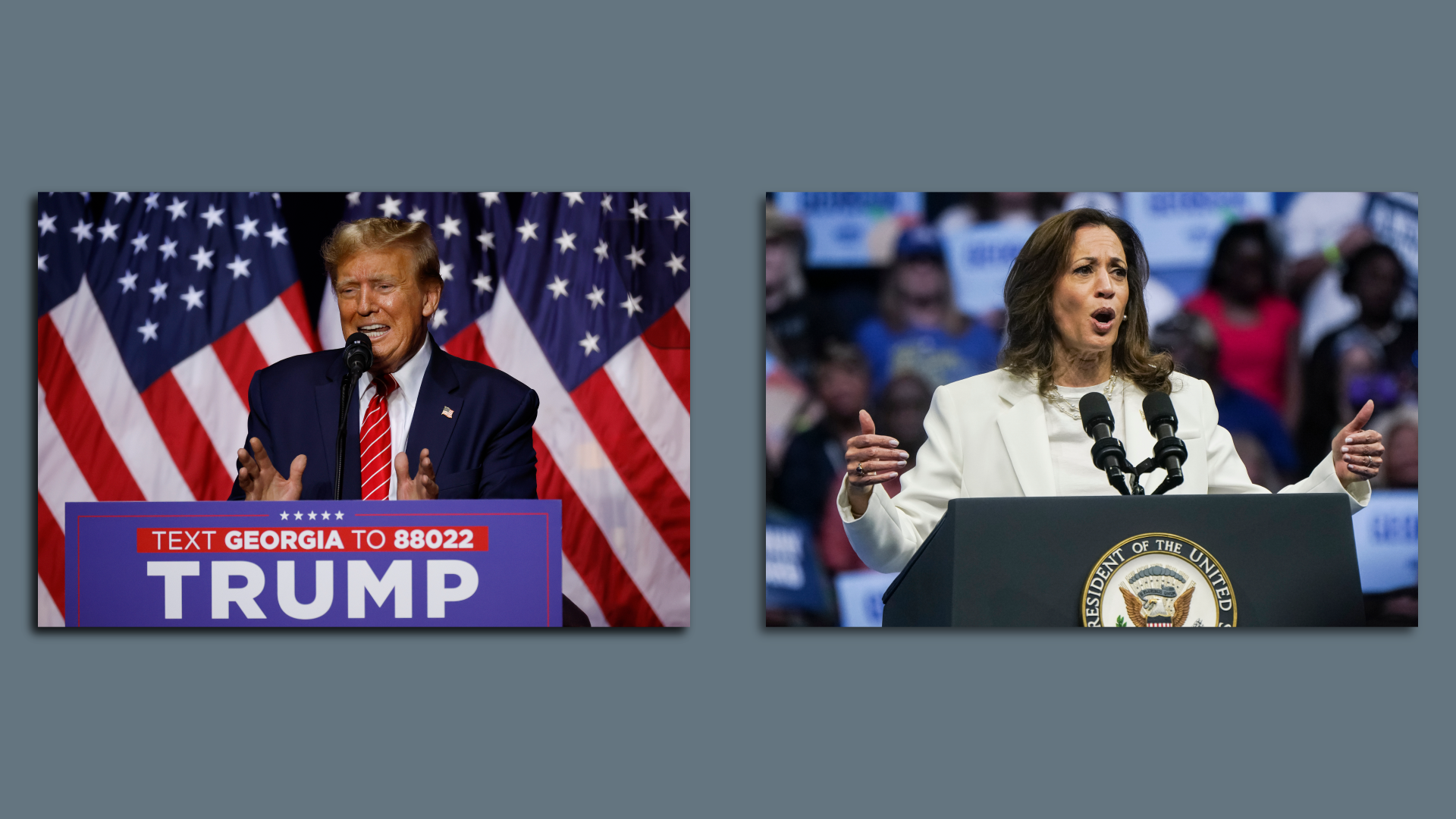
Donald Trump on March 9 in Rome, Ga., and Kamala Harris on Aug 29 in Savannah, Ga. Photos: Chip Somodevilla/Getty Images and Elijah Nouvelage/Bloomberg via Getty Images
Vice President Kamala Harris and former President Trump are set to face off in their first presidential debate on Tuesday, giving voters a chance to finally compare the them side-by-side.
Why it matters: This is the only presidential debate scheduled between Harris and Trump so far, making it a high-stakes opportunity for both candidates to lay out their priorities as voters begin casting ballots.
- It also comes after a period of upheaval in the 2024 race following President Biden's decision to withdraw — caused in part by his own abysmal performance during his presidential debate against Trump in June.
Here are some of the key issues that could come up during the debate:
The economy
Though inflation has fallen from its peak, many everyday Americans are feeling the tightening in the economy as the job market has cooled and the unemployment rate has risen.
- Trump has advocated for an aggressive slate of tariffs on imported goods and promised to extend his signature tax cuts, which are set to expire in 2025.
- He has also vowed to further reduce the corporate tax rate to 15% from the current 21%, while Harris wants to increase it to 28% (It was 35% before Trump's 2017 tax bill.)
Zoom in: Harris recently rolled out a plan to increase the tax on long term capital gains at 28% for wealthy Americans — significantly lower than than President Biden's proposed rate of a near-40%. Long-term capital gains are currently taxed at a maximum of 20%.
- She has also proposed increasing the tax credit for starting new small businesses to $50,000 from $5,000.
- Both candidates have proposed eliminating taxes on tips.
- New analyses published last month showed that Trump's policy proposals would balloon the national debt much faster than Harris' would.
Abortion
Democrats have sought to make abortion a defining issue in the 2024 race and Harris' emergence to the top of the ticket gives the topic new salience.
- Harris has long been one of the administration's strongest messengers on abortion. As a woman, she has the ability to speak authoritatively on women's reproductive rights. She has called on Congress to codify federal abortion protections into law.
- November is the first presidential election since overturning Roe v. Wade. Harris is likely to use the debate to hammer Trump over his views on the subject — emphasizing that abortion is overwhelmingly popular with the American public.
The other side: Abortion remains a key vulnerability for the GOP, leaving Trump to thread the needle between appealing to his base and not alienating large swaths of Americans.
- Trump has campaigned on the notion that abortion regulations should be left up to states to decide. He has said he doesn't support a national ban but has previously suggested a national 15-week abortion ban could be "very reasonable."
Between the lines: The Dobbs decision highlighted the legal murkiness concerning fertility treatments in the post-Roe landscape. Democrats have sought to link Trump to restrictions on reproductive care.
- Trump has said he supports IVF and wants to make it free. Yet his views highlight schisms among conservatives on the issue. In June, Senate Republicans blocked a bill aimed at ensuring federal protections for IVF.
Immigration
Immigration has been a top concern for voters over the course of the 2024 campaign and both candidates have tried to emphasized a their tough-on-immigration stances.
- Trump has sought to hammer the Biden administration — and by extension Harris — as weak on border policy. He and other Republicans have dubbed her the "border czar" — a position she never actually had.
- Harris has sought to emphasize her experience as a prosecutor while outlining a more hawkish stance immigration.
Zoom in: Harris has vowed to sign the bipartisan border deal that Republicans torpedoed, which would allocate new funds for building a wall on the Southern border — a reversal of her previous position.
- Trump has promised to undertake "the largest deportation operation in American history" and end birthright citizenship.
- Harris opposes to Trump's approach to family separation and his plans for mass deportations. She has also flip-flopped on her support for decriminalizing illegal border crossings.
Energy
Harris was an early backer of the Green New Deal and has long been an advocate for environmental justice.
- As vice president, she supported the climate provisions in Biden's Inflation Reduction Act, which provided hundreds of billions of dollars in tax subsidies and grants for low-carbon and renewable energy projects.
- However, she recently reversed her support for a fracking ban.
The other side: Trump has vowed to "drill, baby, drill" to increase fossil fuel production, decrease the "red tape" around oil and gas projects, and roll back Biden's environmental regulations.
- Trump has regularly referred to Biden's environmental policies as the "Green New Scam" and has said he would once again withdraw the U.S. from the Paris Climate Agreement if he returns to office.
Foreign Policy
Wars continue to rage in Ukraine and the Middle East, underscoring the importance of each candidate's foreign policy views.
- Like Biden, Harris has repeatedly called for a Gaza hostage and ceasefire deal and called for a two-state solution to the Israeli-Palestinian conflict.
- However, she has been perceived by some as being more critical of Israel than Biden.
- Trump has repeatedly expressed support for Israel and called for it to quickly end the war — expressing concern that it is damaging the country's reputation — but has not yet put forth his own peace plan.
- "I'm not sure a two-state solution anymore is gonna work," Trump told TIME magazine in April, saying such a deal is "going to be much tougher to get."
Zoom out: Since becoming the party's nominee, Harris has not specified how her approach to Russia's war in Ukraine might differ from Biden's, but many experts expect her to follow in the president's footsteps in supporting Ukraine and NATO.
- The Biden administration has maintained that it would not pressure Ukraine to begin peace talks until or unless it chose to do so. Trump has reportedly suggested in private that he would end the war by pressuring Kyiv to cede territory to Russia.
- Trump is also an avowed NATO-skeptic who has long been critical of the alliance and has routinely avoided criticizing Russian President Vladimir Putin.
- Earlier this year, he sparked outcry by suggesting he would stand by Russia if it invaded a NATO ally.
Go deeper: Wall Street economists forecast Trumponomics vs. Kamalanomics
