Trump and Biden have both embraced tariffs, but their approaches differ

Add Axios as your preferred source to
see more of our stories on Google.
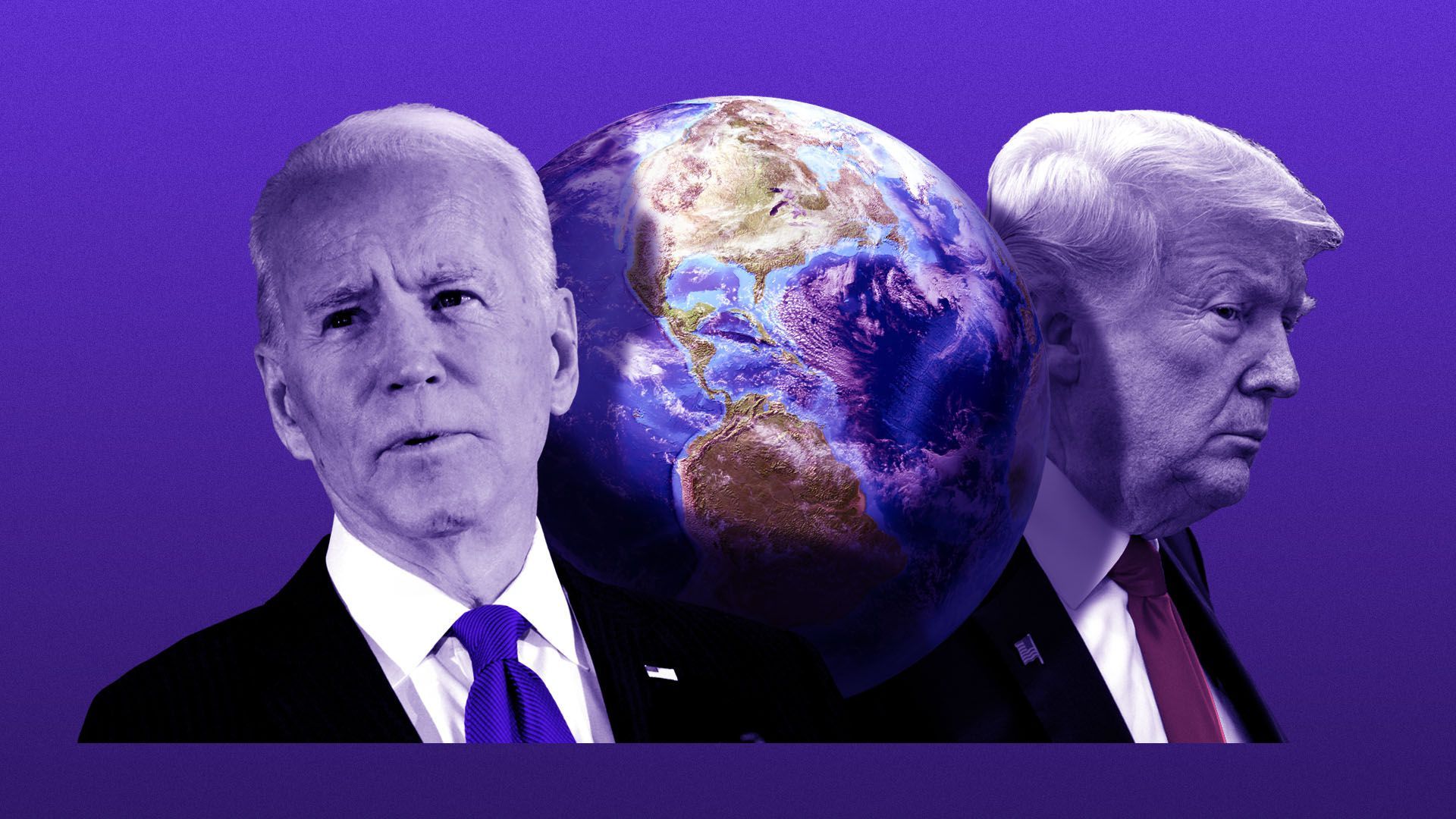
Photo illustration: Sarah Grillo/Axios. Photos: Bastiaan Slabbers/NurPhoto and Bastiaan Slabbers/NurPhoto via Getty Images
Tariffs raise prices for consumers, create economic blowback and should be used sparingly or not at all. That was the consensus among top U.S. political leadership for decades, and among economists for longer than that. Not anymore.
Why it matters: Former President Trump and President Biden each have embraced taxing imports as a key tool of economic statecraft — though they have distinctly different approaches when it comes to the details.
- How the winner of the November election uses those tools will help determine the course of the U.S. economy in the second half of the 2020s.
- Mainstream economic thought views tariffs as inflationary — impeding the ability of consumers to obtain goods from the most efficient global producers. When trading partners inevitably retaliate, it damages the prospects of exporters.
"We're seeing an increase relative to recent decades in tariffs being treated as an offensive weapon, as opposed to as a way to build stronger ties between nations," Michael Strain, director of economic policy studies at the American Enterprise Institute, tells Axios.
- "It's a strange diplomatic tool that has made it harder for businesses to produce goods and services, and led to erosion of purchasing power of households."
State of play: Trump has advanced ideas including a new 60% tariff on all Chinese imports and a 10% across-the-board tax on imports from around the world.
- The U.S. imported $427 billion worth of goods from China last year, so at first glance, a 60% tariff would increase American consumers' prices by about $256 billion — but it would likely be much less than that as production activity shifts to other countries with lower tariff burdens.
- Still, the Peterson Institute for International Economics calculates that the combination of existing tariffs and the ideas Trump has suggested would cost middle-income families $1,700 a year in the form of higher prices.
Trump also reportedly floated using tariff revenue to replace the income tax — an idea tax experts view as implausible given the relative magnitudes involved.
- Total goods imports were $2.8 trillion in 2021, generating $80 billion in tariff revenue.
- By contrast, total individual income was $15 trillion, generating $2.2 trillion in revenue.
- If the government attempted to increase import taxes enough to make tariff revenue a more meaningful share of federal revenue, it would surely reduce trade flows dramatically, cutting into the revenue base further.
What they're saying: "Former President Trump has pointed to the tariff in American history as a motivation for his idea, but the federal government of a century ago is much different from the federal government of today—as is the American economy," wrote Erica York at the Tax Foundation.
- "Back when tariffs were a main source of government revenue, federal government spending was a very small fraction of GDP, barely exceeding 2 percent of GDP in total," she noted. Now it's about 23%.
Last month, the Biden administration rolled out a suite of tariffs on Chinese exports of electric vehicles, solar panels, semiconductors and more. Administration officials emphasized what they see as differences with the Trump approach.
- Biden's "tough targeted approach combining investment and enforcement in key sectors is a sharp departure from the prior administration," White House economic adviser Lael Brainard said last month.
- "The previous administration did not take action to invest in America and failed to follow through on securing the promised Chinese purchases or end to China's unfair practices in its failed Phase One trade agreement with China," she said.
Yes, but: Biden has also elected to mostly leave Trump's China tariffs in place in his first three years in office, even as inflation surged.
- And he has simultaneously taken steps that cause friction with geopolitical allies, including heavy subsidies to U.S. electric car makers and a pledge to stop Japan's Nippon Steel from buying U.S. Steel.
Of note: Sixteen Nobel laureates in economics have endorsed Biden's economic policies, seeing Trump's policy agenda as likely to be inflationary.
Between the lines: There is an internal incoherence in the new bipartisan enthusiasm for trade barriers.
- "What we're seeing is that protectionist policies are being used to advance a number of totally separate goals," which are frequently in tension with each other, AEI's Strain said.
- "One goal is to revive the domestic manufacturing sector, another is to weaken the U.S. economic relationship with China, another is to increase the U.S.'s economic self-sufficiency more broadly, another goal is to advance national security, another is to support the green energy transition, and now adding another is to fund government spending," he said.
The bottom line: "That's an awful lot to ask of trade policy," Strain added.
