March begins with extreme weather, climate events after America's "Lost Winter"

Add Axios as your preferred source to
see more of our stories on Google.
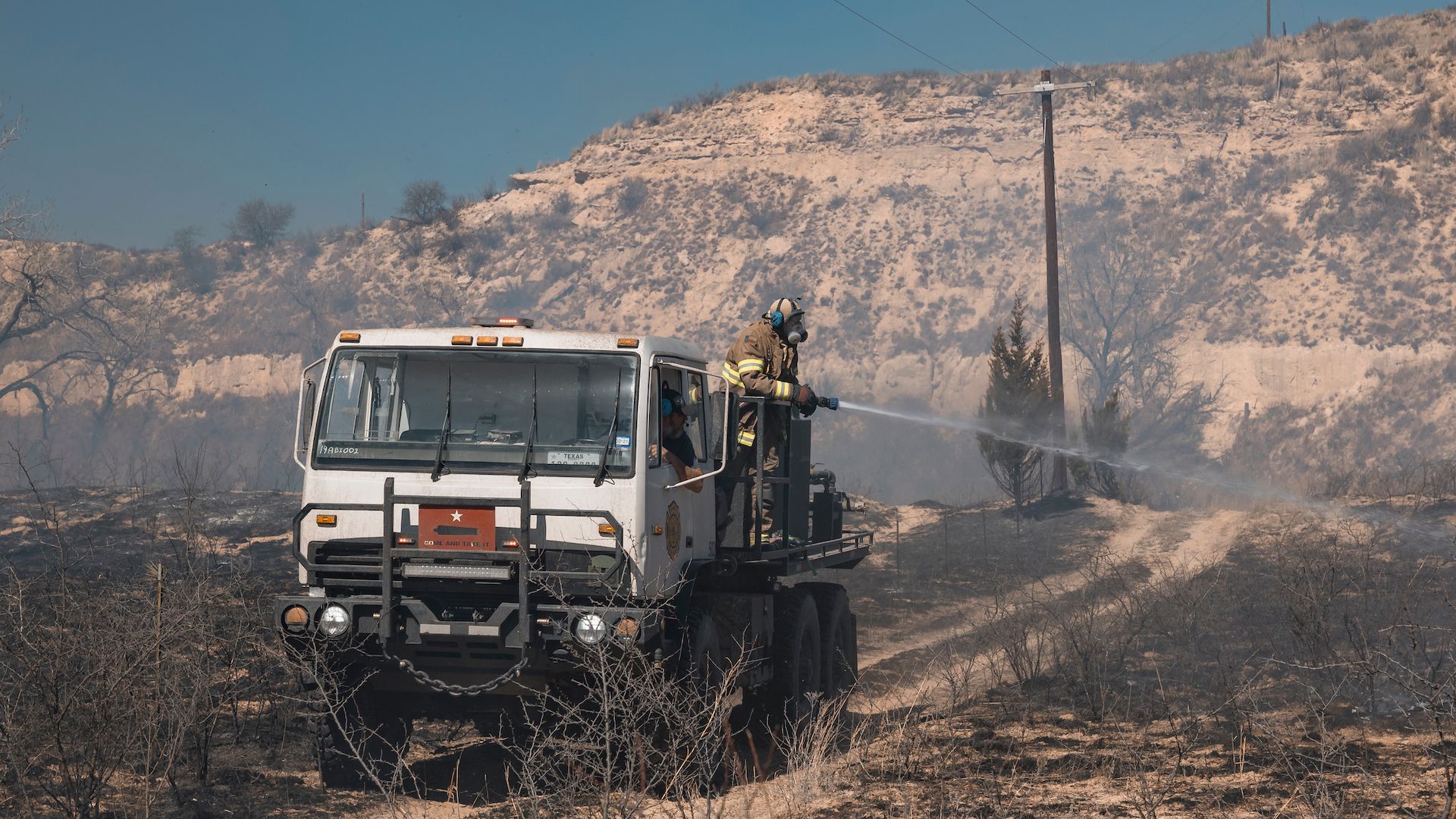
Firefighters extinguish hotspots on Saturday along the Smokehouse Creek Fire in Miami, Texas. Photo: Jordan Vonderhaar/Bloomberg via Getty Images
March has barely begun, and the West is coping with a ferocious blizzard, while Texas is battling its largest wildfire on record.
Why it matters: These extremes are occurring against the backdrop of a record warm U.S. winter of 2023-24, and milestone-setting global warmth as well.
Zoom in: With climate change, long-term trends are often hidden within the noise of day-to-day weather. And then there are moments when those trends become painfully obvious, like a new reality has set in.
- The last 10 days may be one such period, with a season-defying heat wave sweeping much of the nation; an historic Texas wildfire that has a burn scar so large it is clearly visible from space, and a blizzard so severe that it has cut off mountain communities in California's Sierra Nevada range.
The intrigue: But the larger picture cements a view of a changing climate that, for many, is more lasting, front of mind — and disconcerting.
- For tens of millions of Americans, this was the winter that wasn't. And it also wasn't the first such recent occasion, which means it can't be easily dismissed as a fluke.
The big picture: Cold and snow failed to grip the Upper Midwest, the Great Lakes stayed overwhelmingly ice-free, and cities in the mid-Atlantic and Northeast struggled again to see a single six-inch snowstorm.
- Residents of the colder regions in the U.S. are referring to this past season as the "Lost Winter," marking a possible turning point in how people view climate change's role in one of the seasons that most clearly define a region.
- If so, it would be in keeping with the long-term trends. Winter is much of America's fastest-warming season, with the coldest regions warming the fastest.
Between the lines: Even by the standards of significant long-term warming, cities in the northern tier of the country demolished their previous records for their warmest winter this year, according to preliminary data.
- For example, Fargo, North Dakota's mean temperature this winter was 14°F above average, while in the Twin Cities, the winter average temperature was 10°F above average. (Meteorological winter lasts from December through February.)
- Typically, seasonal averages are only broken by a degree or two, at most.
- Locations in the Northeast and mid-Atlantic also saw their warmest winters this year, or somewhere in the top 5.
Caveat: Major snowstorms can, and still will, happen in a warming world. Yet snowfall trends since 1970 are clearly trending downward across large swaths of the Lower 48 states.
- Climate Central, a science research and communications nonprofit, analyzed snowfall patterns since 1970 at 2,041 locations across the country.
- It found that 64% of locations now receive less snow than they did in the early 1970s, while 36% of locations have seen snowfall increase.
What's next: Climate projections are nearly unanimous in showing a retreat of winter snow cover across the U.S. in coming decades, first in lower elevations, then gradually higher.
- For example, in the Northeast, there has been an increase in storms that bring rain rather than snow, and a projected northward drift in the rain/snow line over time.
- In the West and Southwest, shifts in the timing and extent of winter snowfall and spring snowmelt have major water resource implications, numerous climate studies have shown.
The bottom line: Climate change had been slowly chipping away at winter's grip in much of the country. That may just be more obvious now.
