The Commerce Department announced Monday that the Trump administration's effort to export "full-stack" U.S. AI packages will enter its next phase on April 1.
Why it matters: The American AI exports program is meant to bundle the infrastructure, tools and models into ready-to-deploy AI systems for allies and partners, and has been touted as a key part of the White House's AI policy goals.
Nvidia CEO Jensen Huang said Monday that he expects the company to reap "at least" $1 trillion in revenue from its newest AI chips through 2027.
Why it matters: The company is operating at the center of the AI universe, providing the critical processing infrastructure that powers models like OpenAI's ChatGPT and Anthropic's Claude.
Tech industry groups representing hundreds of companies are urging a court to pause the Pentagon's blacklisting of Anthropic.
Why it matters: The Pentagon didn't just stop doing business with Anthropic — it labeled the company a supply chain risk, a move industry says could chill innovation and reshape how the government treats AI vendors.
The S&P 500 appears relatively calm on the surface this year, but dig a little deeper and you'll find some wild swings.
Why it matters: Investors have retreated from the Big Tech names that carried the market in recent years, putting downward pressure on stocks.
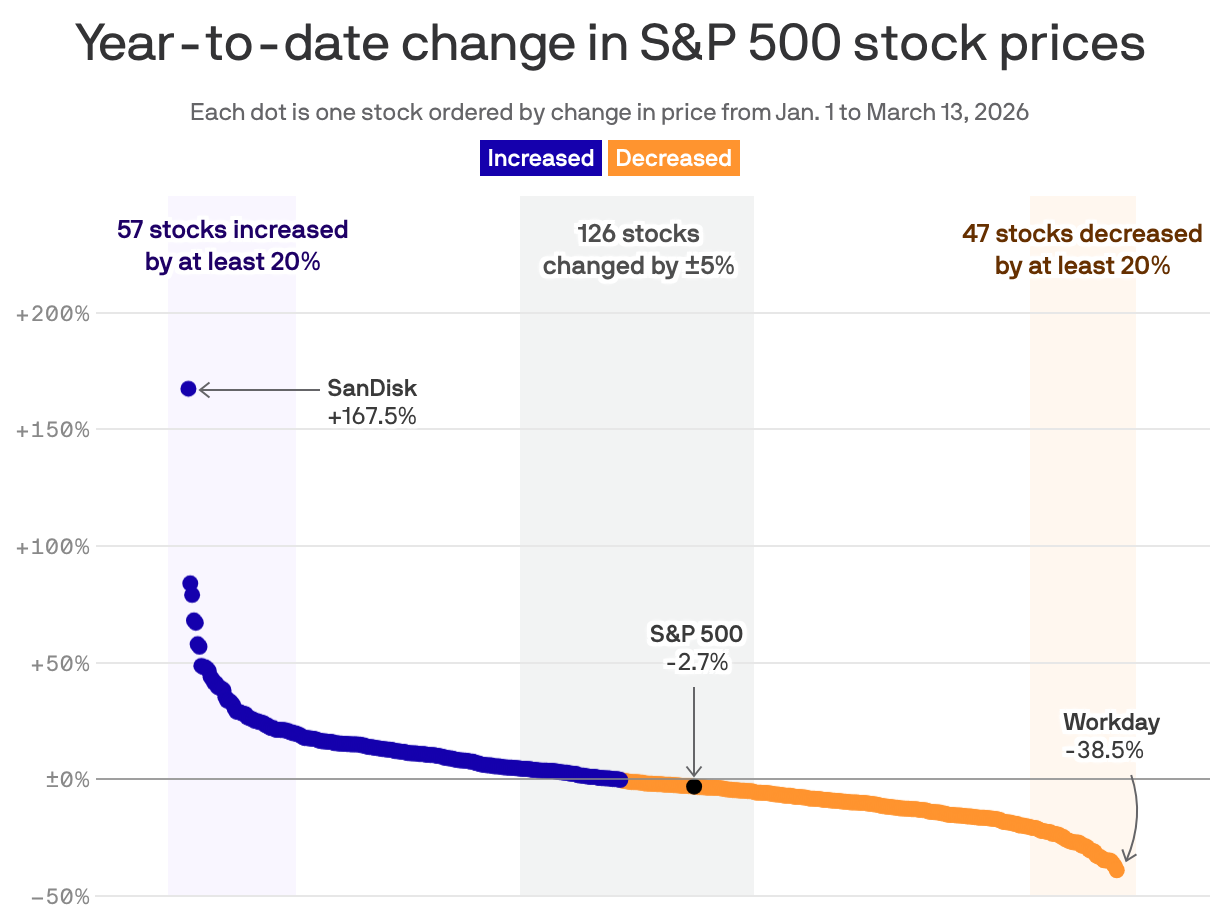
By the numbers: The S&P 500 has fallen just 3% for the year, but that masks some big-time volatility.
57 stocks are up by at least 20%, and 47 stocks are down by at least 20%, according to an analysis conducted Friday afternoon by Bespoke Investment Group.
That's unusual, says Paul Hickey, the investment advisory firm's cofounder.
The big picture: AI and the war are pushing stocks around in new ways.
Investors are pulling back from software in the wake of the SaaS-pocalypse and rotating toward defense and energy stocks.
Winners. Energy and defense industry stocks like Valero (+43%), Occidental Petroleum (+40%) and Lockheed Martin (+34%).
Losers. Workday, which makes HR software imperiled by the SaaS-pocalypse, has declined 39% this year. Oracle, an AI darling stock, is down 20%, and Salesforce, the SaaS king, off 27%.
Yes, but: Software might be out, but hardware is very much in: Companies benefiting from the RAM and memory chip shortage are slaying.
SanDisk is up 168% for the year; Micron (+48%).
Between the lines: The biggest stocks that weigh most heavily on the market haven't seen such wild ups or downs — but things are meh.
The Magnificent 7 was down about 8% for the year, as of Friday afternoon, when Bespoke pulled the numbers.
How it works: The S&P 500 is weighted by company size — bigger firms have outsize impact on the index.
The top 10 stocks on the S&P 500 — that includes the Mag 7 — make up about 40% of the index, as Apollo Global's chief economist Torsten Slok recently pointed out.
"If they do nothing, the other 60% has to go up to move the needle," says Hickey from Bespoke.
Reality check: You could also argue that the relatively mild fall for the Mag 7 stocks is keeping the market from looking even worse.
The intrigue: If Anthropic, OpenAI and SpaceX are added to the S&P 500 this year, market concentration could approach 50%, Slok noted. That would mean the index "basically doesn't offer much diversification anymore."
What to watch: Some of this trend is actually starting to reverse, says Abby Yoder, U.S. equity strategist at JPMorgan Private Bank.
Software started performing better in the first week of the war, she tells Axios. Tech is recovering a bit now that it's out of the spotlight.
"AI is taking a backstep to geopolitics," she says.
The bottom line: "For years we basically heard about how the market was top heavy. Now those mega-cap stocks haven't performed as well," Bespoke's Hickey says. "So they act as a weight on the market."
The U.S. holds an "extremely small" lead on China in the AI race, in part because authoritarian governments have certain advantages in deploying new technology, Anduril Industries founder Palmer Luckey said in a new episode of "The Axios Show."
Why it matters: Having Beijing dominate AI — and thus set the rules of the road globally — is considered a risk to U.S. national and economic security.
The AI boom is pushing one of America's most venerable environmental groups to cautiously support nuclear power after decades of resistance.
Why it matters: The Natural Resources Defense Council's position is both a sign of the urgent power demands that AI is creating and a larger shift underway among environmentalists to embrace an energy source many once rallied against.
It's a CEO's job to sell their product — not scare people it'll ruin their lives.
Tell that to OpenAI's Sam Altman and Palantir's Alex Karp, who've both delivered bleak warnings about the disruption AI could bring.
Why it matters: Portraying AI as immensely powerful — even dangerous — reinforces the idea that only a few companies can build it safely. That's an effective message for fundraising but a scary pitch to consumers.
Teneo, the CEO advisory firm, and Thoughtworks, the software engineering consultancy, are launching an AI-focused joint venture.
Why it matters: AI is advancing faster than many companies can adopt it. This partnership aims to help large corporations turn AI ambition into working tools.