Axios What's Next

October 13, 2023
All sorts of packaging will soon feature QR codes you can scan to find out if an item is recyclable in your neck of the woods, Jennifer reports today.
Today's newsletter is 1,046 words ... 4 minutes.
1. Recycling made easier
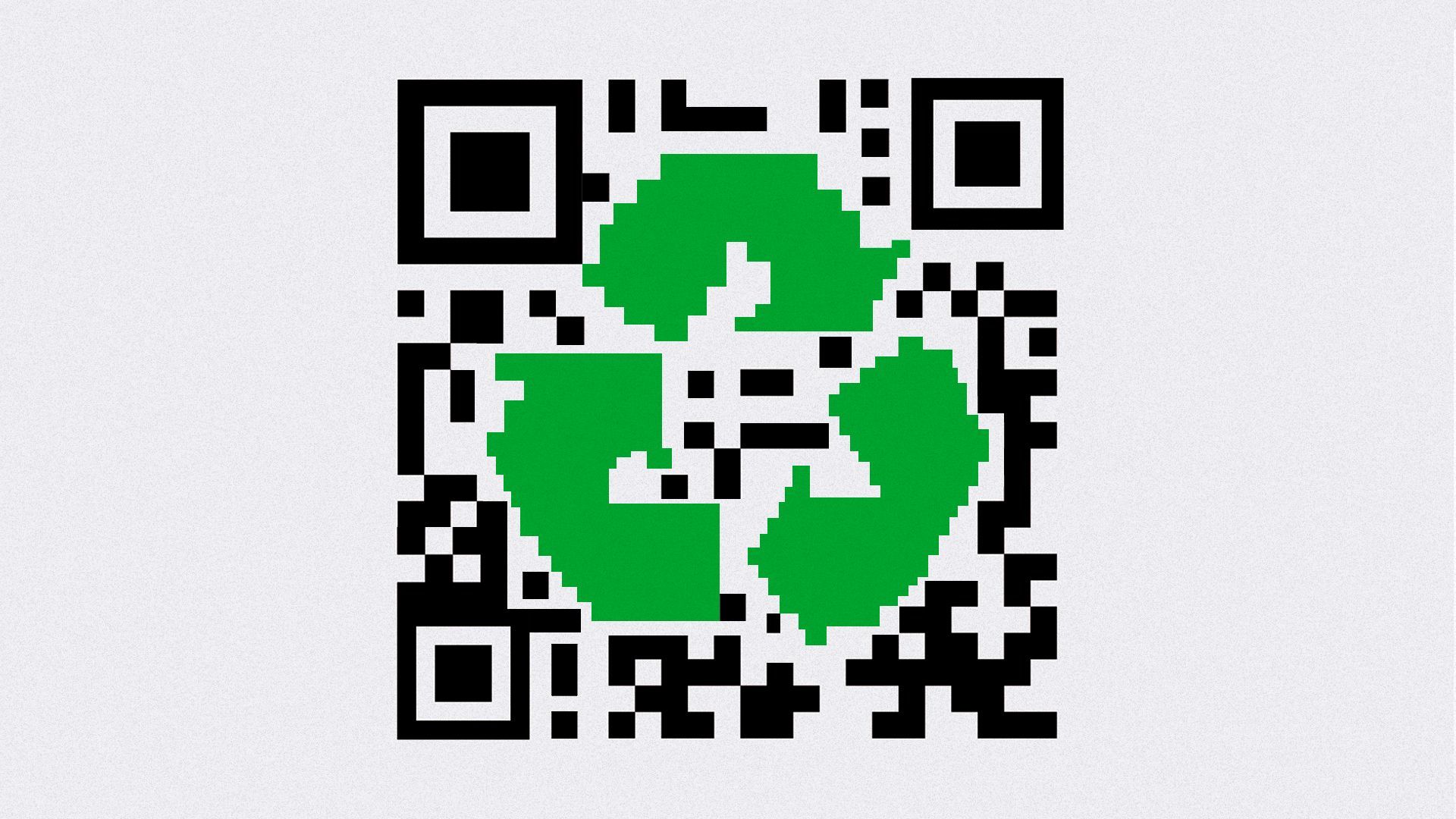
Illustration: Annelise Capossela/Axios
QR codes with hyperlocal recycling instructions will soon show up on your milk cartons, ice cream tubs and more, Jennifer reports — meaning you'll be able to scan an item, type in your ZIP code and see if it's eligible to go in the blue bin.
- "Just because a product says it's recyclable, doesn't necessarily mean it's recyclable where you live," notes Rishi Banerjee, director of the Consumer Brands Association's SmartLabel program.
Why it matters: 60% of consumers are confused about what and how to recycle, according to The Recycling Partnership, a national nonprofit — depressing the already-low recycling law compliance rate.
- The overall U.S. recycling rate is around 32%, the EPA says. For plastics, however, it's under 6%, per a recent report.
Driving the news: Recycle Check, a new program run by The Recycling Partnership, launched earlier this year and is busy signing up consumer brands to add local recycling info to their packaging via QR codes.
- Two early adopters are General Mills (maker of Yoplait, Pillsbury, Chex, Betty Crocker, etc.) and Horizon Organics, which makes dairy products.
- Products from those companies with local recycling details will soon be on store shelves, says Sarah Dearman, chief innovation officer for The Recycling Partnership.
What they're saying: "There's about 9,000 different recycling districts across the U.S., and we have them all in a database," Dearman said. "It takes the guesswork out of recycling."
- The recycling information will be dynamic — meaning that if a facility starts to accept a type of material that it had previously turned away, that change will be reflected in real time.
Where it stands: For now, consumers must either take at face value the recycling information that's printed on a product package (which may be wrong for a particular locality) or actively seek out more granular information if it's available.
What's next: The number of manufacturers using Recycle Check is likely to grow quickly, thanks to deals with two major labeling systems.
- One is with SmartLabel, a program run by the Consumer Brands Association that's put QR codes on 102,000 products from 1,000 brands.
- Another is with How2Recycle, a standardized labeling system from environmental nonprofit GreenBlue, which lets consumers look up local recycling info online.
The big picture: We'll soon be able to find out all manner of things about the products we buy through QR codes, from recipes and nutrition info to potential allergens and product recalls.
- The SmartLabel program, launched in 2016, now has 78 companies participating, including giants like PepsiCo, Coca-Cola, Hershey, Clorox and Reckitt.
- Data from NielsenIQ "shows SmartLabel products represent 76% of the units and 54% of the dollar share in the average grocery shopping cart," according to the Consumer Brands Association.
- For the consumer packaged goods industry, "SmartLabel is pretty much the main transparency tool," Banerjee tells Axios. "You have consistency across brands, across products."
Jennifer tried scanning the SmartLabel on her ubiquitous deskside bottle of Diet Coke and got links to product information, general recycling info, and a swag store with Diet Coke T-shirts and socks.
- The FAQs were disappointing, however — you could search for places to buy more of the stuff, but there was no arcane trivia with which to stump and amaze fellow Diet Coke fanatics. (Ina Fried, I'm looking at you.)
The bottom line: Many powerful forces and organizations are coalescing around making plastics and other materials easier to recycle — and to advance composting, too.
2. AI forecasts new COVID variants
Illustration: Shoshana Gordon/Axios
Researchers are harnessing AI to predict threatening new strains of COVID-19 and other viruses, Axios' Adriel Bettelheim reports.
Why it matters: Forecasting mutations could help public health officials develop more effective countermeasures, potentially minimizing the human and economic toll of a pandemic.
How it works: Researchers developed a generative AI model that's trained on historical viral sequences to predict mutations.
- They then added structural details about the virus.
What they found: When presented with ancestral strains of coronavirus from before the pandemic, the tool, called EVEscape, predicted the most frequent mutations and dangerous variants of SARS-CoV-2, the researchers wrote this week in Nature.
What they're saying: "You can use these generative models to learn amazing things from evolutionary information — the data have hidden secrets that you can reveal," senior author Debora Marks, an associate professor of systems biology at Harvard Medical School, said in a statement.
What's next: EVEscape is being used in real time to predict how COVID will evolve next.
- EVEscape is also being used to make predictions about other viruses, including HIV and influenza.
3. Temper your raise expectations
Illustration: Sarah Grillo/Axios
There are early signs that companies are planning smaller raises next year, Axios Markets' Emily Peck reports.
Why it matters: This is obviously less than great news for workers — but it's also another sign that inflation is cooling and the dreaded "wage-price spiral" didn't materialize as some had feared.
Driving the news: U.S. employers are increasing their compensation budgets by 3.5% for merit raises next year and 3.9% for all wage increases, according to a recent survey from Mercer.
- That's down from 3.8% and 4.1%, respectively, in actual increases in 2023.
Yes, but: Most companies won't finalize their budgets until December, Mercer points out.
State of play: Wage growth is still well above where it was pre-pandemic, but it's trending down.
- In September, average hourly earnings were up 4.2% year over year, according to the Bureau of Labor Statistics. In March 2022, that number was at 6%.
4. One fun thing: "Ring of Fire" eclipse


Set a reminder and find some eclipse glasses, Axios' Kelly Tyko reports: Most Americans will have a chance of seeing a solar eclipse tomorrow, Oct. 14.
What's happening: An annular solar eclipse — also known as a "ring of fire" eclipse — will darken skies above a narrow swath of the country stretching from the coast of Oregon to the Texas Gulf Coast, according to NASA.
- Many others in the continental U.S. and parts of Alaska who aren't in the path of the annular eclipse will have the chance to see a partial solar eclipse. (Here's more on the different kinds of eclipses, via NASA.)
Be smart: You'll need eclipse glasses to safely view any of these celestial spectacles — and hope for clear skies.
What's next: A total solar eclipse is on tap for North America in April 2024.
Big thanks to What's Next copy editor Amy Stern.
Was this email forwarded to you? Get your daily dose of What's Next by signing up here for our free newsletter.
Sign up for Axios What's Next

The next decade of big, sweeping changes will unfold in cities and communities where new technologies like 5G, AI and drones are transforming how we work, live and play together. What’s Next will guide you through the revolution.