Axios What's Next

March 28, 2024
America's emerging innovation hotspots may just surprise you, Alex and Kavya report today.
Today's newsletter is 951 words ... 3½ minutes.
1 big thing: Innovation hotspots, mapped
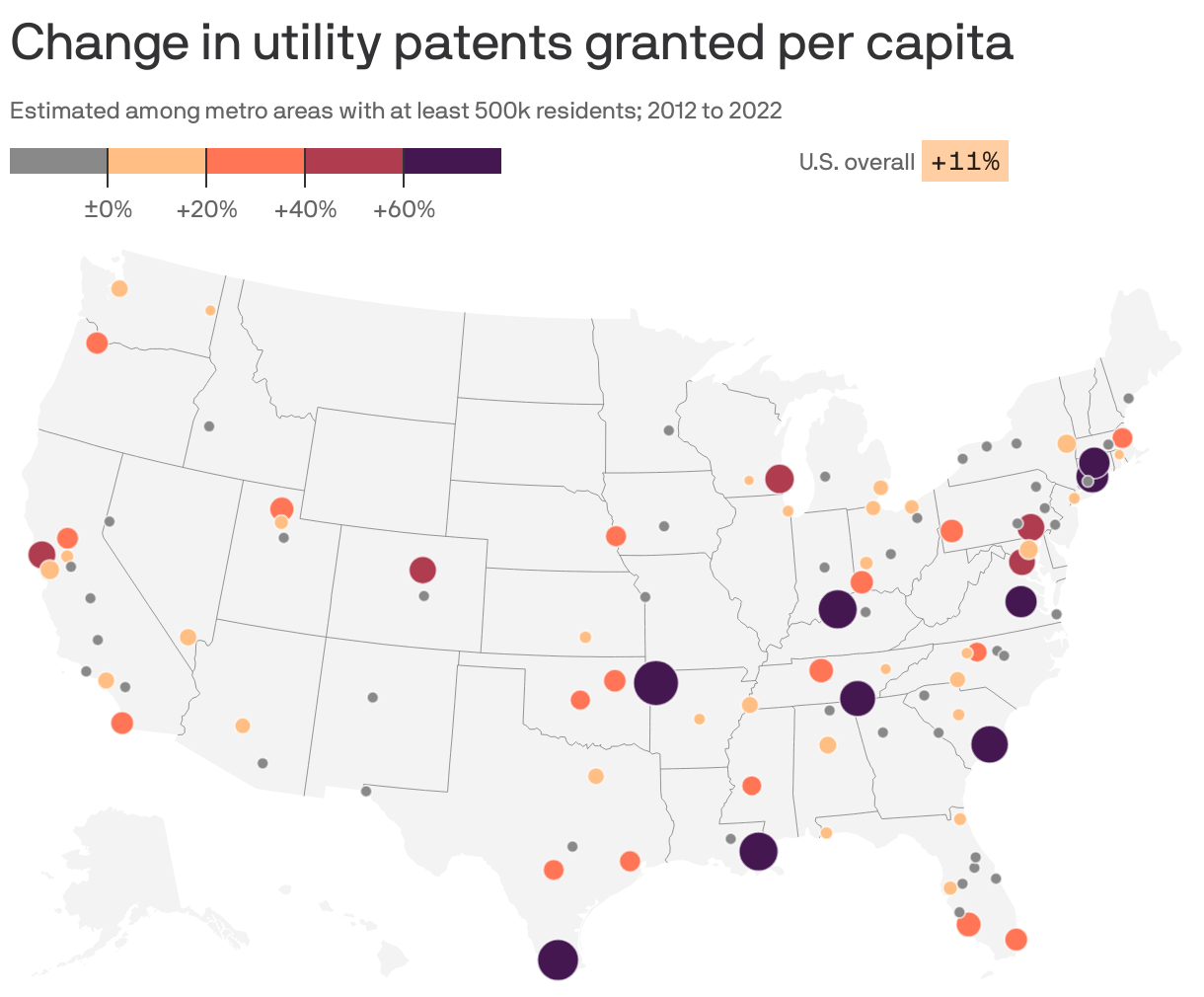
Northwest Arkansas, Louisville and New Orleans are emerging as America's new innovation hotspots, as measured by the change in utility patents granted over time per 100,000 residents, Alex Fitzpatrick and Kavya Beheraj report.
Why it matters: While Silicon Valley still holds the title for most patents awarded overall, the rate of change over time offers a compelling look at newly ascending areas.
- Utility patents may be granted for inventing or discovering a new and useful process, machine or composition of matter, among other things.
By the numbers: The Fayetteville metro area (which includes Bentonville) had 24.9 patents granted for every 100,000 residents in 2022, up from 10.2 in 2012 — a 144.1% increase, per U.S. Patent and Trademark Office data.
- Louisville had 27.3 patents compared to 13.3 (up 105.3%), while New Orleans had 11.4 compared to 5.6 (up 103.6%).
- Nationally, 42.5 patents were granted for every 100,000 residents in 2022, up from 38.4 in 2012 (+11%).
Zoom in: Northwest Arkansas' patent boom comes alongside broader growth for the region, which is home to Walmart headquarters, as Axios NW Arkansas' Worth Sparkman has reported.
- "Organically and by design, NWA is in the midst of reinventing itself, slowly shaking the hillbilly stereotype associated with the Ozarks," Worth wrote.
Yes, but: In terms of raw numbers, the San Jose and San Francisco metros blew the rest of the country out of the water, with 14,089 and 11,346 patents granted in 2022, respectively.
- New York took third place, at 6,979.
The big picture: "U.S. patenting and trademark activities are concentrated in certain areas of the country, with the highest rates on the East Coast and West Coast, around the Great Lakes, and in parts of the Southwest," per a February report from the National Science Foundation.
Caveat: Getting a patent is one thing; actually creating the proposed product or service is another.
- That said, the number of patents granted is still a useful proxy for measuring something as quantitatively slippery as "innovation."
What's next: Expect other potentially surprising innovation hubs to emerge over the next few years, as money from laws like the CHIPS Act and private investment funds new semiconductor plants and other high-tech projects nationwide.
2. AI falls into "trough of disillusionment"
Illustration: Brendan Lynch/Axios
Grumbles about generative AI's shortcomings are coalescing into a "trough of disillusionment," Axios AI+'s Ina Fried writes.
Why it matters: AI is still changing the world — but improving and integrating the technology is raising harder and more complex questions than first envisioned.
The big picture: A year ago, every corporate board was pressuring its CEO to adopt generative AI as quickly as possible.
- Now, many are finding that even promising early experiments have proven tough to scale — and that what appeared to be "good enough" results often aren't.
- Hurdles include everything from embarrassing errors — such as extra fingers or Black Founding Fathers in AI-generated images — to significant concerns about intellectual property, cost, environmental impact and more.
The latest: Some leading startups of generative AI's first wave are falling by the wayside.
- Inflection AI's leadership and top researchers last week decamped for Microsoft, while Stability AI's CEO and co-founder recently resigned amid a talent and financial crunch.
What they're saying: Gary Marcus — a scientist who penned a blog post last year titled "What if generative AI turned out to be a dud?" — tells Axios that outside of a few areas such as coding, companies have found generative AI isn't the panacea they once imagined.
- "Almost everybody seemed to come back with a report like, 'This is super cool, but I can't actually get it to work reliably enough to roll out to our customers,'" Marcus says.
3. Study: Child care benefits "pay for themselves"
Illustration: Shoshana Gordon/Axios
The cost of providing child care benefits to employees is an investment with outsized returns, finds an intriguing new study from Boston Consulting Group and nonprofit Moms First, Axios Markets' Emily Peck reports.
Why it matters: Such benefits are gaining more attention, particularly with less pandemic-era child care funding — but they're still pretty rare.
What they found: For every $1 spent on child care benefits, employers saw a net gain of between $0.90 and $4.25 through reduced absenteeism, less lateness and lower rates of attrition, per the study.
- The researchers looked at five companies of varying sizes and across a range of sectors employing both salaried and hourly workers, including UPS, Etsy, Steamboat (a Colorado ski resort) and more.
What they're saying: "These benefits pay for themselves," the authors write.
Caveat: This is a limited study, conducted in part by a group that advocates for these types of benefits.
4. Winter sports, no mountain needed
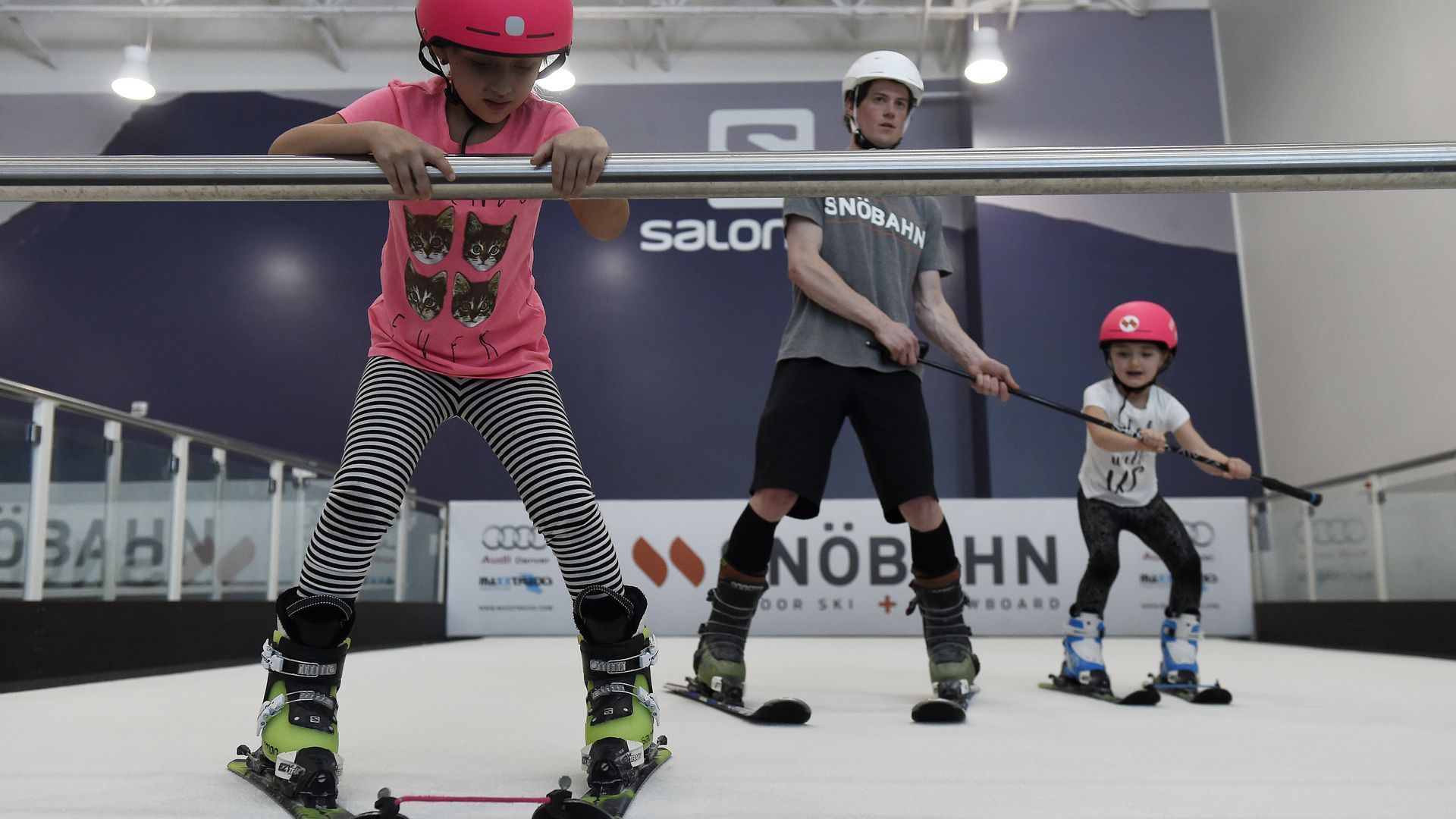
Maya Delatorre, 6, uses a bar to balance herself during a ski lesson at Snöbahn. Photo: Seth McConnell/The Denver Post via Getty Images
Inside a retired big box store in Thornton, Colorado, kids of all ages kickflip skateboards, launch from bike ramps, soar into the air from trampolines and ski down a carpeted slope, Axios Denver's John Frank reports.
- It's extreme chaos, but it's just what Sadler Merrill imagined when he put together a plan for Snöbahn, an indoor action sports training facility.
Why it matters: Merrill hopes to make action sports more accessible to the masses by allowing people to develop their skills closer to home, rather than needing to travel to the mountains.
- Whether it's successful holds major implications for the future of sports like skiing, which are struggling to recruit new fans given the cost and skill barriers involved.
Zoom in: The 38,000-square-foot facility is equal parts play and training, with kids burning energy on trampolines and amateur athletes practicing tricks on ramps.
- It will offer reservations for lessons, camps and birthday parties.
What they're saying: "Our mission is simple: Inspire a life of adventure," Merrill tells Axios.
- "We believe everyone deserves the opportunity to experience the thrill of action sports regardless of age or skill level."
Big thanks to What's Next copy editor Amy Stern.
Was this email forwarded to you? Get your daily dose of What's Next by signing up here for our free newsletter.
Sign up for Axios What's Next

The next decade of big, sweeping changes will unfold in cities and communities where new technologies like 5G, AI and drones are transforming how we work, live and play together. What’s Next will guide you through the revolution.