Axios What's Next

August 23, 2023

Electric cars won't necessarily mean fewer jobs for autoworkers, Joann reports today — but the transition could be rocky nonetheless.
Today's newsletter is 1,116 words ... 4 minutes.
1 big thing: What EVs mean for autoworkers

Illustration: Sarah Grillo/Axios
A big sticking point in contract talks between Detroit automakers and the United Auto Workers union is the popular assertion that it takes fewer workers to manufacture electric vehicles (EVs) than conventional cars.
- In fact, the opposite may be true: Researchers at Carnegie-Mellon University recently found that EVs require more labor hours, primarily to produce battery cells, Joann reports.
- Today, those cells are manufactured mostly in Asia. Yet a slew of companies are shifting production to the U.S. to take advantage of new tax incentives — though the resulting jobs will likely be non-unionized and lower-paying.
Why it matters: The EV transition is fraught with risks for both autoworkers and Detroit's big three manufacturers: General Motors, Ford and Stellantis.
- For UAW members, it's the risk that good-paying union jobs building engines, transmissions and exhaust systems will disappear.
- For auto companies, it's the risk that they'll fall further behind Tesla and other non-unionized rivals that already have a significant labor cost advantage.
The big picture: EVs have fewer moving parts than gas-powered vehicles, with no engines, transmissions or exhaust systems.
- That makes them easier to maintain and — according to some industry experts — simpler to build.
- Even Ford CEO James Farley says so: Last November, he bluntly asserted that EVs will require 40% less labor to produce than traditional cars.
To preserve jobs, Farley said, Ford will need to build more EV components in-house — similar to the way founder Henry Ford operated nearly 100 years ago.
- For example, Ford workers at a former transmission plant near Detroit are now making EV motors and transaxles, while workers at another parts facility are assembling battery packs.
The intrigue: Manufacturing battery pack cells is the most labor-intensive part of EV production, according to Turner Cotterman, a McKinsey consultant who worked on the Carnegie-Mellon study.
Yes, but: Even as cell production shifts to the U.S., that labor will likely be done by non-union workers at factories co-owned by foreign battery partners, and they'll make less money than workers at traditional powertrain factories.
- For example, battery cell factories under construction in Kentucky and Tennessee and co-owned by Ford and Korea's SK On just started hiring workers for $21-$29 per hour, compared to the $28-$35 union workers earn making engines and transmissions at Ford's existing plants.
- A GM battery plant co-owned with another Korean company, LG Energy Solution, opened in Ohio in 2022 with a starting wage of $16.50 an hour, and a promised rise to $20 after seven years.
What's happening: The UAW successfully organized employees at the Ohio plant, called Ultium Cells, last December, making it the country's first unionized battery cell factory.
- But the two sides still have to negotiate a contract.
- GM and Ford insist these new battery plants aren't covered by the national bargaining agreements for existing autoworkers because they are technically owned by separate companies.
The bottom line: "There's a push and pull happening," Cotterman tells Axios, describing the tension between supporting autoworkers and the Biden administration's efforts to catalyze domestic EV production.
- Auto companies will only hire so many workers at a higher wage, potentially slowing the rate of EV production.
- "As the U.S. accelerates the transition to EVs, we have to ask, 'How much do we care about these new workers in the EV industry?'" Cotterman says. "If we value them highly and pay them fairly, it almost runs counter to the pace we can roll EVs out."
- "China is moving a hell of a lot faster. If we want to keep up, it's difficult to support the workers."
2. Robotaxis stumble in San Francisco
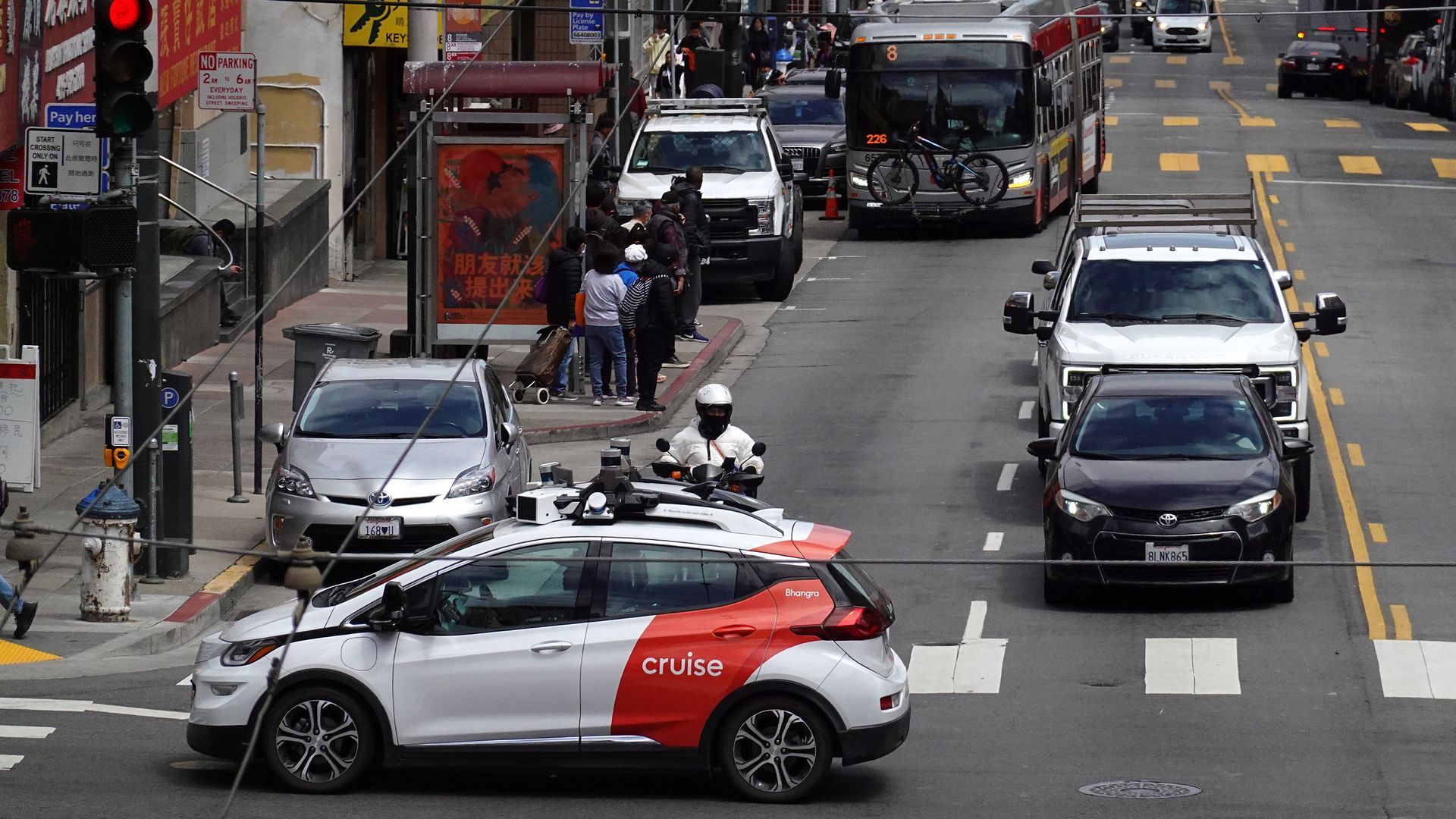
A Cruise self-driving car in San Francisco. Photo: Justin Sullivan/Getty Images
Robotaxis have been involved in several incidents in the days after California regulators approved round-the-clock commercial service for GM's Cruise and Alphabet's Waymo in San Francisco, Axios San Francisco's Megan Rose Dickey reports.
- One Cruise vehicle got stuck in wet concrete, while two others were in car accidents, including one involving a fire truck.
Why it matters: A poor rollout in San Francisco could fuel robotaxi skepticism elsewhere, complicating expansion plans.
What's happening: The California Department of Motor Vehicles asked Cruise to halve its vehicle fleet size as it investigates the situation.
- Cruise has agreed to reduce its San Francisco fleet and work with the DMV "to make any improvements and provide any data they need to reinforce the safety and efficiency of our fleet," spokesperson Drew Pusateri told Axios.
Meanwhile: San Francisco city officials are urging the California Public Utilities Commission (CPUC) to reconsider its Aug. 10 decision allowing Cruise and Waymo to begin 24/7 commercial robotaxi service.
The other side: Waymo will "continue to work with the city of San Francisco in constructive ways while providing safe and accessible mobility to San Franciscans," spokesperson Julia Ilina told Axios.
3. Where art thou, bus drivers?

Illustration: Annelise Capossela/Axios
A bus driver shortage has made the back-to-school season a logistical nightmare in districts nationwide, Axios' Shauneen Miranda reports.
- All 50 states have seen at least "one instance of a major school bus driver shortage" so far this year, per a USA Today analysis.
- Districts in Kentucky, Illinois, Florida and more are being forced to rethink their transportation plans.
Zoom in: Kentucky's Jefferson County attempted to alter bus routes and stagger start times to cope with a driver shortage, but was forced to cancel several days of classes after students were left stranded, the Associated Press reports.
- District superintendent Marty Pollio apologized to students, families, school bus drivers and personnel, calling the mishap a "transportation disaster."
By the numbers: In a new survey from HopSkipDrive, a ride service for kids, 92% of school leaders said bus driver shortages constrained their operations, up from 88% last year and 78% in 2021.
- Respondents cited recruitment problems, pay and driver retirements as key issues driving the shortage.
What they're saying: "There's been a challenge recruiting new drivers for years and years, and we had a massive group of drivers leave the industry due to the pandemic," HopSkipDrive CEO and co-founder Joanna McFarland told Axios.
4. Better AI translation

Illustration: Shoshana Gordon/Axios
Facebook parent Meta has released an AI-powered tool that can more easily translate languages across text and speech, Axios AI+'s Ina Fried reports.
- The new translation engine can translate spoken words from one language to another without first having to convert to text behind the scenes, among other advancements.
Details: The engine, called SeamlessM4T, is being released under a Creative Commons license allowing researchers and developers to build upon Meta's work.
- It supports speech-to-speech and text-to-speech translation for around 100 input languages and 35 output languages, among other capabilities.
What they're saying: SeamlessM4T "even supports changing languages on the fly," Meta research scientist Paco Guzmán told Axios.
- "This allows [it] to better support populations who naturally mix languages in their day-to-day speech."
Big thanks to What's Next copy editor Amy Stern.
Was this email forwarded to you? Get your daily dose of What's Next by signing up here for our free newsletter.
Sign up for Axios What's Next

The next decade of big, sweeping changes will unfold in cities and communities where new technologies like 5G, AI and drones are transforming how we work, live and play together. What’s Next will guide you through the revolution.