Axios Media Trends

May 09, 2023
Today's Media Trends, copy edited by Sheryl Miller, is 1,647 words, a 6-minute read. Sign up.
🦊 Situational awareness: Fox Corp. said this morning that it posted a net loss of $50 million last quarter, mostly "due to charges associated with legal settlement costs at FOX News Media."
- It was a big damper on an otherwise strong quarter. Revenue was up 18% year over year to $4 billion. Ad revenue was up 43% thanks to the Super Bowl, NFL games and growth at its ad-supported streaming service, Tubi.
- CEO Lachlan Murdoch said on an earnings call that Fox News' programming strategy won't change, despite the firing of Tucker Carlson.
1 big thing: American extremists linked to Russian sites

Illustration: Brendan Lynch/Axios
American extremists are consistently turning up on loosely governed Russian social media platforms.
Why it matters: Real-world hate crimes in America are often influenced by online chatter that's increasingly linked to Russian sites or pro-Russian narratives on more obscure parts of the internet.
Be smart: Russian leaders "certainly don't have a huge incentive to try to clamp down on it," said Jared Holt, a senior research manager at the Institute for Strategic Dialogue.
- "You couldn't imagine an easier way of allowing discord to grow within the U.S. and the Western world than suddenly letting people do it to themselves," said Neil F. Johnson, a data physicist at George Washington University.
Driving the news: The gunman who killed eight people and injured seven in a shooting at a Dallas mall Monday had a profile on the Russian social networking platform OK.ru that he used to reference posts from white nationalists, NBC News reported.
- His OK.ru profile also linked to extremist sites, such as 4chan, and content from white nationalists.
Between the lines: The Texas shooter was not the first American to use Russian social media sites or obscure online platforms to connect with fellow extremists around pro-Russia narratives.
- Jack Teixeira, the 21-year-old Air National Guardsman who was charged with leaking highly sensitive classified documents, belonged to a slew of game forums and private online chatrooms where members showed support for Russia's war on Ukraine, per the Wall Street Journal.
How it works: Russian social media sites like OK.ru and VKontakte are far less regulated than American social media platforms, but they're easily accessible in the U.S., making them a haven for extremists.
Zoom out: Johnson and a team of researchers at GWU last year found a clear and growing link between Russian propaganda and online far-right extremism globally.
- Hate groups on 4chan and Gab, which are both based in the U.S., share almost as many links to Russian state media sources as the Russian social media network VKontakte, the study found.
2. Crypto media firm Blockworks raises $12M at $135M valuation
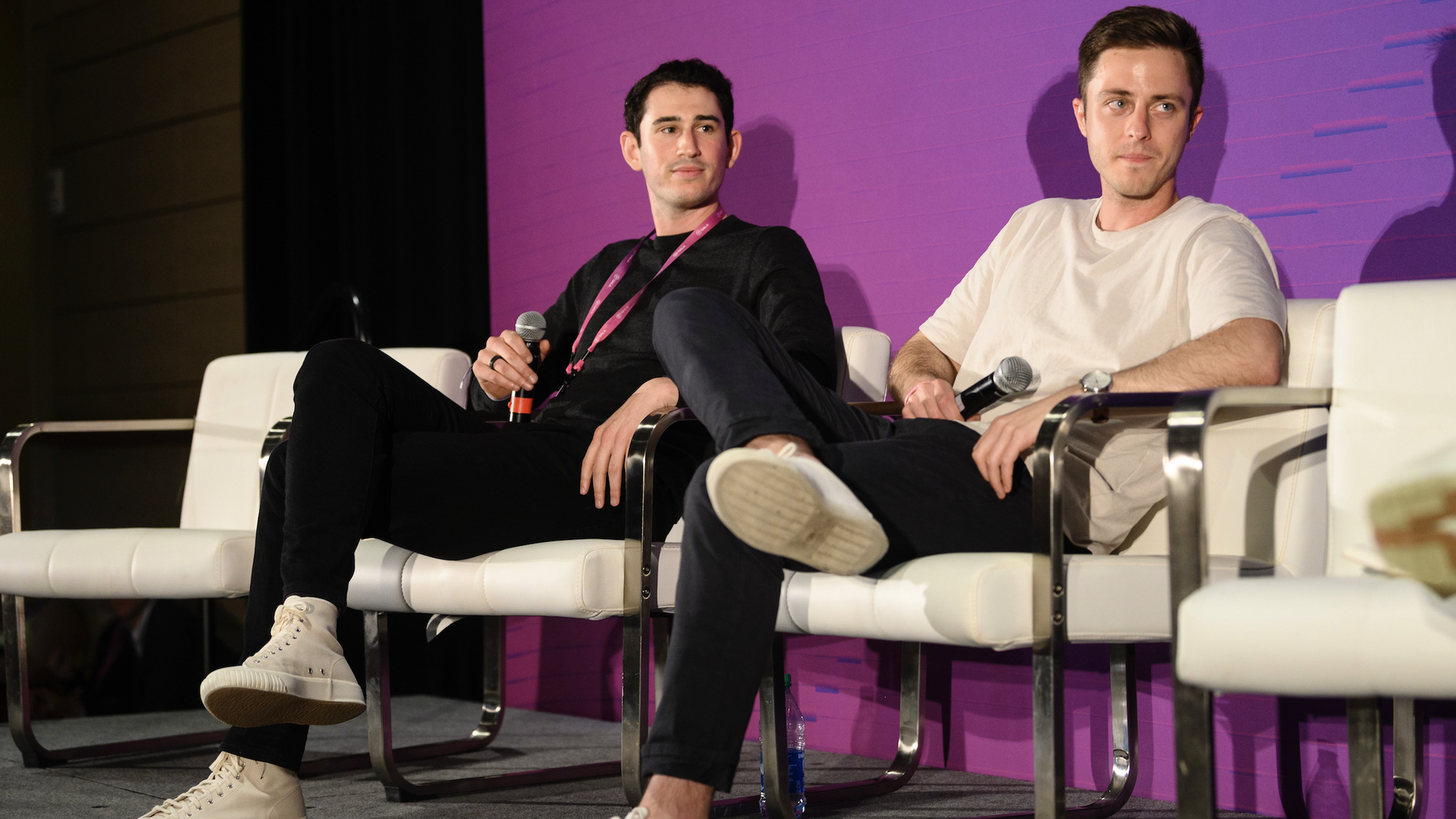
Blockworks co-founders Jason Yanowitz (left) and Michael Ippolito. Photo: Mike Lawrence
Blockworks, a media company that covers cryptocurrency for professionals, has raised $12 million at a $135 million post-money valuation, its co-founder Jason Yanowitz told Axios.
Why it matters: The raise represents a bright spot for crypto media following a brutal year for the industry.
- "There is a ridiculous amount of opportunity to capture market share right now within crypto media because a lot of our competitors are struggling," Yanowitz said.
Details: The round is being led by 10T Holdings, a mid-to-late-stage growth equity fund, with participation from Framework Ventures, a venture capital firm focused on blockchain investments, and Santiago Santos, a crypto investor.
- The money will be used to accelerate the firm's nascent subscription research and data analytics offering, Blockworks Research.
- It will also be used to help the company expand globally. "We are very into Asia, specifically Hong Kong and Singapore," Yanowitz said.
Be smart: The firm, which is based in New York City, has been bootstrapped until this point.
- It raised $100,000 from family and friends at launch, but it's resisted taking on any institutional capital, in part because "we've been profitable since year one."
By the numbers: Yanowitz said the company "significantly exceeded" its revenue goal of $20 million last year, which would represent more than double what it earned the year prior.
- Blockworks currently has around 55 employees, up from 17 in 2021, and it plans to continue hiring with the new capital.
3. MeatEater eyes $100M revenue, makes another acquisition

Photo: MeatEater
MeatEater, the hunting and outdoors brand that went mainstream when its hit TV show debuted on Netflix in 2012, has brought on a new CEO and has closed its fourth commerce acquisition, its founder Steven Rinella told Axios.
By the numbers: In the year ahead, MeatEater is poised to do "on the order of $100 million in revenue," its new CEO Jason Bergsman.
- The company has been profitable every year since 2019, he added. "We expect that to continue to be the case."
- Bergsman was a founding member of The Chernin Group (TCG) and led its $50 million investment in MeatEater four years ago.
Driving the news: MeatEater will announce today its acquisition of Dave Smith Decoys (DSD), a leader in ultra-realistic hunting decoys and gear.
- DSD marks MeatEater's fourth hunting and outdoor gear acquisition in four years.
- The company has grown those companies "substantially," Rinella said, adding that the company has more than "doubled" the size of those businesses since acquiring them.
Between the lines: Most of MeatEater's revenue comes from commerce sales via the brands it acquired, its online store and in-person retail.
- In addition to gear, the company also sells a successful line of cookbooks. To date, the company has sold over 1.5 million copies of MeatEater books.
The big picture: A focus on commerce has shielded MeatEater from the ad market slowdown following the pandemic, although it does still make money from ads sold alongside its podcasts and its videos on YouTube and other free streaming platforms.
- Today, MeatEater has a network of 10 podcasts, including one hosted by Rinella. It also makes money from live events.
- Looking ahead, Bergsman said he's eager to start placing more of MeatEater's content on more video platforms.
What's next: Asked if the company planned to raise more money, Bergsman said that he and Rinella "would anticipate that there will be a need in the future for further capital to continue to execute on our [growth] plan."
4. Scoop: Puck co-founder and CEO exits
Puck News co-founder and CEO Joe Purzycki is leaving the company, according to an internal note sent from co-founder and editor-in-chief Jon Kelly to staff Monday obtained by Axios.
Why it matters: Purzycki exits as Puck looks to finalize a new financing round. Puck raised $7 million in a Series A funding round the year it launched in 2021.
Details: Purzycki, who previously served as the co-founder of the podcast company Luminary, "will remain as an advisor to the company in the coming weeks as we transition," Kelly said in the note.
- Puck is "beginning a search to find a successor, with experience in growth stage companies, to help us achieve our vision," Kelly added.
By the numbers: Kelly told Axios in March that Puck has roughly 240,000 free and paid newsletter subscribers.
- The New Yorker reported in December that Puck has roughly 30,000 paid subscribers.
What's next: Kelly noted that as Puck looks to secure its next round of fundraising, it has "full support of our founding investors, Standard and TPG."
5. Era of big money is over

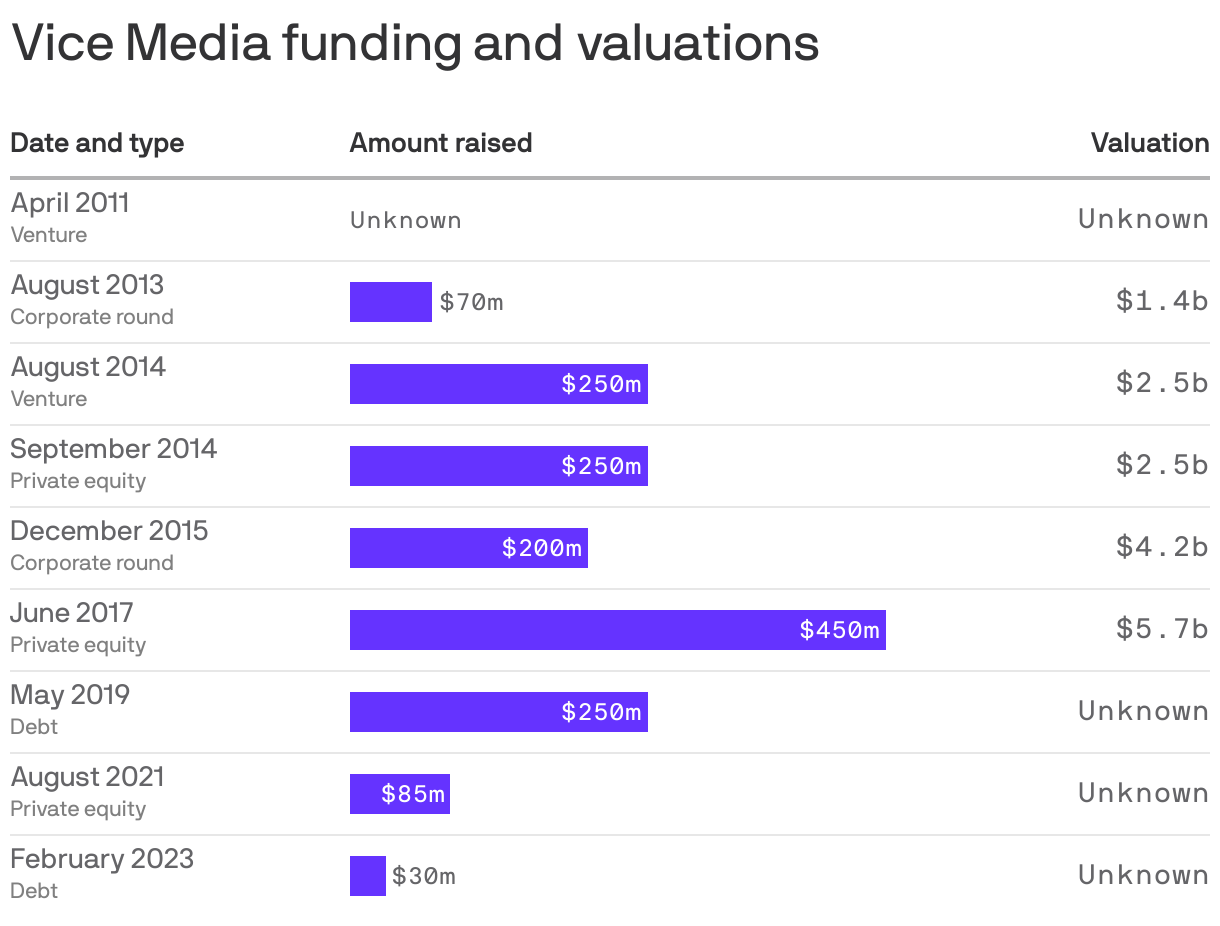
At its peak six years ago, Vice was valued at $5.7 billion. Today, it's looking to possibly self itself out of bankruptcy for $400 million.
Why it matters: Vice, like many digital media upstarts from the aughts and early 2010s, struggled to continue growing at a clip necessary to justify the lofty valuations it received when it raised lots of money.
- Case in point: Vice's 2018 revenues were reportedly between $600 million and $650 million. The Wall Street Journal reported last year that its revenues were $600 million in 2022.
- State of play: As growth slowed, Vice raised nearly $300 million in debt and, along the way, made certain preferential commitments to investors. That debt has become expensive to restructure due to high interest rates in the wake of the pandemic, impacting its sale prospects.
The big picture: Other digital media companies have found themselves in somewhat similar situations.
- BuzzFeed is today valued at less than $100 million on the public market. It raised nearly $500 million in venture capital before going public in 2021.
6. 🥊 Tucker rallies allies in contract battle with Fox
Screenshot: Twitter
Tucker Carlson is preparing to unleash allies to attack Fox News in an effort to bully the network into letting him work for — or start — a right-wing rival, sources close to him tell Axios' Mike Allen.
Why it matters: Tucker vs. Fox could reshape the conservative news world. Fox, which has seen its ratings plunge in Carlson's slot since he was let go 15 days ago, wants to sideline him by paying him $20 million a year not to work.
The intrigue: Axios has learned Carlson is busy plotting a media empire of his own. But he needs Fox to let him out of his contract, which expires in January 2025 — after the presidential election.
- Carlson has been contacted by outlets — including the right-wing Rumble and Newsmax — that offered to pay him more than his Fox contract.
Behind the scenes: Carlson and Elon Musk had a conversation about working together, but didn't discuss specifics, Axios has learned.
- Carlson's confidants say he also is contemplating building a direct-to-consumer media outlet where his millions of fans could pay to watch him. Carlson's predecessor in his Fox slot, Bill O'Reilly, created a blueprint for this.
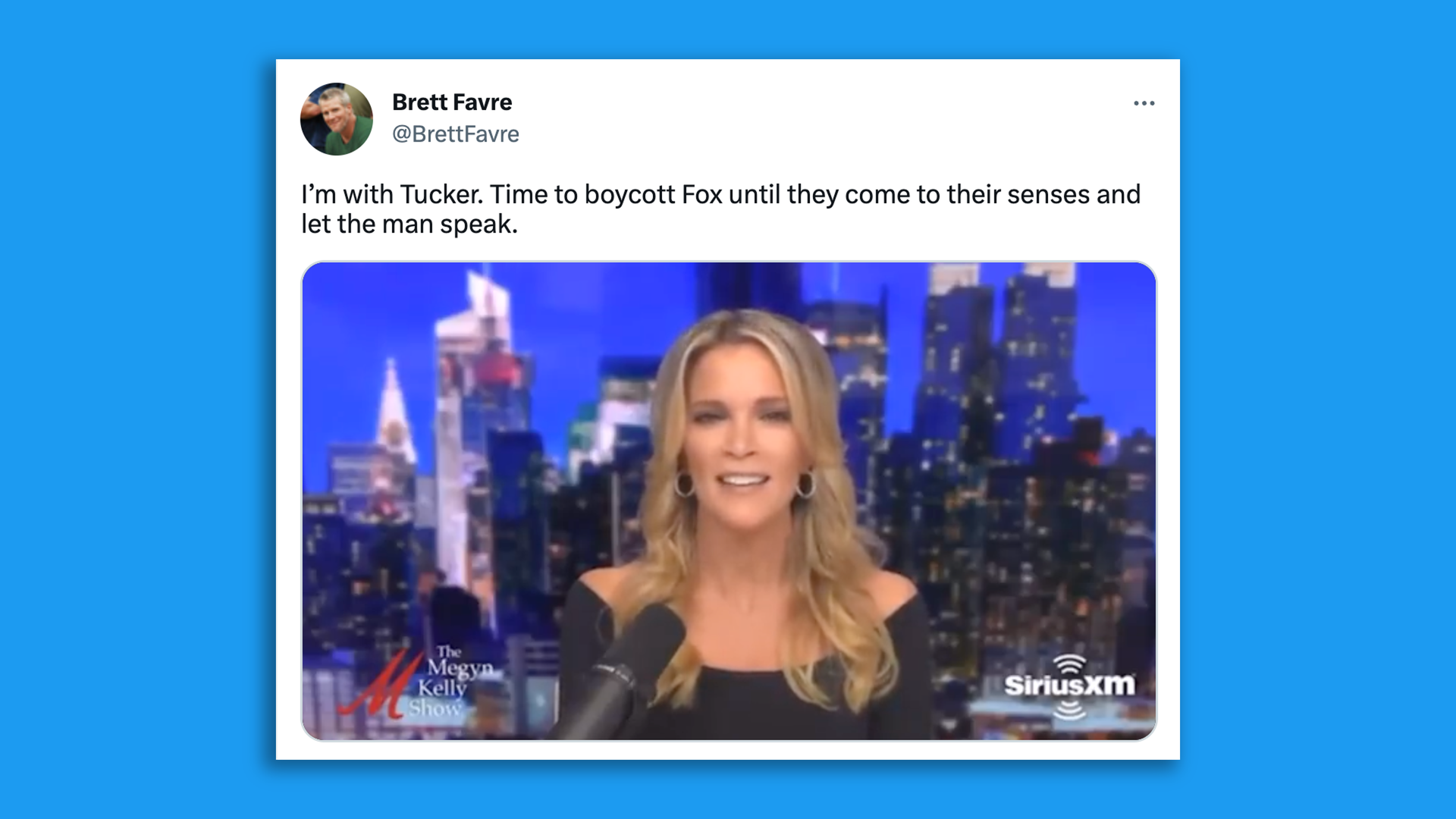
What to watch: Carlson's team is "rolling out a coordinated pressure campaign from a rogues gallery of surrogates including NFL legend Brett Favre, MAGA Rep. Marjorie Taylor Greene, Sen. J.D. Vance, and even former Fox News colleague Megyn Kelly," The Daily Beast reported.
7. 🎥 OnlyFans doesn't plan to go public
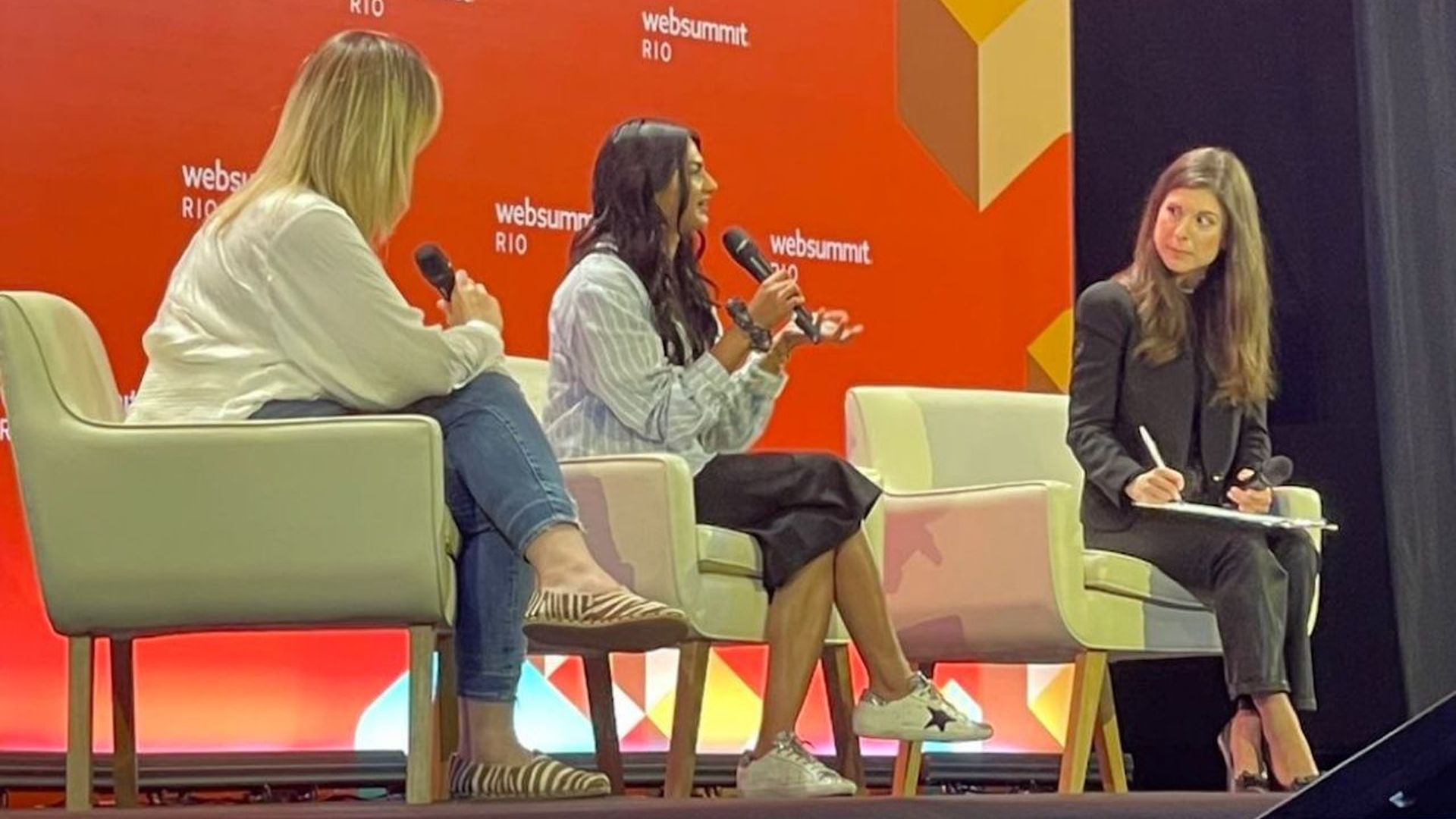
Left to right: OnlyFans CSOO Keily Blair, CEO Amrapali Gan and Sara at Web Summit in Rio de Janeiro last week. Photo: Lucinda Shen/Axios
OnlyFans CEO Ami Gan told me last week in a joint interview with OnlyFans' chief strategy and operations officer Keily Blair that the firm is “very happy as a private company.”
Why it matters: Last year, Axios’ Dan Primack and I reported that OnlyFans was exploring an IPO via a blank check merger.
- "We have a ton of conversations pretty regularly," Gan told Axios on stage last week. She noted that the company plans to stick to its current strategy of focusing on creator monetization and expanding globally.
The bottom line: "For a lot of companies, they need to go public to raise cash," Blair said.
- "We don’t need the cash," she added.
8. 🏅 1 fun thing: Local success story
The 2023 Pulitzer Prize winners were announced Monday, with four of the 16 awards for journalism across 15 categories going to local outlets reporting on corruption among local officials.
- Among them was a father-son duo from Birmingham, Alabama.
- 🗞️ Full list of winners.
Sign up for Axios Media Trends

Sara Fischer’s inside look at the forces reshaping media.