Axios Media Trends

October 13, 2026

Hello! Today's Media Trends, edited by Christine Wang and copy edited by Sheryl Miller, is 2,295 words, an 8½-minute read. Sign up.
🎟️ Media Trends Live is just one week away. Get your tickets here. Kerry Flynn and I will interview:
- Kenan Thompson, actor, comedian, Saturday Night Live; Emma Tucker, editor-in-chief, the Wall Street Journal; Almar Latour, CEO, Dow Jones; Kevin McGurn, CEO, Trump Media & Technology Group; Bob Pittman, chairman and CEO, iHeartMedia; Anna Gomez, commissioner, FCC.
- Plus, Darren Walker, president and CEO, Anonymous Content; Mark Lazarus, CEO, Versant; Lena Waithe, writer, producer and actor; Steven Swartz, president and CEO, Hearst; Peter Micelli, CEO and co-founder, Range Media Partners; Mat Ishbia, president and CEO of United Wholesale Mortgage and owner of the Phoenix Suns and Phoenix Mercury.
1 big thing: 🕯️Hello Sunshine markdown
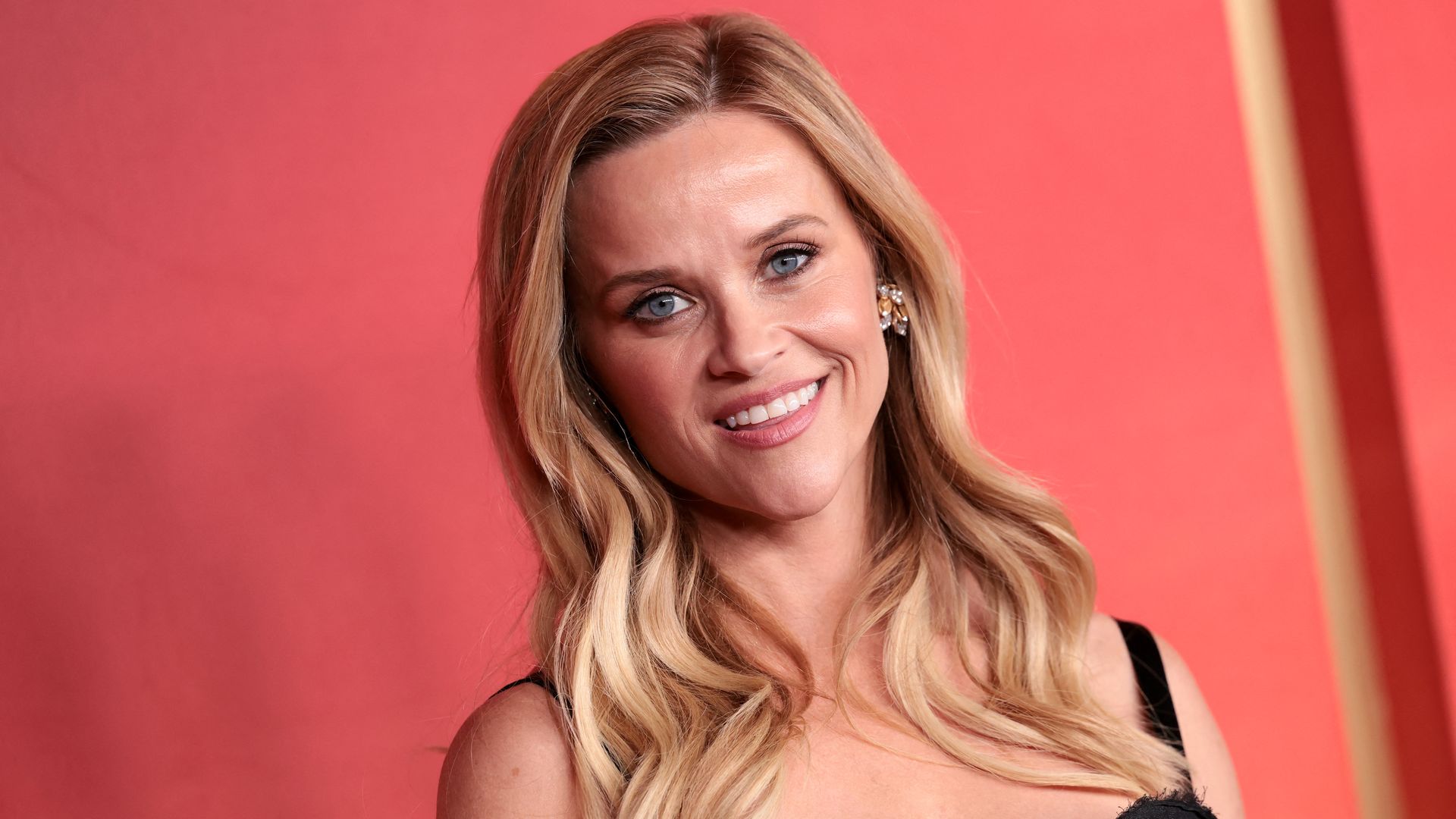
Reese Witherspoon has teamed with Mediawan, a Paris-based independent production company, to buy back her production firm Hello Sunshine for low- to mid-eight figures, sources told Axios.
- Hello Sunshine, Mediawan and Candle Media declined to comment.
Why it matters: The sale price is a fraction of Hello Sunshine's $900 million valuation when Candle Media acquired a controlling stake in the company in 2021.
- It's a notable deal for Witherspoon and Hello Sunshine investors, who are now buying it back at a fraction of that cost.
- It's reminiscent of Dave Portnoy buying back Barstool for $1 after selling it for $551 million.
Zoom out: The sale represents Candle Media's continued shift away from its original plan to build an integrated media company and eventually sell it or take it public. Instead, the company is focusing on operating — and potentially selling — its individual brands.
- In February, Axios reported that Candle sold a majority stake in digital media company ATTN: back to its co-founders, Matthew Segal and Jarrett Moreno.
Zoom in: In a statement, Witherspoon called the deal a "homecoming," noting that Hello Sunshine was originally backed by Peter Chernin and Jesse Jacobs of The Chernin Group. Their production company North Road was recently bought by Mediawan.
- As part of the transaction, Hello Sunshine says it will refocus "on premium film and TV and Reese's Book Club, while expanding into new storytelling formats and distribution models."
- Reese's Book Club, it notes in a statement, reaches 6.2 million readers and drives approximately $900 million in U.S. book sales.
The big picture: Candle Media raised a lot of money at a time when the streaming wars were driving a boom in entertainment production spend. Eventually, that momentum slowed as streaming giants looked to live sports to grow.
- Candle's $2 billion raise from Blackstone saddled the company with debt, which it was forced to pay down with profits from its most lucrative properties, including ATTN: and children's YouTube brand Moonbug.
- Much of its investment went into production firms like Hello Sunshine, a $900 million deal that critics subsequently said overvalued the company.
- Last year, Candle Media CEO Kevin Mayer told Axios he was eyeing individual exits for some of the company's biggest brands, including Hello Sunshine and Moonbug.
2. 📺 Local TV's chokehold

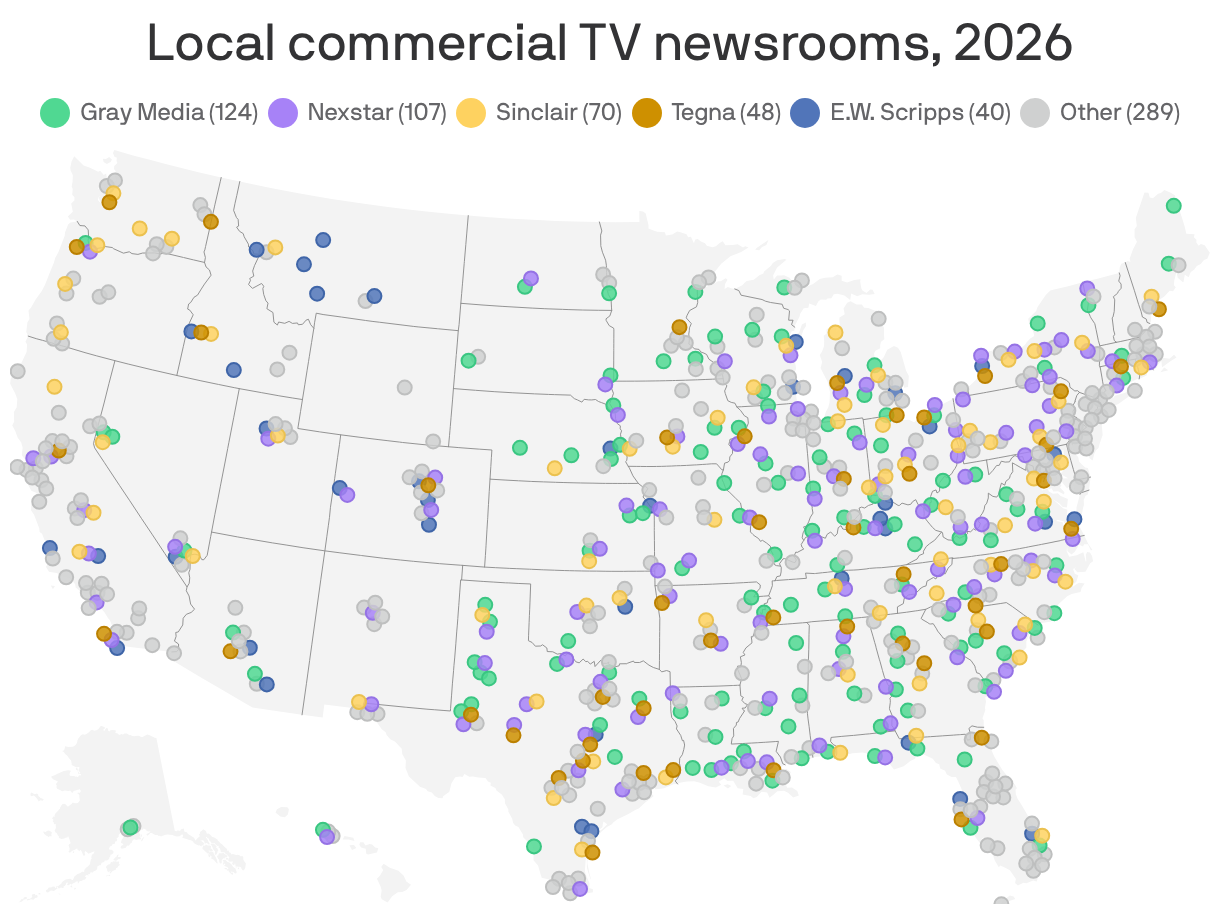
The 10 largest owners control 75% of local commercial TV newsrooms, according to a new report from the Medill School of Journalism at Northwestern University.
- By comparison, the 10 largest newspaper owners control less than a quarter of all local newspapers.
Why it matters: Increased consolidation in local broadcast news could mean fewer journalists covering communities, more duplicated newscasts and fewer choices for viewers, said Tim Franklin, a Medill professor who founded its Local News Initiative.
State of play: The report includes, for the first time, the total number of distinct TV newsrooms nationwide (678), rather than just stations.
- The distinction avoids double-counting stations that share a newsroom and broadcast the same news coverage.
- Researchers at the University of Delaware have previously found content duplication in 39% of U.S. TV markets in 2019.
Between the lines: Given that context, the pace of local TV newsroom closures is notable.
- Medill's report found that at least 10 local TV newsrooms disappeared through mergers so far in 2026.
- If Nexstar's $6.2 billion takeover of Tegna is allowed to proceed, it would combine two of the four largest broadcast owners. The report notes that 33 of Tegna's 48 newsrooms overlap geographically with Nexstar operations, creating opportunities for further consolidation.
Zoom out: The FCC's decision to waive the broadcast ownership cap, combined with increased economic pressure, could drive a new wave of consolidation that will further shrink the number of local TV newsrooms, the report's co-author Zach Metzger noted.
- "This is an election year, which helps mitigate some of the other revenue losses. But things are getting tight financially in the local TV news business, and that's contributing mightily to consolidation in the industry," said Franklin.
The big picture: The Medill study has for years tracked the rapid closure of local newspapers in America. Each year, the rate of closures gets worse.
- In the past year, 170 local newspapers closed or merged, nearly three per week. That's up from 148 in the previous year's report, which amounts to a roughly 15% increase in the pace of losses.
- About 425 newspapers changed hands, per the report, a signal of how volatile the industry has become as it faces increased revenue pressure from rising print costs. Newsprint costs are up around 18% nationally, per the researchers, about five times the rate of inflation.
Reality check: The report notes that newspaper closures are increasingly hitting small, independent owners, not the giant chains that drove earlier waves of consolidation.
- Less than 10% of closures in the past year came from the 10 largest newspaper companies. Meanwhile, more than 40% came from midsize private chains and roughly one-third came from smaller independent owners.
What to watch: While there are efforts to fill the local news void with digital upstarts, most of those new newsrooms target cities, not rural communities hit hardest by closures.
The bottom line: "We're seeing the economic disruption that hit newspapers a decade and a half ago now hitting local television in a big way," Franklin said.
3. 🎥 Newsmax won't air livestreamed public execution

Newsmax and TikTok say they wouldn't allow livestreams or clips of a possible public execution by firing squad that the Defense Department says it plans to livestream, when asked by Axios.
- No other major platform or TV network would comment on their plans.
Why it matters: It's still unclear whether the early December event will actually be livestreamed, but if it does, it will test whether America's biggest media and tech companies are willing to enforce their content moderation policies against the U.S. government.
Context: The last time these companies were put in this type of position was when multiple platforms removed or restricted a video posted by President Trump to his supporters on Jan. 6.
State of play: Representatives from Meta and YouTube declined to comment on whether they would allow video of the firing squad execution of the convicted Fort Hood shooter to be livestreamed or distributed as clips.
- A representative from Snap also did not comment on whether the company would allow the clips on its platform. It doesn't have a livestream feature.
- A TikTok spokesperson said the video would not be allowed, as it would violate its content policies.
Between the lines: Some firms explicitly bar this type of content but allow exceptions for content that is considered newsworthy or in the public interest.
- Meta, for example, explicitly states in its policies that it does not allow users to post "live-streams of capital punishments," but it has made exceptions to its broader policies for newsworthy events.
Zoom out: News networks, which already face pressure to carry broadcasts from the administration, are mostly choosing not to comment for now, except Newsmax.
- "Newsmax will not air the livestream. We will not show the actual execution on air. We will review what clips we may show, but at no time will they be graphic. Newsmax disagrees with the Pentagon's plan to livestream the execution," the company said in a statement provided to Axios.
- CBS News and NBC News declined to comment. Fox News and ABC News did not respond to a request for comment. CNN said it will have guidance closer to the event if it goes ahead but has nothing to share at this point.
- The FCC chair Brendan Carr said he would defer to the Pentagon on whether broadcasters could air the execution.
The intrigue: None of the major conservative networks or platforms commented or responded to requests for comment on whether they plan to take the event live, including Rumble, Truth Social, Real America's Voice or OAN.
- The White House did not respond to a request for comment on whether Trump TV would air the event.
The big picture: It's possible the livestream doesn't happen at all, in which case, networks may not want to prematurely comment on their plans.
4. ⚠️ Gamifying tragedy hits a red line
The planned livestream execution of the Fort Hood shooter has triggered bipartisan concerns over whether the video would amplify the military firing squad execution as entertainment.
Why it matters: In an attention economy that rewards shock and extremes, everything has become a reality show. Injury-related prop bets have become the norm in online sports gambling. True crime has turned real-world investigations into public spectacles.
- The livestreamed public execution appears to be a red line.
State of play: A handful of Republican and Democratic lawmakers have spoken out against the move. Newsmax, as previously mentioned, says it disagrees with the Pentagon's plan.
- Even President Trump has privately shared misgivings about livestreaming it, Axios' Marc Caputo reported. Vice President JD Vance has said he would not watch the execution.
Zoom out: Tragedy and struggle have long inspired entertainment, but new platforms make it easier to exploit current events for financial gain or entertainment, rather than cast a critical or artistic eye on the past.
- Earlier this year, a ForbesPredict box asked readers to predict whether or not Congress would pass new gun safety laws this year after Forbes published a story about a Louisiana man killing eight children. (A spokesperson later said that market was removed for not meeting its standards.)
- There has been continued scrutiny over prediction market traders profiting off war, conflict and tragedy, including betting on developments in the Iran war, Nicolás Maduro's capture or Nancy Guthrie's kidnapping.
Reality check: Livestreaming reflects a shift toward putting raw, real-world violence on display for unlimited audiences, Axios' Neal Rothschild and Herb Scribner note.
- While AI is making it easier for tech firms to catch gruesome content, the real-time nature of live videos can still be hard to manage.
- Earlier this year, a moderator error enabled a gruesome video of celebrity blogger Perez Hilton harming himself to remain on the platform long enough to be captured and shared.
5. 🏛️ DOJ probe raises fears of a press dragnet

Legal experts and press freedom advocates believe the Justice Department's White House television press pool probe could be a pretext for seeking additional records from reporters.
Why it matters: Antitrust lawyers argue the DOJ's legal case against the networks is thin.
State of play: The Justice Department is investigating whether members of the pool violated antitrust laws by opting not to air pool coverage in solidarity with outlets the White House banned, the DOJ confirmed to Axios.
- CNN, MS NOW and Politico sued the White House last month on First Amendment and Fifth Amendment grounds after the administration revoked press pass access.
- The broader White House press pool, which consists of outlets that cover the president and travel with him on rotation, has stood in solidarity with the barred outlets.
- Axios is among dozens of media organizations that have joined amicus briefs urging a federal court to prohibit the Trump administration from excluding CNN, MS NOW and Politico from the White House because of their news coverage.
What they're saying: "It doesn't seem to have much investigatorial or prosecutorial merit," Shan Wu, an attorney and former federal prosecutor, told Axios.
- Bill Baer, who served as the DOJ's antitrust chief under President Obama, told the Washington Post, "It looks like total retaliation."
Between the lines: Press freedom experts argue the lawsuit is a pretext for seeking records from the networks about how they covered the White House during the media ban.
Zoom out: The allegations of pretext come amid broader concerns about the Justice Department in Trump's second term, like seeking journalists' records, compelling reporters to testify before a grand jury and defending the White House's restrictions on press access in court.
- "Given that deep history, it's certainly possible this is something with a different agenda potentially," Wu said.
Disclosure: Sara Fischer is a paid contributor for CNN.
6. 🤖 Character.ai's bankruptcy exposes AI's brutal economics
Character.ai, the buzzy personalized AI chatbot developer, filed for Chapter 11 bankruptcy protection yesterday, after struggling to turn user adoption into a meaningful business.
Why it matters: The company, which was valued at over $1 billion in 2023 after raising $150 million, was losing money. Legal and regulatory exposure made it difficult to find a buyer.
- The company settled multiple lawsuits earlier this year brought by families of teens who harmed themselves or died by suicide after interacting with Character.ai's chatbot online.
- It also faced legal pressure from Disney over copyright infringement.
State of play: Disney has emerged as the stalking-horse bidder for Character.ai's assets.
- The company, which hired Character.ai's former CEO as its new technology chief last month, has offered $20 million for a nonexclusive license to certain Character.ai intellectual property.
What's next: Character.ai will solicit other bids ahead of a planned sale by early December. If it doesn't find a buyer before then, it could shutter entirely.
Elsewhere in bankruptcy land... Koch Equity Development has agreed to acquire Getty Images via a prepackaged bankruptcy, in partnership with the company's founding family, per Axios' Dan Primack.
- Getty is the king of newswire photography, but its stock image business has been undercut by AI-generated images.
Sign up for Axios Media Trends