Axios Media Trends

May 06, 2025

Good afternoon. Today's Media Trends is 2,301 words, a 9-minute read. Sign up.
Situational awareness: The name of Comcast's new spinoff company is Versant.
1 big thing: 🦊 Exclusive ... Major Fox haul

Fox News Media is projecting half a billion dollars in revenue this fiscal year for its non-cable TV businesses, executive vice president of ad sales Trey Gargano told Axios in a rare interview about the company's financials.
Why it matters: Fox has been insulated from some of the viewership challenges plaguing its competitors in the streaming era, but its efforts to diversify away from cable will make its brand even less vulnerable to cord-cutting long term.
- "We see on digital that our audience is an average of 30%-50% younger than those watching linear television in general," Gargano said.
The projection includes revenue from all of its products outside of linear television, including podcasts, books, streaming and digital channels.
- Gargano noted these businesses have collectively seen double-digit growth every year since 2020.
Zoom in: Fox News Media's push to diversify started in 2018 when its newly named CEO Suzanne Scott began to introduce new digital lifestyle products across platforms. Many of those products focused on digital video and streaming, specifically.
- In 2018, the company launched Fox Nation, a subscription streaming service focused mostly on lifestyle and entertainment content. CEO Lachlan Murdoch recently said the service has 2 million to 2.5 million subscribers.
- On Tuesday, Fox Nation announced its first-ever streaming bundle with SiriusXM, a testament to the appeal of its audience to other subscription media companies.
- It introduced Fox News International, a live streaming service for its Fox News and Fox Business linear networks for overseas users in 2020, and Fox Weather, an ad-supported streaming service, in 2021.
- In 2020, it debuted its imprint, Fox News Books, which has sold over 3 million copies across 14 titles, mostly authored by Fox talent.
Zoom out: While Fox News' subscription streaming and book businesses present significant growth opportunities, Gargano said the majority of its digital business revenues are coming from advertising.
- The growth of premium video on its website, combined with Fox Weather's ad-supported platform, have created opportunities for Fox News to begin selling connected TV ads to marketers looking to extend their campaigns beyond linear television, Gargano said.
The big picture: Every cable news company is scrambling to diversify its business away from linear television, but few are as far along as Fox News Media.
- CNN, under its new CEO Mark Thompson, plans to introduce a new cross-platform streaming service this year as part of a broader effort to introduce more subscription and lifestyle products.
- MSNBC has launched ticketed events for hyper-fans around the country, but it hasn't yet launched its own standalone streaming service.
- CNBC debuted a standalone streaming service, CNBC+, earlier this year.
2. 🇬🇧 Scoop: The Guardian's $65M U.S. biz

The Guardian is hiring to support its U.S. expansion after increasing its overall revenue year over year by 25%, a source familiar with its plans told Axios.
Why it matters: U.K. publications are scrambling to tap into America's lucrative subscription and advertising markets, but The Guardian has found unprecedented success from reader donations.
By the numbers: The Guardian US is expected to report in coming months that it earned $65 million in revenue last fiscal year, according to a source familiar with its finances.
- 💸 It's also expected to report that revenue from reader contributions made up around 68% of its total U.S. business last year, or around $44 million — a new record.
- 📣 The rest of its U.S. business last year included around $20 million in advertising and $2 million in philanthropic funding, the source said.
State of play: The Guardian's editor-in-chief, Katharine Viner, told staffers last week that the U.S. expansion plan focuses on building the outlet's presence in Washington, D.C., according to a Guardian staffer.
- 🎙️ In addition to hiring new political journalists, it plans to launch its first-ever U.S. daily news podcast from its New York headquarters.
- 🔬 It will add a media reporter and its first-ever science reporter to chronicle shifts in the news landscape and science industry, respectively, under the Trump administration.
- ⚽ The Guardian also plans to expand its soccer coverage significantly ahead of the 2026 World Cup hosted by the U.S., Canada and Mexico.
🇬🇧 The big picture: The Guardian joins a long list of U.K.-based publications expanding in the U.S., including Reach, The Financial Times, Hello! magazine, The Sun, The Spectator and The Daily Mail.
3. 🎞️ Hollywood's hell scenario

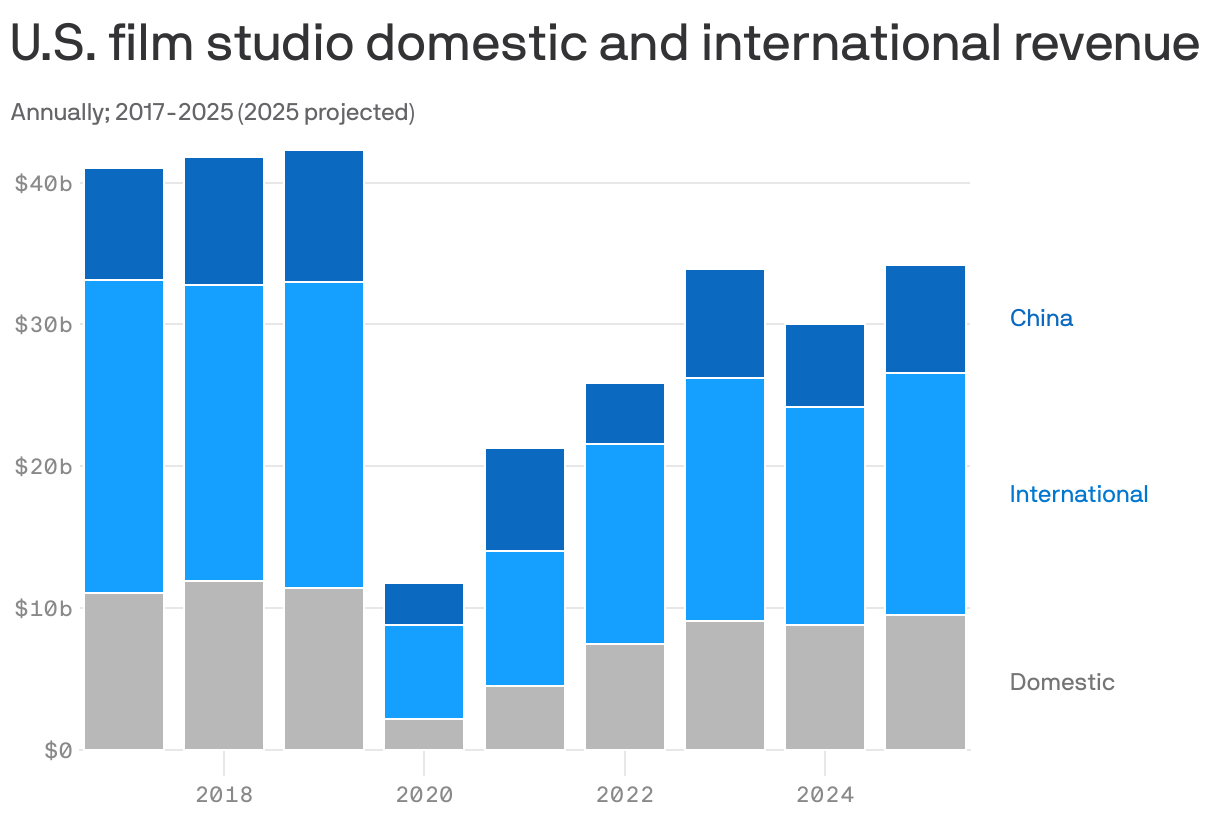
President Trump's threat to impose tariffs on film imports to the U.S. could risk retaliatory actions in international markets, where American film studios make the bulk of their box office revenue.
📉 Why it matters: Studios are already reeling from a weakened box office following the pandemic. Tariffs could send the industry into a tailspin.
How it works: The U.S. is the top exporter of films globally by far, with export value running at three times imports, according to the Motion Picture Association.
- 🇺🇸 U.S. movie studios typically drive the bulk of global box office sales. The majority of their revenue tends to come from distribution outside of the U.S., which is why any sort of retaliatory tariffs on U.S. film exports would be disastrous for Hollywood.
- 🌍 For example, the top-grossing movie globally last year, "Inside Out 2," was produced by Disney, but the bulk (61.6%) of its $1.7 billion in box office revenue was made abroad.
State of play: Most major studios and even some analysts are withholding commentary until the Trump administration offers more details about how a tariff on intellectual property would work.
- 🎟️ A tariff on production costs abroad would create a much different calculus for a studio to consider, versus a tariff on box office sales.
- 🎬 The definition of production is also puzzling. Many Hollywood hits are partially shot, edited or directed overseas. Some are shot in the U.S. but rely on cheaper labor abroad for some editing, set design or costume manufacturing.
- 📺 The ambiguity also has implications for global streamers, like Netflix, that distribute local content from foreign countries to subscribers in the U.S.
- 🧊 Some analysts have warned that studios may freeze overseas production, weakening the overall box office, until they have answers.
Zoom out: Outside of the U.S., most movies are filmed in places like the U.K., Canada and European countries that offer sizable tax incentives.
- California Gov. Gavin Newsom has pushed to double the state's film and TV tax credit to lure production back.
- Others, such as actor Jon Voight, have pitched the Trump administration on a federal tax credit to keep production in the U.S.
Of note: The Trump announcement came shortly after he met with Voight to discuss a plan to boost U.S. entertainment jobs over the weekend, per Bloomberg.
4. Public media battles for survival
President Trump signed an executive order last week that's designed to cut over $500 million in annual funding to NPR and PBS.
Why it matters: While local stations are already starting to prepare for the worst, don't expect the two public broadcasters to go down without a fight.
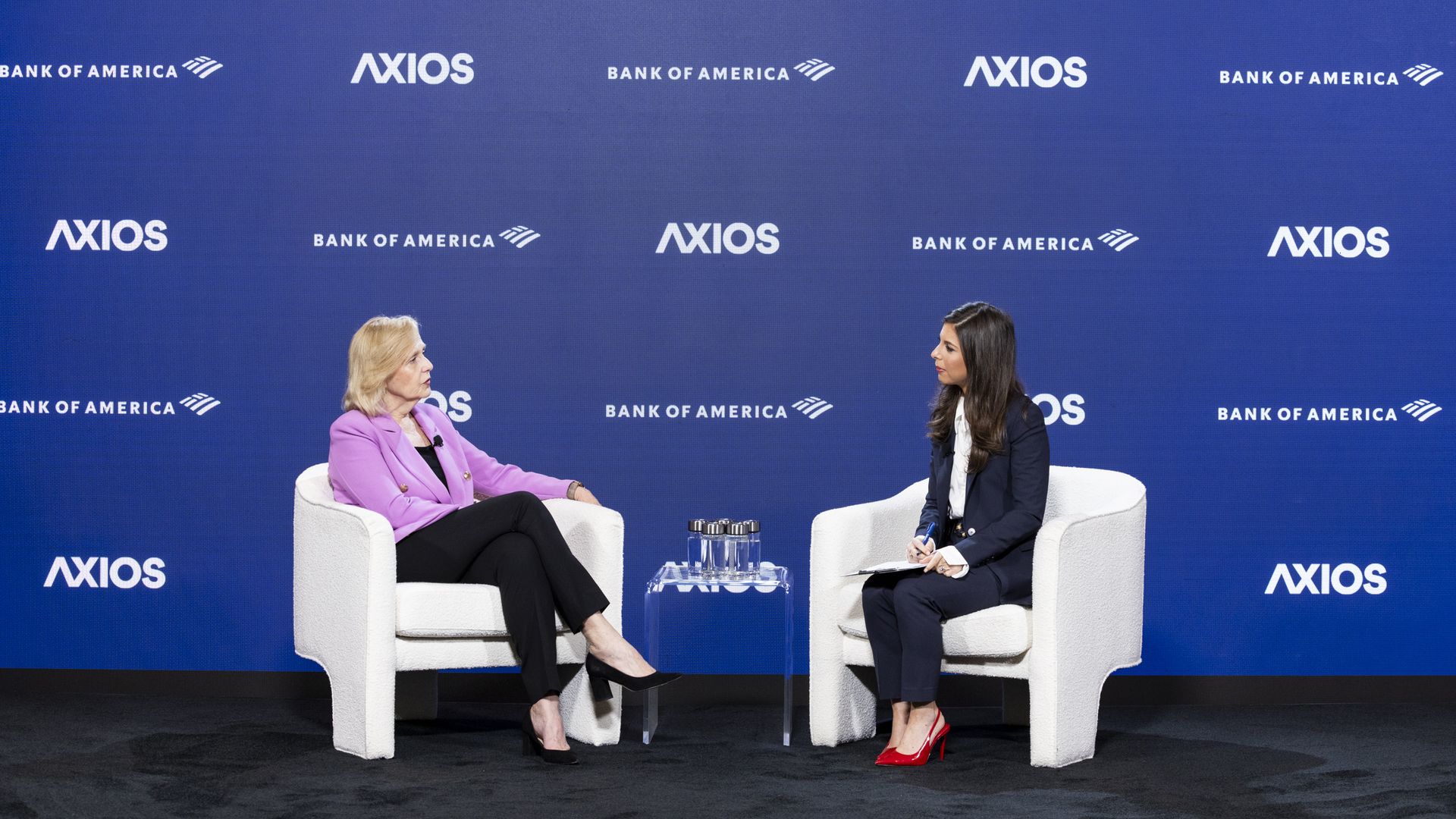
- In an interview with me last week, PBS CEO Paula Kerger said she was prepared to "vigorously" defend the independent broadcaster's board when asked if she would sue the Trump administration if it tried to fire any of PBS' board directors.
📰 Between the lines: Kerger highlighted that PBS differs from NPR in that only 10% of its programming is news-focused.
- 🖍️ Around eight hours of PBS programming per day is dedicated to kids.
State of play: The order, which calls public broadcasters in the U.S. "biased," directs the Corporation for Public Broadcasting to "cease direct funding."
- On Tuesday, CPB sued Trump and several administration officials for attempting to fire three members of its board. A federal judge granted it an emergency injunction hours later.
The big picture: The Trump administration's attempt to gut funding to PBS and NPR follows a slew of efforts to target the press that have been taken to court.
- ⚖️ In some cases, like with the Associated Press, judges have sided with news outlets. In others, conflicting verdicts put journalists in limbo.
What we're watching: A district judge ruled in favor of Voice of America a month ago in its lawsuit against the Trump administration, saying it could not unilaterally dismantle the government-funded broadcaster by systematically firing its staff.
- 💼 But over the weekend, just as VOA workers were preparing to go back to work, an appeals court said that the district judge didn't have the authority to block provisions of Trump's executive order to dismantle the agency.
Reality check: Amid the legal chaos, VOA and other government-funded broadcasters have struggled to survive. Radio Free Asia last week said it would lay off most of its staff amid a funding fight with the administration.
5. ⚾ Exclusive: Sports data dump


Over the weekend, we published our fourth exclusive report for Axios Media Trends Executive members about the U.S. sports media rights landscape.
Key takeaways:
- 🏈 American sports franchises have become one of the most valuable asset classes in the world. U.S. TV and streaming sports media rights are projected to total nearly $30 billion in 2025, representing a roughly 100% increase over the past decade.
- ⚾ Major League Baseball's media rights overhaul following its breakup with ESPN and the chaotic bankruptcy of Diamond Sports Group (now known as Main Street Sports Group), could set the stage for the league to finally start nationalizing its local sports rights.
- 🇺🇸 Local rights are going national. It's not just the MLB. The NBA is also trying to understand ways streaming could help nationalize local rights.


- 📍 Local team streaming surge: More local networks and teams are launching their own direct-to-consumer streaming services to hedge against the fallout of RSNs on cable.
- 🏎️ UFC, Formula One and the NFL Draft are among the major sports media rights deals currently being negotiated. UFC is likely to split its rights for its next deal, sources told Axios, after its seven-year exclusive with ESPN ends this year. Sources tell Axios the NFL will likely add a digital partner for NFL Draft rights.
- ⛹️♀️ U.S. women's sports rights have exploded in value. WNBA, NWSL, and NCAA women's media rights increased by 300%, 3,900%, and 900%, respectively, between their previous and current contracts.
Become a member to get access to the full report, data, and all of our executive briefings.
6. 🌪️ Ad giants play it cool amid economic chaos
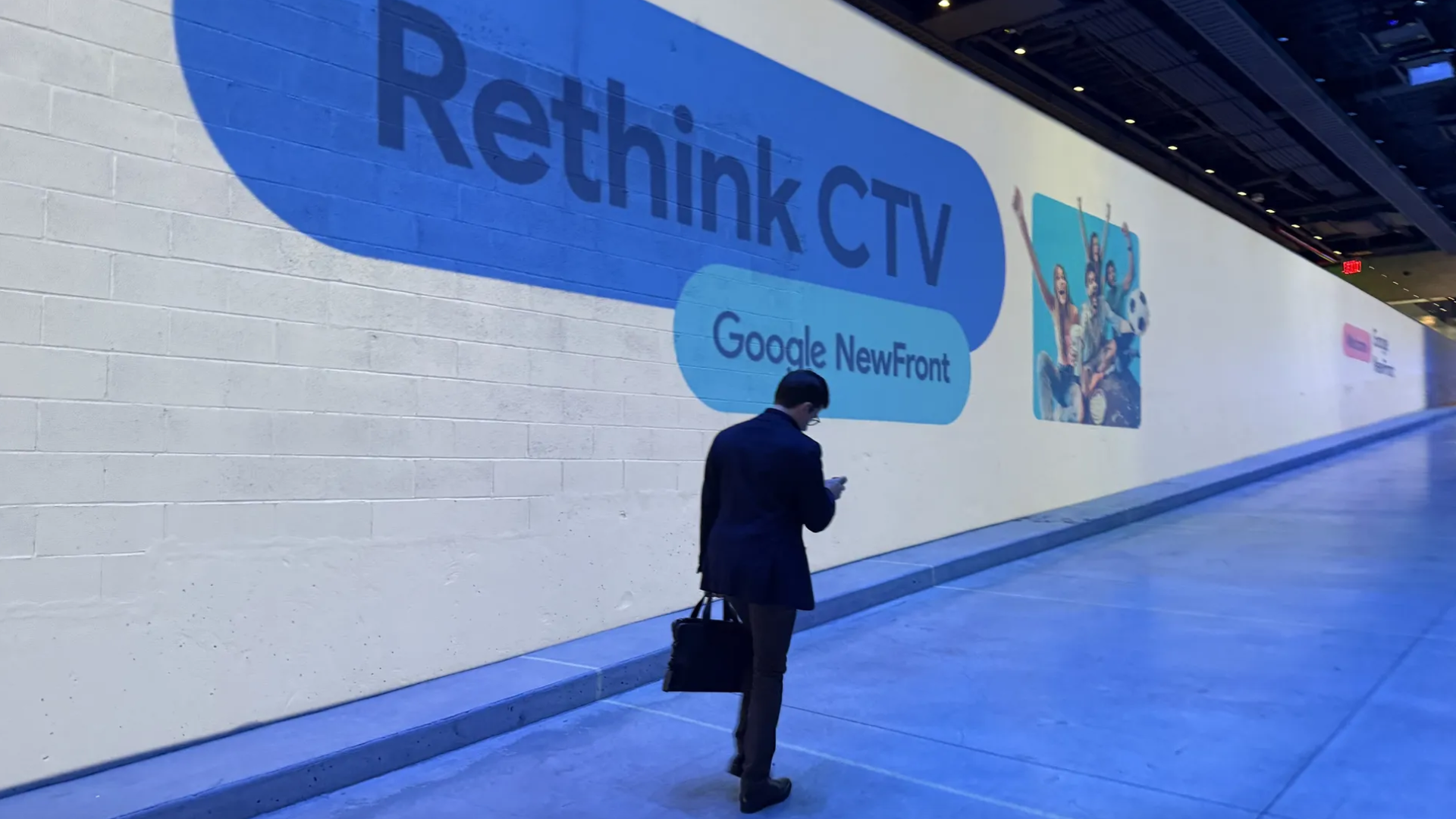
Despite serious economic and regulatory headwinds, the digital ad industry is pitching its strengths to Madison Avenue this week as if everything is on track.
Why it matters: President Trump's economic policies present a significant threat to ad spend, causing analysts to reduce their forecasts and companies to withhold guidance, Axios' Kerry Flynn writes.
Driving the news: Google's hour-long presentation yesterday did not mention losing a federal antitrust case on online advertising, which sought to force Google to sell off part of its "network" ad business.
- Instead, Google repeatedly touted its dominance with its overall network and YouTube.
- Meanwhile, yesterday the Justice Department argued Google should sell two of its ad businesses.
The big picture: David Cohen, CEO of the Interactive Advertising Bureau which hosts the annual NewFronts event, kicked off this week's showcase with a reminder that change can benefit the industry.
- The digital ad spending sector grew 35% during the pandemic, from 2020 to 2021, he noted.
Zoom in: Ad giants still believe in the power of the NewFronts despite how crowded the week has become.
- Snap chief business officer Ajit Mohan, who is presenting on Wednesday, told Axios that he views this NewFronts as a good time to be a challenger company and noted Snap's unique audience and improved ad platform.
- T-Mobile is also returning to NewFronts after hosting its first presentation last year as it invests more in ad tech with its acquisition of Vistar Media and Blis even as its telecom competitors retrench.
- Vizio on Monday said it is making its ad inventory available on the demand-side platform of its new parent company, Walmart, to select advertisers.
- LG announced more interactive ad formats, in partnership with BrightLine, and shoppable ad units with QR scans.
What's next: Other presenters this week include TikTok and Meta.
- Next week, legacy networks and streaming giants including NBC, Fox, Disney, Amazon, Netflix and YouTube will host their own events.
7. 📉 U.S. record low

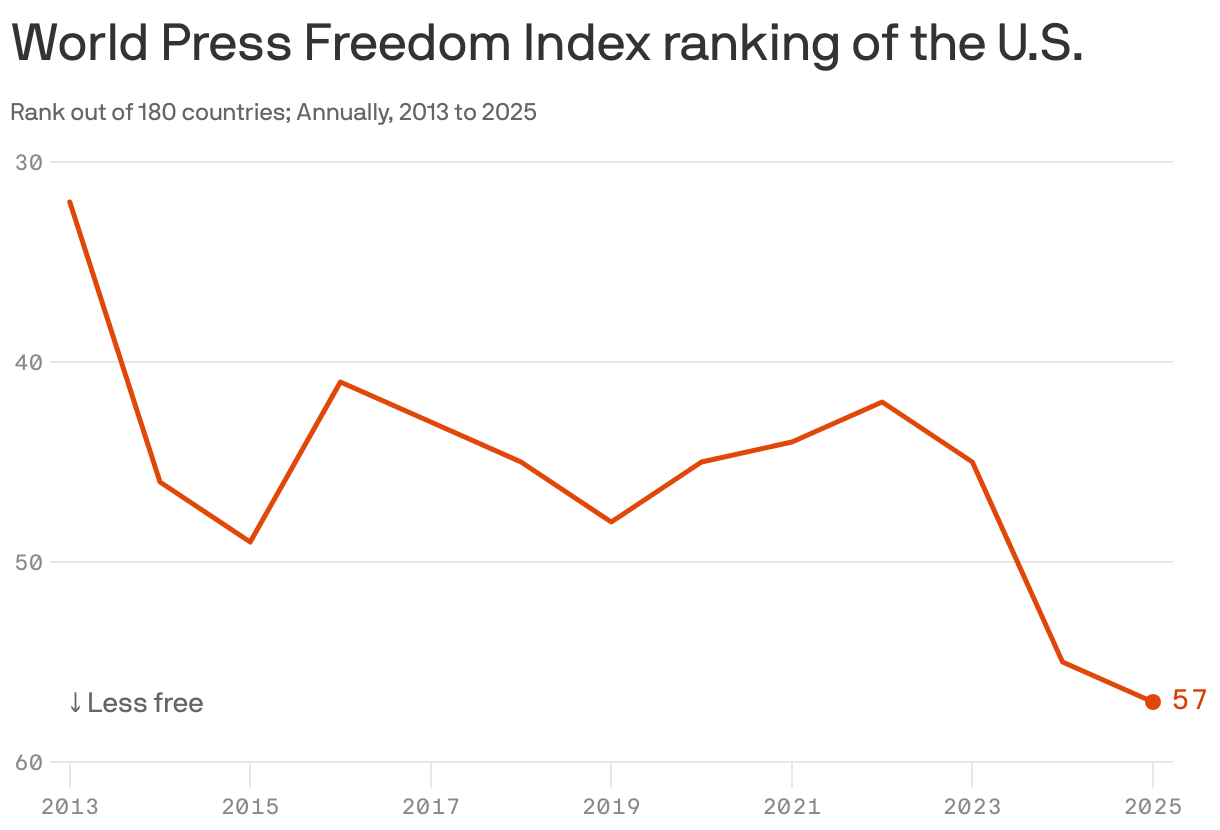
Press freedom in the United States has hit a record low, according to the latest World Press Freedom Index published annually by Reporters Without Borders.
Why it matters: For years, American press freedom was generally considered "satisfactory" by Reporters Without Borders' standards. As of last year, it's "problematic."
- Press freedom in the U.S. now falls in line with developing countries, such as Gambia, Uruguay and Sierra Leone.
Zoom out: While physical threats against journalists are often a clear sign of eroding press freedoms, Reporters Without Borders cites economic strains on the media as the biggest driver of declines globally.
The big picture: More than half of the world's population now lives in countries where press freedom is entirely absent and practicing journalism is considered dangerous, according to the index.
8. 1 🎮 thing: Gaming coverage gutted

Vox Media on Thursday announced it is selling its gaming and entertainment site Polygon to Canadian media company Valnet, which owns pop culture and entertainment sites, such as Collider and Screen Rant.
- That same day, gaming site Giant Bomb said it would undergo a reset following a programming pause and a public spat over editorial direction with its parent Fandom.
The big picture: Gaming journalism has proved challenging for general news publishers to monetize and integrate within their portfolios.
- The Washington Post shuttered its gaming vertical, Launcher, in 2023.
- Vice Media ended WayPoint, its gaming publication, that same year.
- GameStop shut down Game Informer in 2024, although it was recently relaunched by game developer Gunzilla.
What we're watching: The Vox divestiture is part of a broader effort to streamline its portfolio and invest in its biggest brands and businesses, such as New York Magazine, The Verge and its podcast network.
Sign up for Axios Media Trends