Axios Media Trends

September 18, 2018

1 big thing: Big Tech's Hollywood splash
Illustration: Axios visuals
2. EU crackdown misses big tech targets

Illustration: Lazaro Gamio/Axios
3. The new philanthropy for West Coast billionaires
4. Video measurement is still a total mess

Illustration: Sarah Grillo/Axios
5. Reality check on digital video
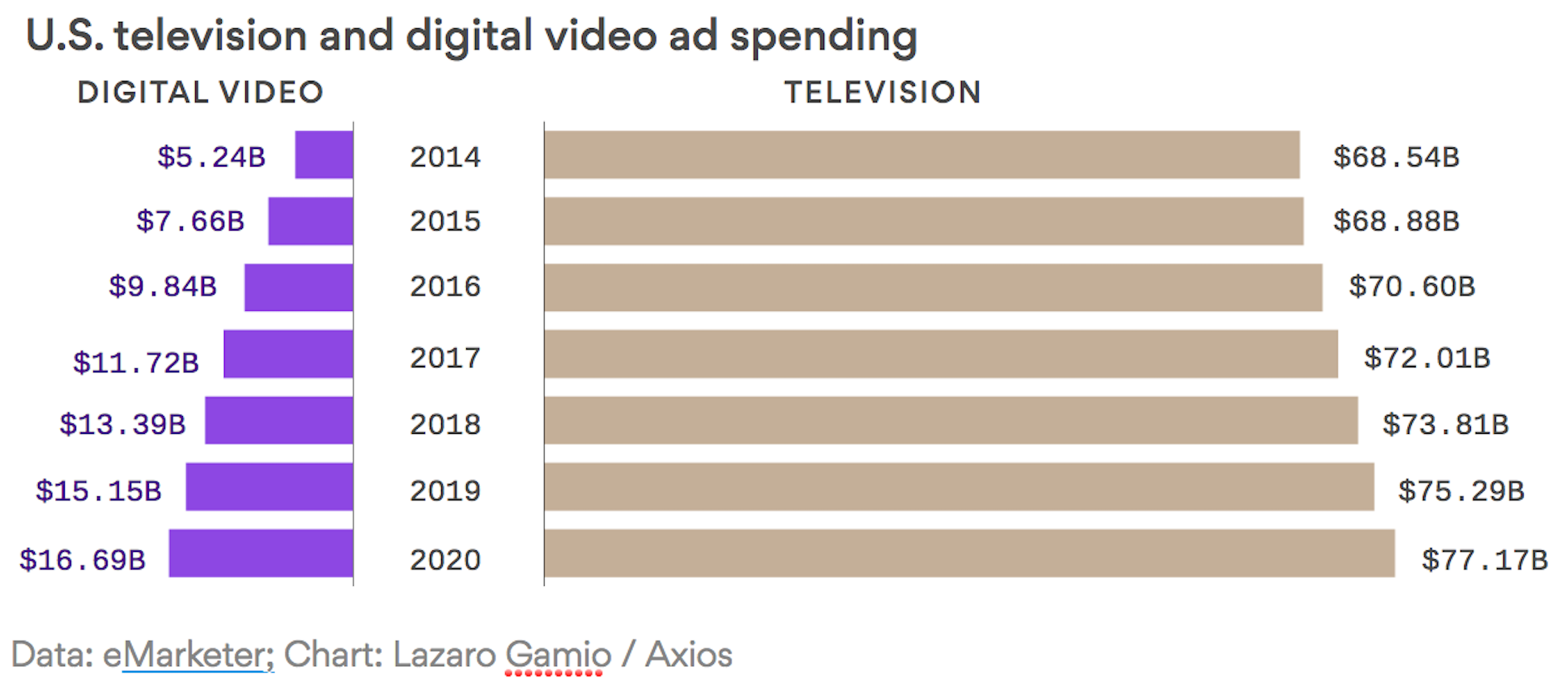
Inflated digital video metrics would leave you to believe that most people spend all their time on their phones consuming viral videos and that television is dead.
But while TV companies are struggling and more people are watching less TV, it's still the most dominant medium for watching video in terms of time spent for the average American, and it still dominates ad spend over digital video.


6. Exclusive: Google says ads.txt adoption reaching "critical mass"
7. Changes coming to the podcast biz


The podcast business is exploding, but not all companies are finding success in creating podcast content.
- Last week Nick Quah, who writes the Hot Pod podcasting newsletter, broke that podcast network Panoply (a sister company to Slate Media) is exiting the podcast content business to focus on podcast hosting and ad-serving.
- In August, Nieman Lab reported that the entire group responsible for Amazon Audible’s shorter-form podcast-style programming was being eliminated.
At the same time, iHeartMedia is looking to cement its lead in commercial podcast publishing by acquiring of Stuff Media, one of the largest U.S. podcasting companies, for a deal valued at roughly $55 million, sources tell WSJ.
- Quah also reports that Slate Group chairman Jacob Weisberg is leaving to launch a new podcast company with author Malcolm Gladwell.
The bottom line: Podcasting is a small business, but ad revenue grew by 94% between the end of 2016 to the end of 2017.
- But creating a hit podcast isn't easy, especially as the field becomes more crowded. According to Edison Research, a leader in podcast data, the share of time spent listening to podcasts amongst all audio has doubled amongst U.S. consumers in the past four years.
Go deeper: Nieman Lab's Joshua Benton has a good roundup on the latest podcast news.
8. 1 fun thing: What happens when you turn off Facebook
Axios Media Trends

Sara Fischer’s inside look at the forces reshaping media.