Axios Markets

December 15, 2023
Happy Friday ... ICYMI: Mortgage rates dipped below 7% this week. Today's newsletter is 1,145 words, a 4.5-minute read.
1 big thing: Starbucks softens its union stance
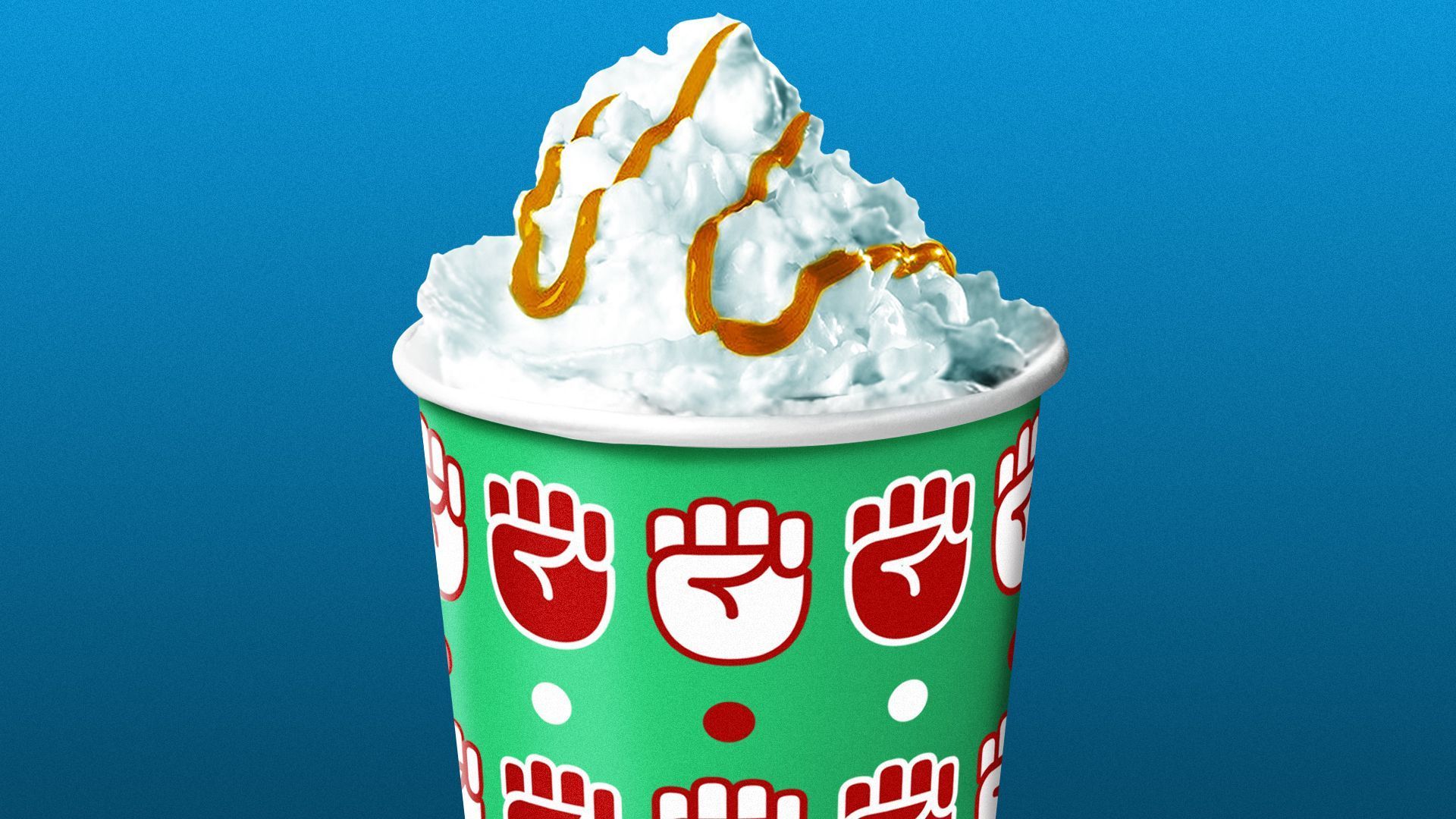
Illustration: Sarah Grillo/Axios
Starbucks is softening its stance toward unionization after years of pushing back, Emily writes.
Why it matters: It's a potentially huge shift for the chain and a signal of the staying power of the labor movement that surged in the wake of the pandemic.
- "They know this isn't going away," said Nick Setyan, an equity analyst at Wedbush who covers Starbucks. He called the company's new posture "capitulation."
- Setyan said recent worker walkouts were a turning point. Also, at least five more stores this month voted to unionize.
Zoom out: Union organizing efforts have been a public relations headache for Starbucks since at least 2021 when a store in Buffalo became the first to vote for a union. Meanwhile, pressure from labor regulators isn't slowing.
Zoom in: Starbucks' strategy shift began in March when Laxman Narasimhan took the CEO reins from founder Howard Schultz, who had repeatedly clashed with workers over unionizing. The new CEO spoke of the need to care for customer-facing staff, per Reuters.
- It's accelerated over the past week β last Friday, Starbucks vice president Sara Kelly sent a letter to Workers United (the union that reps workers), saying the company wanted to restart bargaining.
- The union has yet to bargain a contract. Starbucks now says it wants an agreement by next year.
- On Wednesday, the company released an audit on its labor relations practices that was commissioned by Starbucks β after a shareholder vote forced its hand β and conducted by a former management-side lawyer.
- Though the report asserted Starbucks didn't have an "anti-union playbook," it did find the company was unprepared to deal with its unionizing workforce and acknowledged that store managers made mistakes in how they handled the situation.
- The report offers recommendations for improvement β including better training. Change starts with "tone from the top," the audit says, suggesting that the company should reach agreements with the union "expeditiously."
What happened: Starbucks initially believed it could fend off unionization by messaging about best-in-class wages and benefits, Setyan said, noting that it's true the chain offers better compensation than competitors.
- "Internally, they felt kind of aggrieved," he said, that workers who management perceived as well-compensated would want to organize.
- For a while it seemed like the messaging campaign was working, but the Red Cup Rebellion walkout last month and a flurry of new union votes changed minds.
- Starbucks has historically been very sensitive to public relations β and it became clear pushing back isn't great for its image, Setyan said.
The other side: Union representatives are skeptical of Starbucks' new position.
- "We are hopeful your letter is indeed the beginning of a sincere effort, and not a publicity move in the face of pressure from partners, Wall Street, shareholders, and others," Workers United president Lynne Fox, said in a letter to Kelly last week.
What to watch: If Starbucks' change in tone is a sign that the company will finally come to terms with these workers, and agree to a contract, or just a shift in its public stance while it continues efforts to avoid a deal.
2. Starbucks vs. NLRB
One of 23 closed Starbucks locations at issue in an NLRB complaint, this one's in Seattle. Photo: David Ryder/Bloomberg via Getty Images
In a complaint issued this week, an administrative law judge in the Seattle office of the National Labor Relations Board said that Starbucks illegally closed 23 of its stores last year to suppress union organizing, Emily writes.
- The NLRB's general counsel is seeking an order to get Starbucks to reopen the stores, the complaint notes.
The big question: Can the NLRB really force Starbucks to reopen its stores?
- Kate Bronfenbrenner, a labor professor at Cornell University, says it's unlikely the labor board can force Starbucks' hand. These kinds of orders are extremely rare, she says.
How it works: If such an order were issued, it would likely be appealed: It could go all the way to the Supreme Court, Bronfenbrenner said.
Between the lines: Even if a ruling goes against Starbucks, historically courts have been unwilling to order a company to reopen stores or facilities.
- "Courts tend to hold the company line that the decision to open or close a facility is part of a constitutional right of private property," she said.
For the record: Starbucks says the store closures were part of regular business operations. Last year, the company opened 437 stores and closed 116 in the U.S.
- "Each year as a standard course of business, we evaluate the store portfolio to determine where we can best meet our community and customers' needs," the company said in an emailed statement.
Flashback: More than a decade ago, the NLRB asked for an order forcing aircraft maker Boeing to move a production facility to Washington State from South Carolina.
- That set off a political firestorm, and the board eventually dropped the case.
4. Defaults are back to normal


U.S. companies' debt default rates have been unusually low since 2021 β but that's changing now, Axios' Kate Marino writes.
- The default rate has been climbing all year, and in November it reached its historical average of 4.1%, according to S&P Global Ratings.
Why it matters: The Fed's interest rate hikes are squeezing company balance sheets. Defaults are going up as a growing number of companies can't make their interest payments, or can't afford to refinance their debt.
- And even if the Fed cuts interest rates a few times next year, they'll still be pretty high β so defaults could keep on rising.
State of play: Defaults often go hand-in-hand with bankruptcy β but defaults are a broader measure.
- This year, 43 of the 89 U.S. defaults didn't involve bankruptcies; they were what's known as "distressed exchanges."
In a distressed exchange, the lender agrees to a deal in which it won't get paid back in full, but it gets something in return, like a higher priority spot in the company's debt structure.
- The point of these types of deals is to limit the downside for the lender while helping to create a more sustainable debt structure for the company.
- For example: Carvana, creator of the famed "car vending machines," did one such deal in July, which helped it avoid a full-blown bankruptcy.
Of note: The default data includes all the companies with credit ratings from S&P β that means it's mainly larger companies with bonds or loans that trade in the market. It doesn't include companies that have borrowed in the growing private debt sector.
5. Boomers at work


An increasing number of Americans age 65 and older are working βΒ and earning higher wages, per a study from the Pew Research Center out yesterday, Emily reports.
- Why it matters: This is good for the economy, especially as the U.S. population ages βΒ but whether or not it's good for older Americans is a bit more subjective.
Was this email forwarded to you? Subscribe here.
Axios Markets is edited by Kate Marino and copy edited by Mickey Meece.
Sign up for Axios Markets

Stay on top of the latest market trends and economic insights