Axios Login

October 28, 2022
Happy Friday. TGIF, indeed.
🎙 "How It Happened: Elon Musk vs. Twitter" unpacks Twitter's history, its challenges, what Musk has said about his intentions for the platform, and the tension between free speech ideals and content moderation. Listen here.
Today's newsletter is 1,267 words, a 5-minute read.
1 big thing: Musk takes over Twitter, fires top execs
Photo illustration: Megan Robinson/Axios. Photo: Britta Pedersen-Pool/Getty Images
Elon Musk on Thursday night completed his $44 billion acquisition of Twitter, after months of dramatic attempts to renege, Axios' Sara Fischer and Dan Primack report.
Why it matters: The deal gives Musk sole control of one of the most important global platforms for political speech and social discourse.
- CEO Parag Agrawal, CFO Ned Segal, and general counsel Sean Edgett all were fired.
What they're saying: In his first comments since completing his Twitter takeover, Musk tweeted just before midnight Thursday: "the bird is freed."
Backstory: In April, Musk had a signed deal to buy the company. By May, he was publicly expressing doubts. And in July, he tried to officially walk away.
- Twitter sued, Musk countersued, and the two sides were headed to trial before Musk caved in early October.
Be smart: Musk first said his backpedaling was because Twitter underreported its number of fake accounts, before later adding in concerns tied to a whistleblower complaint from the company's former chief security officer.
- But the subtext always was that he'd agreed to significantly overpay for a company with significant business challenges.
The big picture: Musk assumes control of Twitter at a chaotic time for free speech in America.
- Trump, who was permanently suspended two days after the January 6 insurrection at the U.S. Capitol, has said he wouldn't resume using Twitter even if his account was reinstated, something Musk has pledged to do.
Between the lines: Musk hasn't yet laid out a clear vision for Twitter.
- He reportedly told some investors that he'd cut 75% of Twitter's headcount once the deal closes, but he more recently told employees otherwise.
- Musk said he wants Twitter to prioritize free speech, but has said he would adhere to the local laws of any country Twitter operates in. He also tweeted a message to advertisers, acknowledging that the platform "cannot become a free-for-all hellscape."
Go deeper: The Twitter executives departing after Elon Musk's takeover
2. Big Tech's ranks swelled last year

In just the past year, Microsoft, Facebook and Google parent Alphabet have all seen their headcount rise by upwards of 20%. As Big Tech companies shift from growth to belt tightening, they will have to reckon with just how many employees they've hired since the pandemic began.
Why it matters: Hiring freezes may not do enough to cut costs, as companies' payroll will rise significantly just due to all the employees hired in the last year.
The big picture: Nearly all large tech companies say they expect to slow hiring this year, with many turning to partial or complete hiring freezes. Microsoft has already conducted a small number of layoffs, Snap is cutting 20% of staff and other tech companies have indicated layoffs could be coming.
- Meta has said that most departments will see lower budgets in the coming year. "In aggregate, we expect to end 2023 as either roughly the same size, or even a slightly smaller organization than we are today," CEO Mark Zuckerberg said on the earnings conference call this week.
- Microsoft CFO Amy Hood told analysts that any growth above current levels "should be minimal" this quarter.
- Alphabet CEO Sundar Pichai said any headcount growth this quarter will "be significantly lower" than the past quarter.
By the numbers:
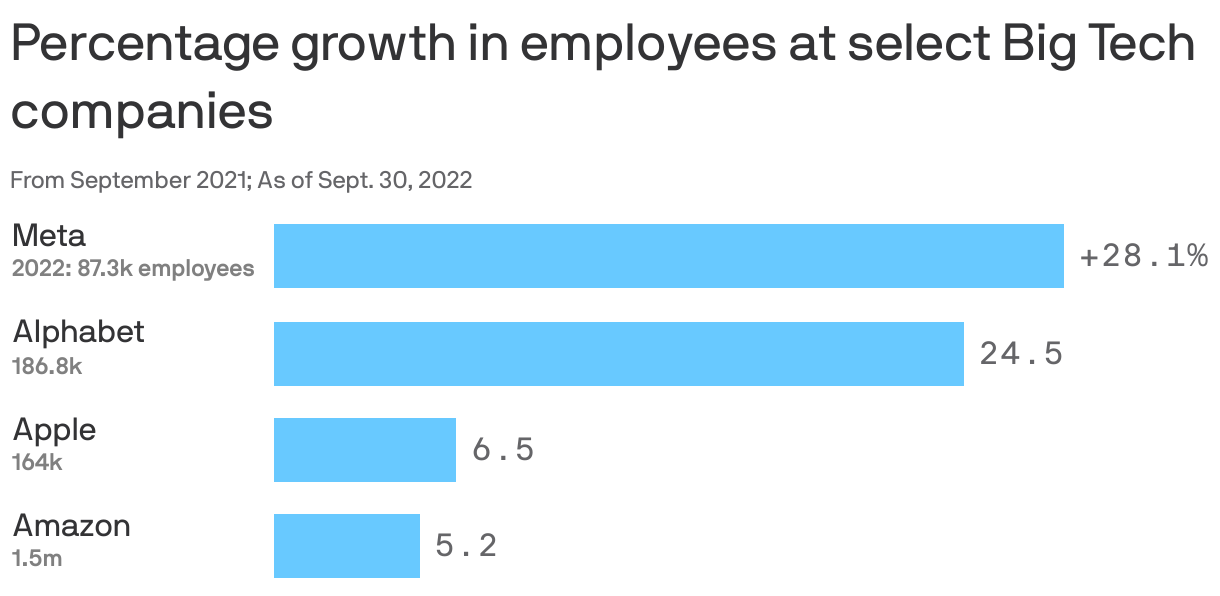
- Meta ended the last quarter with 87,314 employees, an increase of 28% year-over-year.
- Microsoft had 221,000 employees, up 22.1% from a year ago.
- Alphabet reported 186,779 employees at the end of September, up 24% from the 150,028 workers it had a year earlier.
- Apple's headcount grew, but less substantially than those companies. As of Sept. 24, Apple had approximately 164,000 workers, up 6.5% from the prior year's 154,000.
- Amazon, too, showed more modest growth, ending the quarter with 1,544,000 workers, up 5% from the 1,468,000 people it employed a year ago.
What they're saying: Matt Perault, director of UNC's Center on Technology Policy, told Axios that Meta has doubled in employee size between late-2018 and late-2021, with many other tech companies also having grown headcount significantly in recent years.
- "It's not clear to me that the hiring has resulted in increased impact or innovation at a pace commensurate with the increased costs," Perault said, and that he imagines "companies can impose some headcount cuts without seeing a meaningful negative impact on their productivity."
Between the lines: In some cases, those growth numbers include acquisitions, such as Google's acquisition of Mandiant or Microsoft's purchase of Nuance, which also bring added revenue.
- However the numbers don't include temporary workers and contractors, which make up a significant proportion of Silicon Valley's overall workforce.
3. Exclusive: Pols want more tech aid for Iranians

A protester holds up a note reading "Woman, Life, Freedom, #MahsaAmini" while marching in Tehran, Iran. Photo: Getty Images
A bipartisan group of lawmakers urged Google, Amazon and other tech companies Thursday to expand access to online tools and services for Iranian protestors after the U.S. Treasury Department relaxed restrictions last month, Axios' Margaret Harding McGill reports.
Why it matters: Iranians protesting the death of 22-year-old Mahsa Amini while she was in police custody are trying to evade internet disruptions and government restrictions of social media platforms.
Driving the news: A letter led by Rep. Tom Malinowski (D-N.J.), and signed by at least 10 other lawmakers, calls on the companies to "provide expeditiously and lawfully the tools Iranians need to circumvent government blockages."
- Those technologies include cloud and hosting services, messaging platforms and access to app stores, according to the letter.
- The letter was sent to leadership at Google, Amazon, Apple, Meta, Microsoft and Digital Ocean, a cloud infrastructure company.
What they're saying: Malinowski told Axios he's frustrated with tech companies' lack of action in Iran.
- "We're not seeing nearly enough. Iranians are risking their lives, and these big companies seem to be unwilling to risk anything, and that's just wrong," Malinowski said in an interview.
Catch up quick: Use of anti-online censorship tools has surged in Iran since the September death of Amini, who was in police custody for violating the country's mandatory head-scarf law.
- The Treasury Department revised its sanction rules to allow tech companies more latitude in providing online tools and services political dissidents could use.
- Google said in September its Jigsaw subsidiary's open-source Outline VPN tool saw a spike in demand from Iran after the sanctions were revised.
The other side: Google also launched location sharing on Maps locally in Iran in late September. "We are also working on technical ways to ensure continued access to generally available communications tools like Google Meet and our other Internet services," the spokesperson said.
- Meta spokesperson Andy Stone said hashtags related to the protests in Iran were used more than 100 million times on Instagram around the world in the days since Amini's death.
- Microsoft and Amazon declined comment. Apple and Digital Ocean did not respond to requests seeking comment.
4. Take note
On Tap
- Today is National Chocolate Day, so be sure to do your part to celebrate.
Trading Places
- Longtime Microsoft executive Joe Belfiore announced his plan to retire next summer, after more than 30 years at the software maker.
- Retired U.S. Army Gen. Gustave Perna has joined DEFCON AI as chief operating officer. He previously led Operation Warp Speed, the COVID vaccine delivery program, and was commander of the Army Materiel Command.
ICYMI
- Amazon gave a disappointing holiday outlook and said its highly profitable AWS unit is seeing slower growth. (Axios)
- Apple beat quarterly earnings and sales expectations despite economic headwinds. It also forecast slower revenue growth in the current quarter. (Axios)
- Intel announced plans to cut $10 billion in costs over the next three years as it struggles with manufacturing and other challenges. (CNBC)
5. After you Login
Harvey has this book, "Shark vs. Train," illustrating which would win in various types of contests. Unfortunately, the battle of train vs. delivery robot was pretty one-sided.
Thanks to Peter Allen Clark for editing and Bryan McBournie for copy editing this newsletter.
Sign up for Axios Login

Taking you inside the AI revolution, and delivering scoops and insights on the technologies reshaping our lives.