Axios Latino

December 17, 2024

Welcome back.
🚨Some major and majorly sad news: Thursday's edition will be the final ever for Axios Latino. More on that in a couple of days.
👀 En español 👀
This newsletter, edited by Astrid Galván, is 1,401 words, a 5.5-minute read.
1 big thing: A migrant story for this Christmas

Some Catholic and evangelical leaders say they will unpack the Holy Family's immigration plight during Christmas services to offer hope for immigrants worried about what's coming under President-elect Trump.
Why it matters: Trump and his incoming administration are promising immigration raids — even inside churches — as part of their mass deportation plan, and church leaders say that's already prompting some immigrants to go into hiding.
State of play: Undocumented immigrants appear to be taking Trump at his word — some have left the country, stopped coming to work or disappeared, Allen Sánchez, New Mexico Conference of Catholic Bishops executive director, tells Axios.
- Others are emotionally asking evangelical pastors for protection, Gabriel Salguero, president and co-founder of the National Latino Evangelical Coalition, tells Axios.
- "What I'm telling people in this advent of Christmas is ... Jesus understands you because he lived your reality."
Zoom in: Latino evangelical churches will be telling attendees at Christmas services to remember Jesus and his family were forced to migrate to Egypt for reasons that they could not control, Salguero says.
- Salguero says the immigrant story is Christ's story. "Our primary call is to love our neighbors and love the immigrant and love the stranger, and we're going to live that through."
- "There may not be room at the inn, but there is room at the church."
- Similarly, Catholic churches will share the Christmas story as a call to action to everyone, Sánchez says.
Yes, but: Conservative white evangelical church leaders, many of whom supported Trump, have endorsed mass deportations and some have used racist language to describe immigrants.
- That view comes from how some white evangelicals interpret the Bible's Book of Revelation as Heaven being a closed-off place, Yale Divinity professor Yii-Jan Lin tells Axios.
- Some English-speaking Latino evangelicals who belong to white-majority churches also supported Trump.
The big picture: Religious leaders of many faiths have long played a role in immigrant rights.
- Some have allowed undocumented immigrants to find sanctuary in churches, where immigration authorities have typically not arrested people.
- During Trump's first term, some churches erected nativity installations depicting Mary, Joseph and Jesus separated in cages to protest Trump's immigrant family separation policy.
Now, church leaders say they want to use Christmas to send immigrants a message: The family of Jesus experienced what you experienced, and the church will be a place of refuge in the coming months.
2. Latino businesses are making progress

The share of Latino entrepreneurs who applied for credit grew last year, and their credit scores improved as they increasingly became boosters of the U.S. economy, a new study from McKinsey shows.
Why it matters: Latinos in the U.S. create small- and medium-sized businesses at a greater rate than other demographic groups, and they grow their revenue faster.
- But Latinos sometimes struggle for the funds to scale their businesses.
What they're saying: "When you have more of these Latino businesses in different sectors, it creates a positive feedback loop and growth opportunities," says Alberto Chaia, a senior partner at McKinsey in Miami and author of the report.
- Chaia says that has been especially the case in heavily Latino cities like Miami and Austin, but that "establishing these networks, alongside greater access to education and credit or capital, means the gains are reproducible" for the benefit of other urban areas.
By the numbers: 36% of businesses established in 2023 were Latino-owned, per the McKinsey report.
- 15% of all credit applications in the U.S. came from Latino-owned companies, compared to 12% in 2022.
- That increase could be due to growing financial literacy and a greater presence of Latinos in booming industries like fintech, Chaia says.
- The average credit score of Latino business owners also rose, from 632 in 2022 to 647 last year, which McKinsey says is a sign of their increased financial stability.
"There's still a gap in credit approval rates, but not as large as there used to be," Chaia adds.
3. Leader of the largest Hispanic Caucus ever
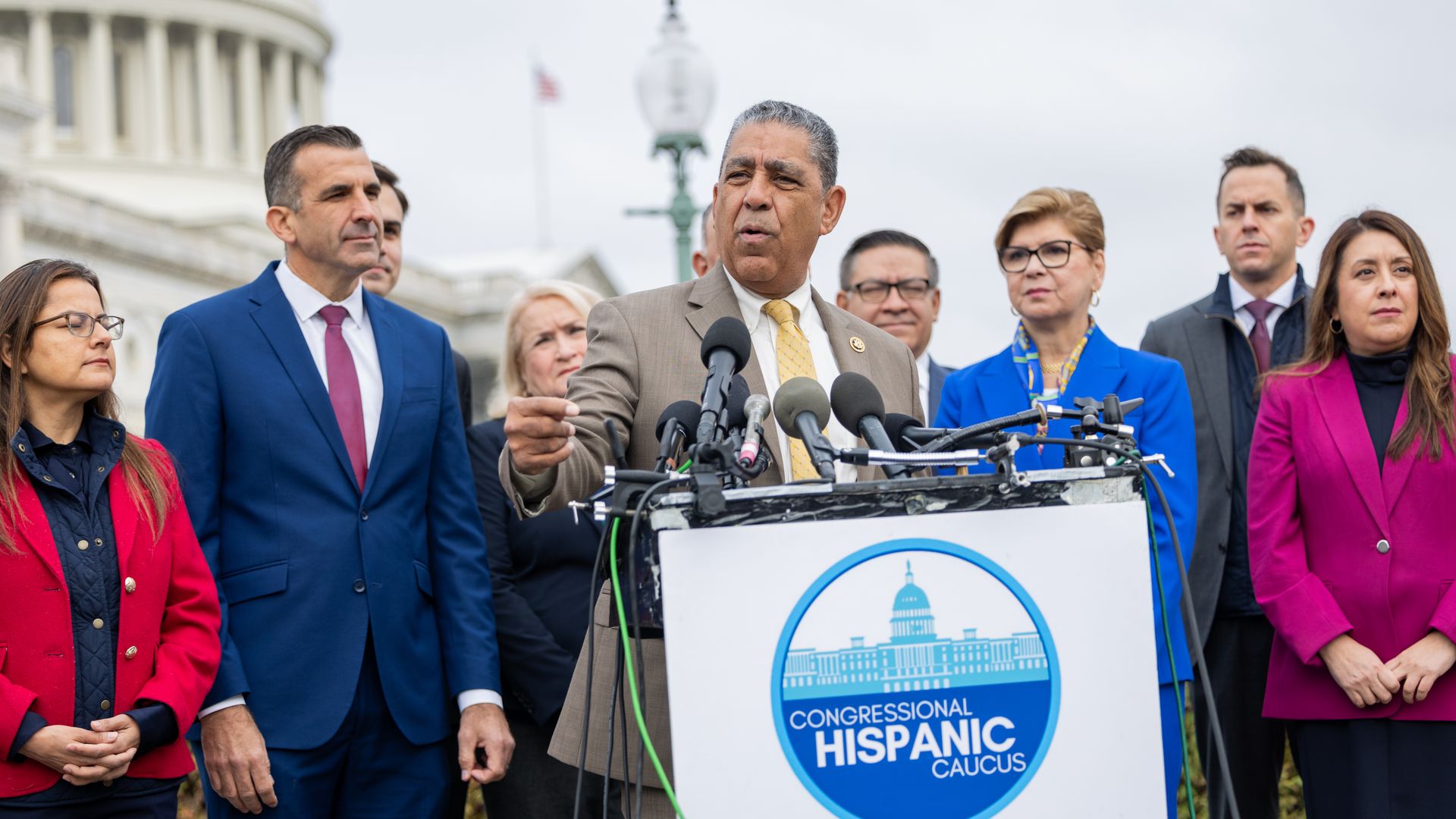
The Congressional Hispanic Caucus' new leader, Adriano Espaillat (D-N.Y.), says he aims to reach across the aisle to work in favor of Latinos.
The big picture: Espaillat was elected last month to be the chairman of the caucus when the next congressional term starts.
- The upcoming CHC, with 43 members, will be the largest since the it was established in 1976.
What they're saying: "We've had conversations with Republican leaders in the past for issues like immigration, which will also be a very important issue (next term), but we'll also be looking to do so for issues like artificial intelligence, economic development for small businesses and a handful of other agenda items" relevant to Latinos, Espaillat said in an interview with Noticias Telemundo this month.
Espaillat, who became the first Dominican American representative in the House when he was elected in 2016, also said he's worried about how President-elect Trump's mass deportation plans might be implemented.
- "We've seen in other cases … both the 'righteous and the sinners' can be swept up, so I think that's a danger and concern," he said.
- Espaillat, who is now a U.S. citizen, was formerly undocumented. He has championed measures like getting FEMA funding to help asylum seekers in New York.
What we're watching: Espaillat stressed it will be important for Democrats to "better communicate" how they operate on behalf of working Latinos.
- President-elect Trump made inroads in this election with Latino voters, who repeatedly said the economy and jobs were among their main concerns.
- "I think we've been champions for the working class, but where we've stumbled is in how we've put that message across," Espaillat said, pointing to measures like a cap on insulin prices.
4. Olmos movies make it into national registry

Two Edward James Olmos classics, "American Me" and "Mi Familia," were selected for the National Film Registry, the Library of Congress announced today.
Why it matters: Just 5% of the 900 films in the registry, which has significant cultural value, are of Latino stories.
State of play: The registry this year selected 25 films for preservation, including the two Olmos was involved in.
- The other selected films by Latinos were Cheech and Chong's "Up in Smoke" and the Robert Rodriguez-directed "Spy Kids."
Background: "Mi familia" is about generations of a Mexican American family in the LA area. It's directed by acclaimed director Gregory Nava, who also was behind "Selena" (added to the registry in 2021).
- "American Me," Olmos' directorial debut, is about a family involved in crime.
5. Stories we're watching
1. Venezuelan authorities said yesterday they've released more than 530 people detained after anti-government protests that started in July.
- The government of President Nicolás Maduro has given no reason for the releases, but they come as the UN and International Criminal Court have been investigating human rights abuses by his regime.
- U.S. Sen. Marco Rubio, named by U.S. President-elect Trump to be secretary of state, is also a fierce critic of Maduro's government.
2. Ecuador and Colombia have pledged to reinforce environmental protections near the Galápagos and the marine territory on their nearby coastlines.
- The commitment, made Sunday during a high-level meeting between Presidents Daniel Noboa and Gustavo Petro, comes after the countries also announced a shared marine protected area in November.
6. 🐝 Smile to go: This superfood is creating a buzz

Colombian scientists have developed a special food supplement they hope can protect bees as their population contends with a decline.
State of play: Bees are key pollinators for up to a third of all the world's food supply.
- Every winter on average about 18% of colonies are lost, according to a 2020 study from 37 countries.
- The "superfood" developed by these scientists is meant to counteract the effect on bees of pesticide use, though they say initial findings suggest it can also protect them against parasites.
What they're saying: "After bees ingest (the supplement) they have slight physiological improvements that prep them so that, if they come in contact with pesticides, they can detox faster," Andre J. Riveros, a professor at Bogotá's Rosario University, tells Noticias Telemundo.
Russell is listening to "No Me Digas Adiós" over and over.
Marina is so sad about the newsletter, but at least she had a decent birthday weekend.
Astrid is also really sad.
Many thanks to Carlos Cunha, Alison Snyder and Axios Visuals for their many contributions.
Sign up for Axios Latino