Axios Hill Leaders
August 14, 2026

1 big thing: 💰 Money's diminishing returns
The 2026 midterm election is on track to be the most expensive in history.
Why it matters: So far, the money hasn't always mattered.
- 🍺 Pour one out for your favorite political consultant. Polling has gotten noisier, and money can't compete with momentum.
- In three of the most expensive Democratic primaries, the winner was dramatically outspent on TV and radio, according to Kinetiq Political Insights.
- 💸 "Dollars don't vote — people do," said Adam Wise, a strategic consultant for KPI. "The pattern is hard to miss: The winners didn't outspend anyone, they got more voter for their dollar."
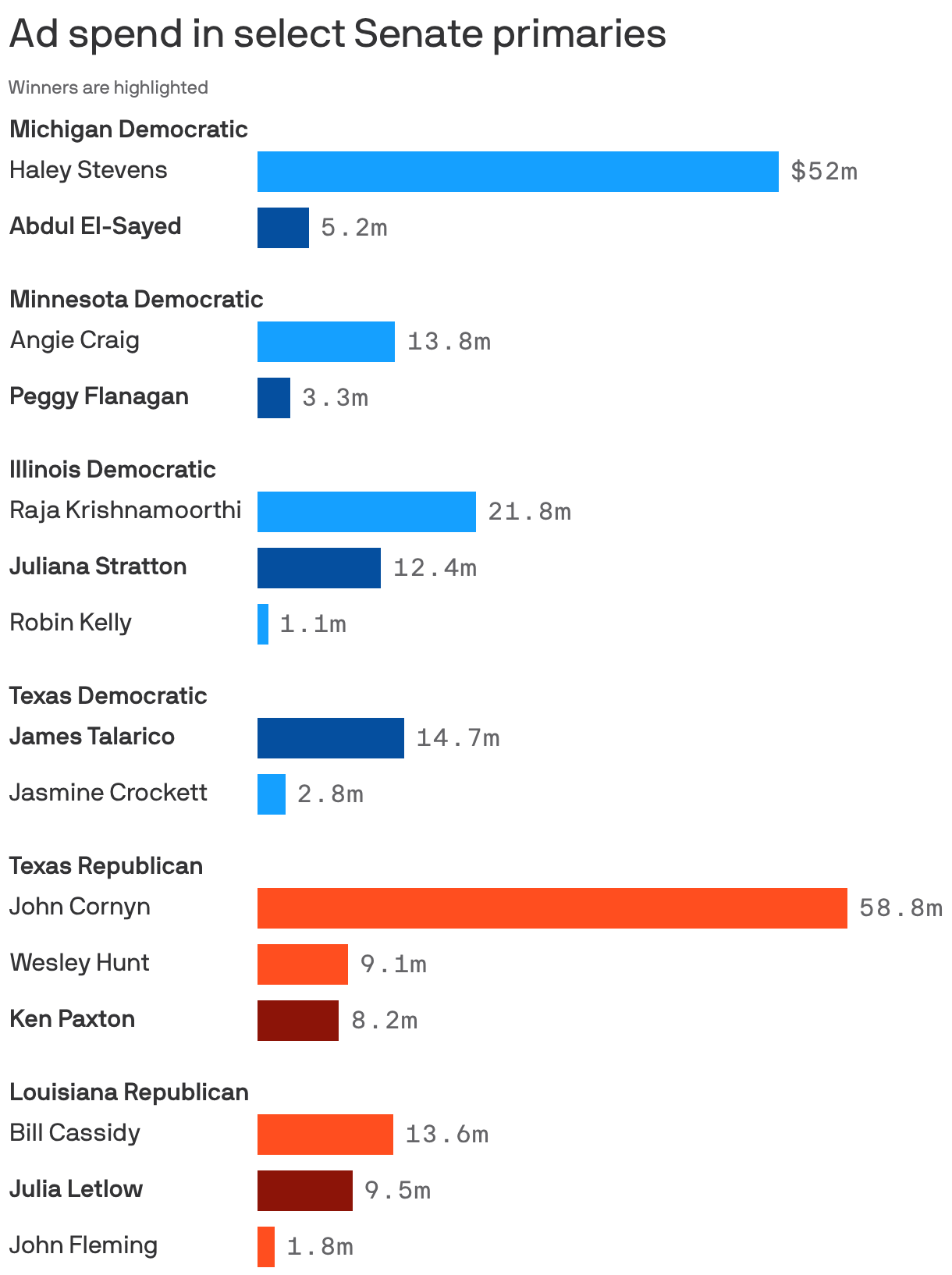
By the numbers: In Michigan, Rep. Haley Stevens (D-Mich.) and her allies outspent Abdul El-Sayed and his allies nearly 10 to 1 on cable, broadcast and radio — $52 million to $5.2 million. El-Sayed won 48.5%–47.5%.
- In Minnesota, Rep. Angie Craig (D-Minn.) and outside groups backing her put $13.8 million into TV and radio, compared with $3.3 million for Peggy Flanagan. Flanagan won by 20 points.
- In Illinois, Rep. Raja Krishnamoorthi (D-Ill.) unleashed $21.8 million in advertising, compared with $12.4 million from Lt. Gov. Juliana Stratton and a super PAC supporting her. Stratton won 40%–33%.
Go deeper: The same pattern played out in the three most competitive Republican Senate primaries: The losers had the bigger advertising budgets.
- 🤠 In Texas, Sen. John Cornyn and his allies had a $58.8 million advertising operation — seven times the $8.2 million behind Attorney General Ken Paxton. Paxton won the runoff 64%–36%.
- In Louisiana, Sen. Bill Cassidy and his allies put $13.6 million into advertising, versus $9.5 million from Rep. Julia Letlow (R-La.) and outside groups backing her. Letlow won the runoff 57%–43%.
- In Georgia, Rep. Buddy Carter had $4.4 million behind him, compared with $925,000 for Rep. Mike Collins and his allies. Collins won the runoff 55%–45%.
Between the lines: President Trump endorsed the winner in all three, showing that in congressional races, his endorsement is still the most valuable currency in the Republican Party.
The other side: Money did prevail in three other Democratic primaries, but in all three it was paired with momentum.
- In Texas, state Rep. James Talarico and affiliated groups put $14.7 million into advertising — five times Rep. Jasmine Crockett's $2.8 million. Talarico won 52%–46%.
- 🦞 In Maine, Graham Platner put $5.4 million into TV and radio, compared with $700,000 from Gov. Janet Mills.
Platner was also the target of $2.8 million in ads from GOP super PACs. Mills dropped out — and Platner later did as well — but both remained on the ballot. Platner beat Mills 78%–17%.
- 🌽 In Iowa, state Rep. Josh Turek and his allies had a $7.2 million advertising advantage, compared with $600,000 for Zach Wahls. Turek won 63%–37%.
🌎 Zoom out: Republican committees ended the second quarter with a cash advantage over their Democratic counterparts, even as many Democratic House candidates have outraised their GOP opponents in individual races. And Elon Musk is waiting in the wings.
- But if the environment is as bad as some GOP strategists privately fear, money won't be able to save all of their candidates.
The bottom line: Candidates can spend a lot of money to lose an election.
— Hans Nichols
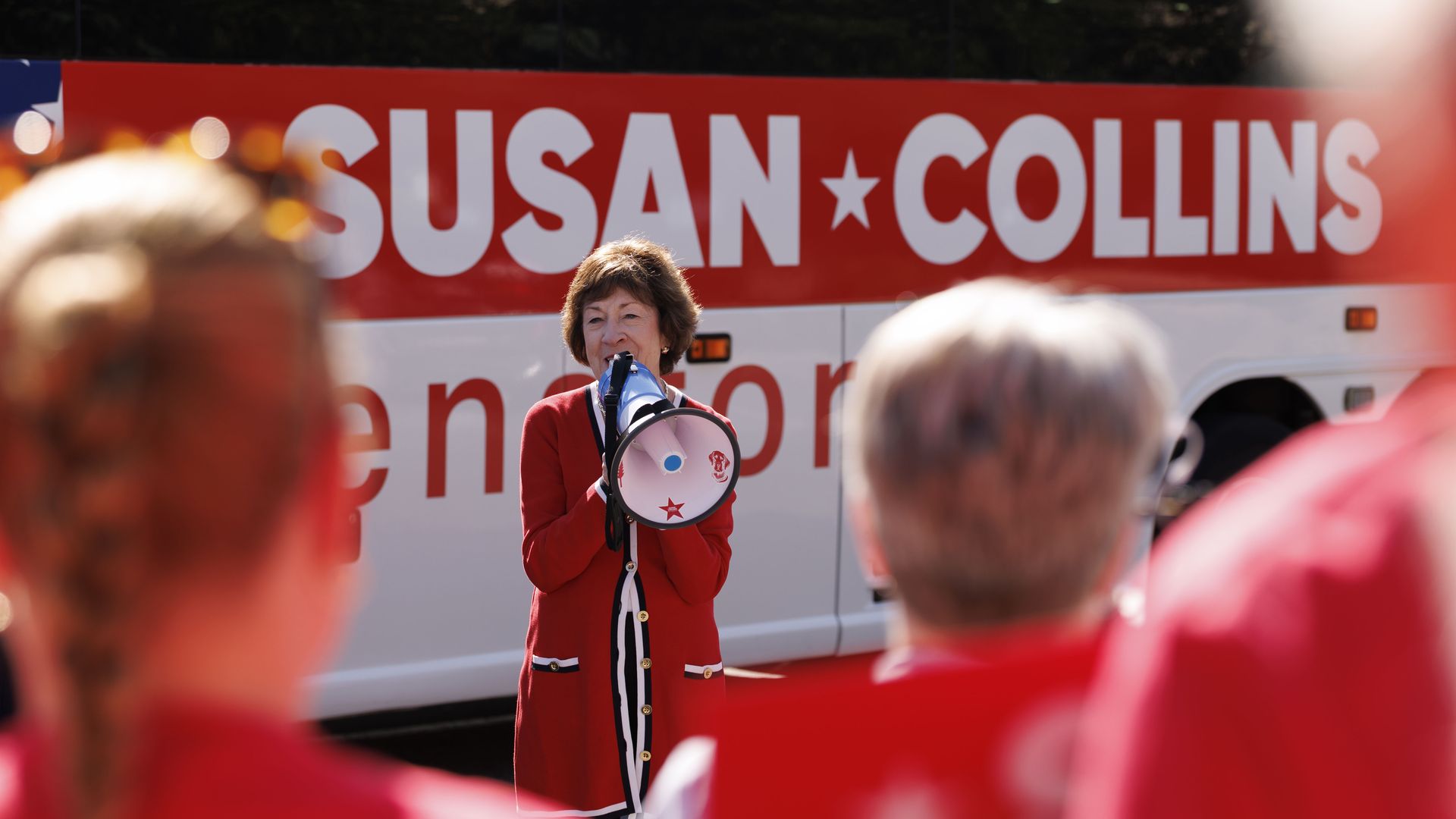
2. 🔎 Friday Focus: Collins vs. Jackson
Axios Hill Leaders