Pollsters missed again in Wisconsin. Here's why.

Add Axios as your preferred source to
see more of our stories on Google.
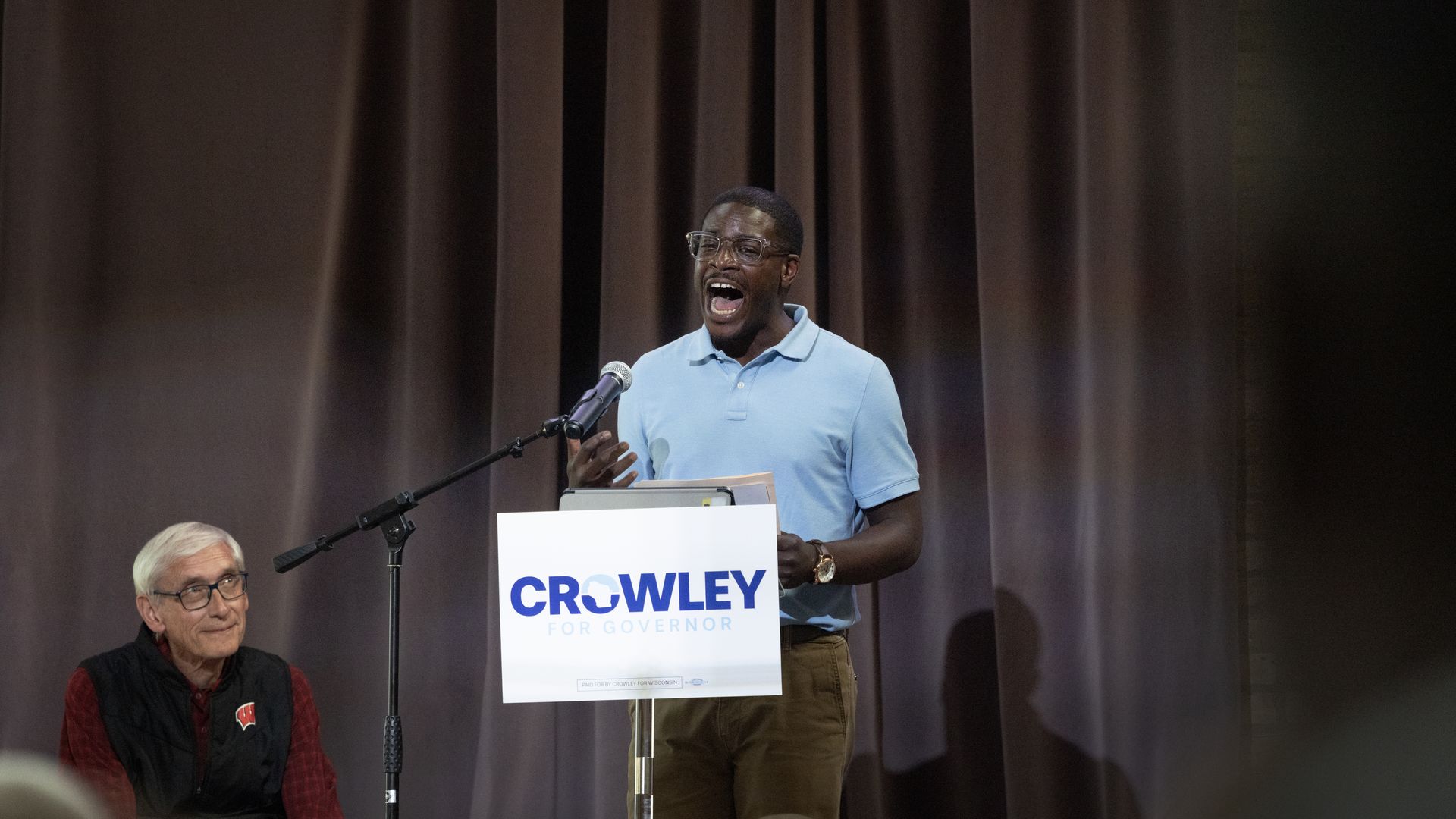
Wisconsin Gov. Tony Evers (D) listens to Milwaukee County Executive David Crowley at a rally just before Tuesday's primary. Photo: Scott Olson/Getty Images
Pollsters appeared to blow another high-stakes Midwest election Tuesday, as center-left Democrat David Crowley stunned socialist Francesca Hong in Wisconsin's primary for governor.
- But on Wednesday, the reasons for the miss seemed clear: Surveys a week before the primary captured only a hint of a rapidly changing roller coaster of a race in which Crowley was gaining fast, and Hong was playing defense.
Driving the news: Two polls had shown Hong up by about 20 points over Crowley. But Crowley wound up winning by half a percentage point in an upset that interrupted a run of primary wins by left-wing Democrats this spring.
- Just a week earlier, polls also had overestimated progressive Abdul El-Sayed's strength in the Michigan Senate race by double digits. He won by 1 point.
Polls help shape the pre-election narrative for campaigns, but the Midwest misses were reminders of the surveys' limitations in capturing voters' feelings over just a few days in a long race.
- In the days before the primary, even Crowley's own pollster had him down by nearly 20 points.
Zoom in: The final month of the gubernatorial primary was particularly chaotic. There was a mad dash by the party's establishment to stop Hong out of fear that the state Assembly member was too far left to win in November.
- Two candidates dropped out amid sudden scandals. Crowley, the county executive in Milwaukee, actually exited his campaign as well — then re-entered the race to try to take out Hong.
- The last week of the campaign was dominated by the fallout from Hong struggling to explain to CNN why she'd once taken to social media to say "cancel Thanksgiving."
Amid that hurricane, Democratic strategists saw late-deciding voters flocking toward Crowley as he barnstormed Wisconsin with Democratic Gov. Tony Evers, questioning Hong's electability.
- Even some people at Hong's events said they were undecided as the primary approached.
- "Part of it is the old saw that we often say but rarely hear: Polling is a snapshot in time," former top Obama strategist David Axelrod told us. "A lot of the polls were taken too early to capture the movement."
Just dig into the numbers. Hong won about 39% of the electorate — and the final polls had her in the low 40s.
- It was Crowley whose standing appeared to change dramatically — jumping from around 20% support to roughly 40% within days.
- Another factor that helps explain the miss, strategists told us, is that it's difficult for pollsters to model an open primary, in which voters can participate in either party's primary regardless of their registration.
- "It's hard to know who's going to show up," Axelrod said.
The intrigue: Chaz Nuttycombe, founder of the nonpartisan group State Navigate, put out one of the early August polls that had Hong up by double digits.
- He speculated that in Wisconsin's open primary, some people who usually vote in Republican primaries may have crossed over to vote in the more competitive Democratic contest to stop Hong.
- Fox was airing wall-to-wall coverage about Hong at the time.
- Nuttycombe also said his site's last poll received more than 10,000 visits from IP addresses in Wisconsin and the surrounding area — an indication that many anti-Hong voters were paying close attention to polling in the race last weekend and likely used it to determine which alternative candidate they should support.
Dan Pfeiffer, another former top adviser to President Obama, noted on X and Substack that Hong — with little campaign money — also didn't air TV ads during the campaign's stretch run to counter the attacks against her in the critical last few days before the primary.
- "Hong ran an inspirational grassroots campaign that mobilized people around key issues like data centers, but her failure to advertise in the final days probably cost her the election," Pfeiffer wrote.
- "In the final days, voters only heard concerns about Hong, but no countervailing positive message."
