In 2026, money doesn't always matter

Add Axios as your preferred source to
see more of our stories on Google.
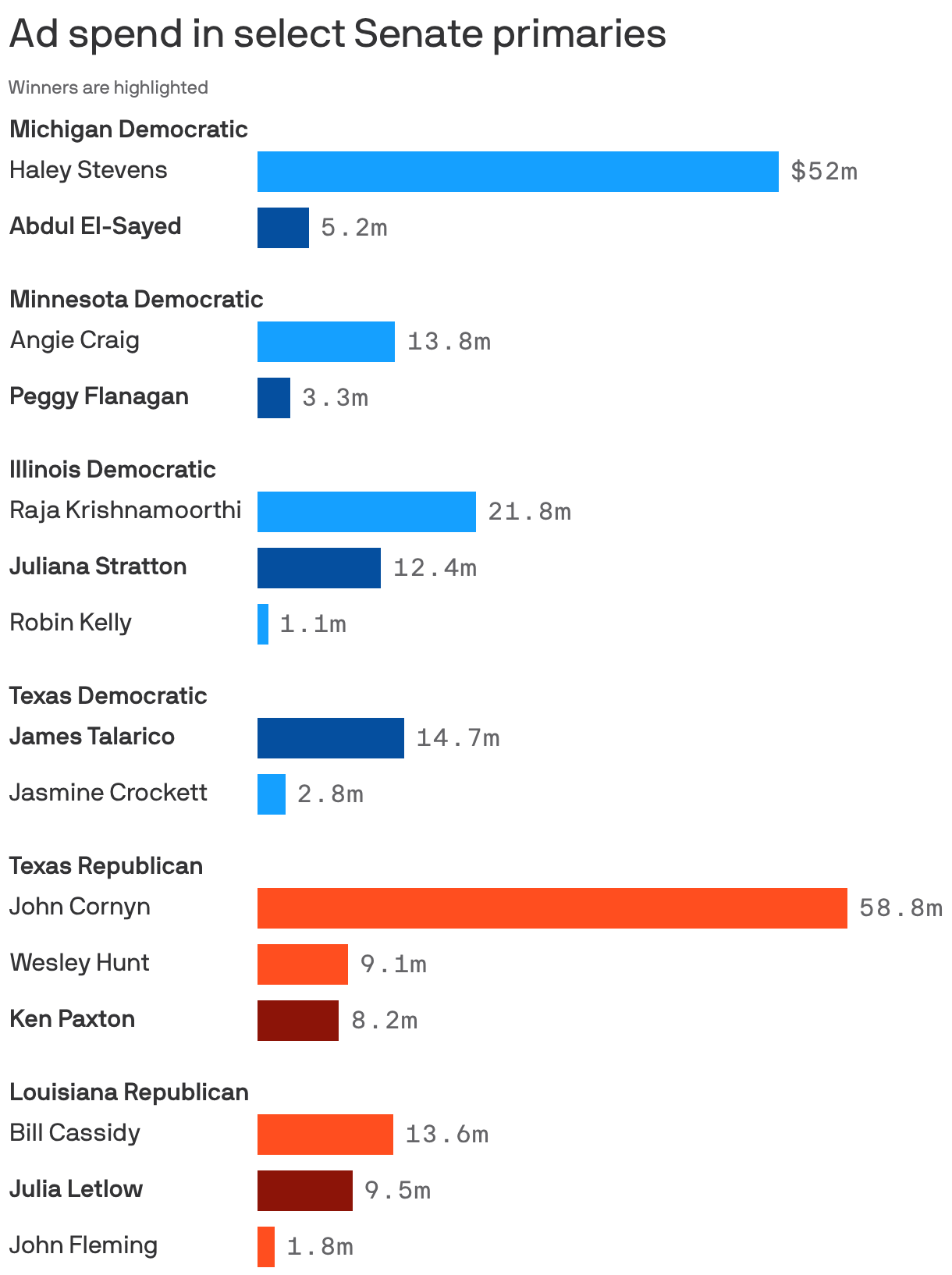
The 2026 midterm election is on track to be the most expensive in history.
Why it matters: So far, the money hasn't always mattered.
- Pour one out for your favorite political consultant. Polling has gotten noisier, and money can't compete with momentum.
- In three of the most expensive Democratic primaries, the winner was dramatically outspent on TV and radio, according to Kinetiq Political Insights.
- "Dollars don't vote — people do," said Adam Wise, a strategic consultant for KPI. "The pattern is hard to miss: The winners didn't outspend anyone, they got more voter for their dollar."
- "With audiences spread across more screens than ever, the exchange rate on a media dollar now matters more than the size of the check," he said.
By the numbers: In Michigan, Rep. Haley Stevens (D-Mich.) and her allies outspent Abdul El-Sayed and his allies nearly 10 to 1 on cable, broadcast and radio — $52 million to $5.2 million. El-Sayed won 48.5%–47.5%.
- In Minnesota, Rep. Angie Craig (D-Minn.) and outside groups backing her put $13.8 million into TV and radio, compared with $3.3 million for Peggy Flanagan. Flanagan won by 20 points.
- In Illinois, Rep. Raja Krishnamoorthi (D-Ill.) unleashed $21.8 million in advertising, compared with $12.4 million from Lt. Gov. Juliana Stratton and a super PAC supporting her. Stratton won 40%–33%.
Go deeper: The same pattern played out in the three most competitive Republican Senate primaries: The losers had the bigger advertising budgets.
- In Texas, Sen. John Cornyn (R-Texas) and his allies had a $58.8 million advertising operation — seven times the $8.2 million behind Attorney General Ken Paxton. Paxton won the runoff 64%–36%.
- In Louisiana, Sen. Bill Cassidy (R-La.) and his allies put $13.6 million into advertising, versus $9.5 million from Rep. Julia Letlow (R-La.) and outside groups backing her. Letlow won the runoff 57%–43%.
- In Georgia, Rep. Buddy Carter had $4.4 million behind him, compared with $925,000 for Rep. Mike Collins and his allies. Collins won the runoff 55%–45%.
Between the lines: President Trump endorsed the winner in all three, showing that in congressional races, his endorsement is still the most valuable currency in the Republican Party.
The other side: Money did prevail in three other Democratic primaries, but in all of them it was paired with momentum.
- In Texas, state Rep. James Talarico and affiliated groups put $14.7 million into advertising — five times Rep. Jasmine Crockett's $2.8 million. Talarico won 52%–46%.
- In Maine, Graham Platner put $5.4 million into TV and radio, compared with $700,000 from Gov. Janet Mills.
- Platner was also the target of $2.8 million in ads from GOP super PACs. Mills dropped out — and Platner later did as well — but both remained on the ballot. Platner beat Mills 78%–17%.
- In Iowa, state Rep. Josh Turek and his allies had a $7.2 million advertising advantage, compared with $600,000 for Zach Wahls. Turek won 63%–37%.
Zoom out: Republican committees ended the second quarter with a cash advantage over their Democratic counterparts, even as many Democratic House candidates have outraised their GOP opponents in individual races. And Elon Musk is waiting in the wings.
- But if the environment is as bad as some GOP strategists privately fear, money won't be able to save all of their candidates.
The bottom line: Candidates can spend a lot of money to lose an election.
