Axios Generate

November 14, 2024


✅ Thursday. We've got artisanal small plates of U.S. and global news, and it's all just 1,349 words, 5 minutes.
🎵 Exactly 20 years ago, Usher and Alicia Keys ruled the Billboard Hot 100 with today's beautiful intro tune...
1 big thing: Different funding strategies emerge at COP29

Well into the first week of the latest UN climate summit in Azerbaijan, there are signs of movement — and signs of the arduous task ahead for diplomats.
Why it matters: Countries at COP29 are in no mood to fork over large increases in traditional public funds to contribute to a new, globally-agreed target for climate finance.
Zoom in: Coming up with a large sum of public financing in the midst of inflation concerns, two major regional conflicts and the impending return of President-elect Trump to the White House isn't going to be easy.
- Developing countries, many of which are heavily in debt from previous development loans, are seeking major new public funding commitments, which would come with fewer strings attached.
The intrigue: So far, multilateral development banks and some countries have pledged new money, which adds to the existing $100 billion annual developed country target.
- But the sums being mentioned don't get to the scale needed to address the climate challenge.
- Still, the commitments provide an increase in public finance which could build up going forward through these talks and into subsequent rounds, David Waskow of the World Resources Institute told Axios.
- He noted that with the banks' commitments on Tuesday, total climate finance would increase to about $165 billion per year by 2030.
- "I think there's an important base there, in fact, for public financing," Waskow said.
Between the lines: One key question facing negotiators is how to raise vast amounts of private sector money to help countries become more resilient to climate disasters and cut emissions.
Zoom out: At the same time, there has been some action on the emissions-reduction front, despite COP29 being known as the "finance COP."
- Yesterday, Brazil submitted its new climate plan, known as a Nationally Determined Contribution (NDC), to the UN climate panel.
- It calls for a 59% to 67% emissions cut below 2005 levels by 2035, with a goal of carbon neutrality by 2050.
Yes, but: Brazil's NDC doesn't contain goals for reining in its oil and gas production, including plans to expand that sector.
What we're watching: How negotiations on a new climate finance target progress as crunch time approaches next week.
2. 🌡️Rapidly warming winters, mapped
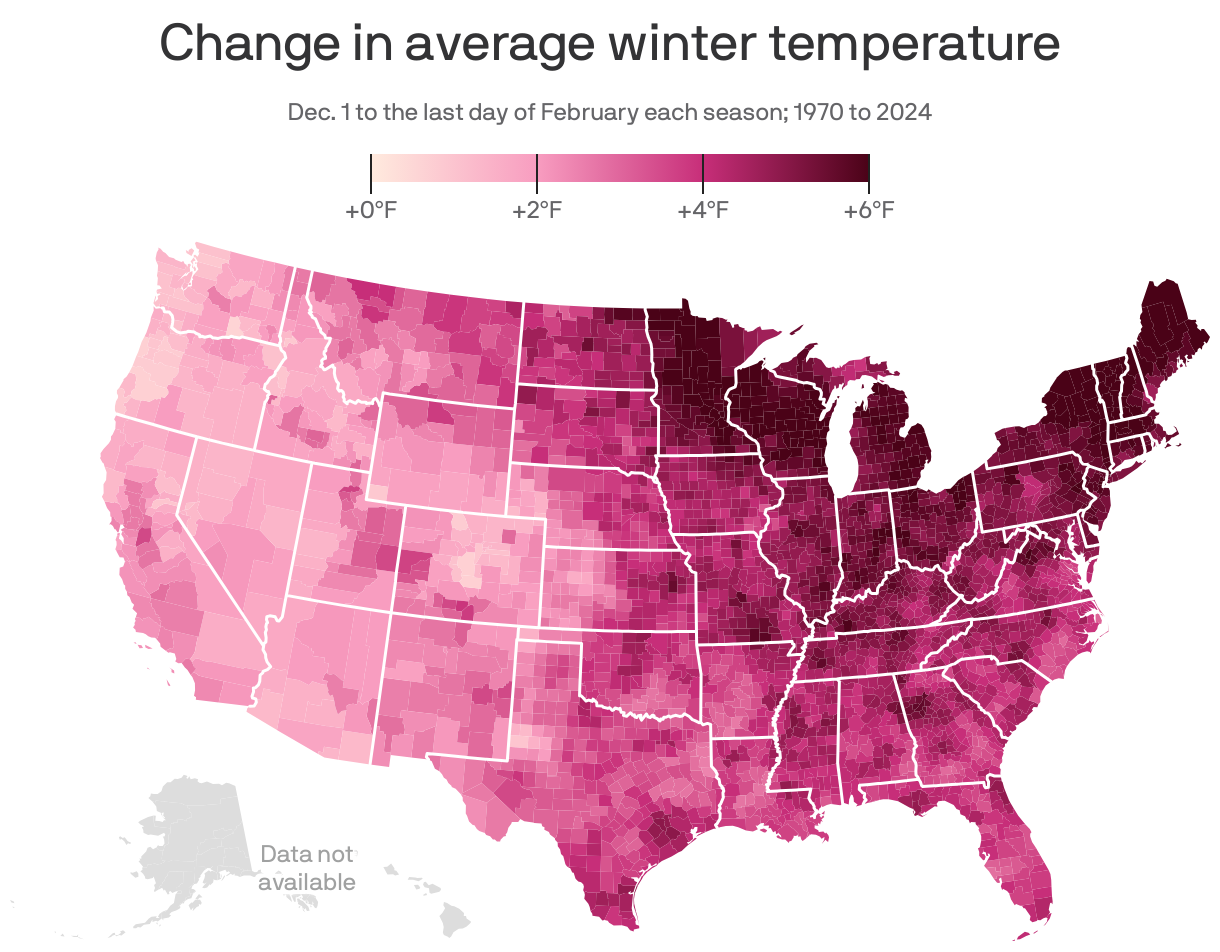
Winters are warming quickly across much of the Lower 48 states, particularly during the past three decades. This is tied to human-caused climate change.
Why it matters: Warming during meteorological winter, which runs from December through February, affects winter sports, recreation and water supplies and can even alter a region's cultural identity over time.
Zoom in: According to an analysis from the research group Climate Central, states known for their cold weather have seen some of the fastest warming rates.
- This includes counties in Minnesota, Wisconsin, New York, Vermont and Maine, the research shows.
3. 🚨New: Beta tests its first production plane

Beta Technologies yesterday completed its first test flight of an aircraft that rolled off the electric aircraft maker's new assembly line in Vermont, the company announced this morning.
Why it matters: The flight, for which the company received an FAA special airworthiness certificate, demonstrates how the electric aviation industry is moving from concepts and testing to routine production.
Zoom in: The first flight of the production line ALIA electrical conventional takeoff and landing aircraft, known as an eCTOL, lasted about an hour and took the plane to 7,000 feet while demonstrating various maneuvers.
- The test pilot was Kyle Clark, who is also Beta's CEO and founder.
- The flight comes about a year after the opening of the 200,000-square-foot production line in South Burlington.
- The company is selling both the conventional eCTOL version of ALIA and also a much-heralded eVTOL version that would open up new possibilities in urban transportation, outside of traditional airports.
Zoom out: The company's competitors, such as Joby Aviation, are also moving toward producing test aircraft while seeking to get assembly lines in place.
What's next: Beta aims to fly the plane to the standard 50 hours of flight test time before it is allowed to fly beyond Burlington and nearby Plattsburgh, N.Y., to train more pilots.
4. 🔭 Thune we'll know the IRA's future

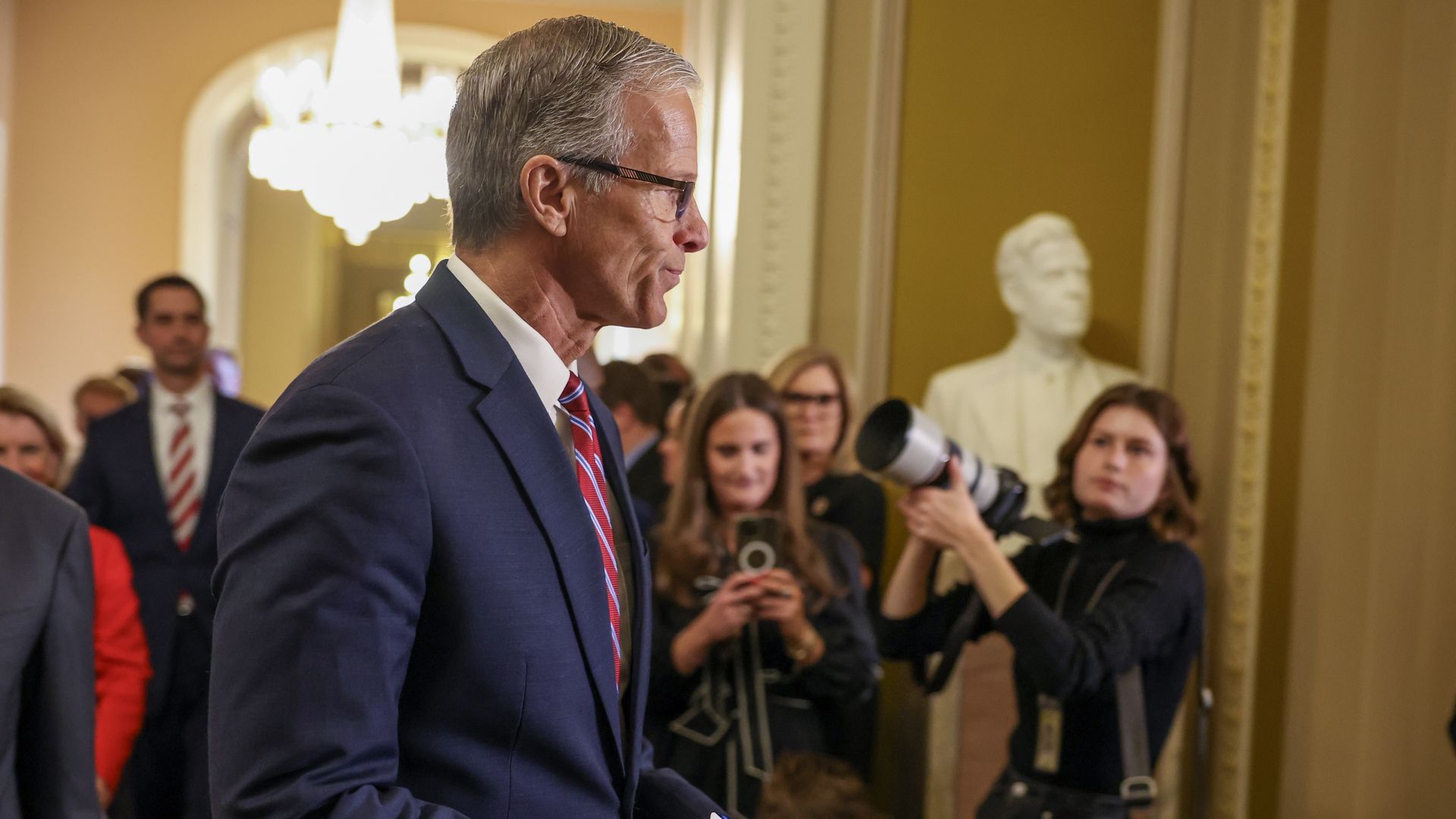
He doesn't have a deep background on energy issues, but Sen. John Thune (R-S.D.) is now one of the most important figures in the Trump "energy dominance" agenda.
Why it matters: As majority leader, he'll shepherd a major tax and spending package through the GOP conference and determine how the party will cut or revise the IRA.
The big picture: Thune's views on energy are broadly in line with his party: advocating "all of the above," revising regulatory laws and focusing on energy prices.
- His Fox News op-ed this week pledged to "take a hatchet to the regulatory apparatus choking our economy."
- That could take the form of Congressional Review Act resolutions to peel back regulations, including some IRA implementing rules.
What we're watching: How he balances competing interests.
- Thune's home state gets 55% of its power generation from wind, per EIA. And it produces lots of ethanol and hydropower.
- Thune has historically supported the wind production tax credit, and he's worked with Democrats on implementation of the IRA's provisions for sustainable aviation fuel.
- Thune has also worked to boost NOAA's weather and seasonal climate forecasting and led legislation on weather modeling and drought forecasts.
If you need smart, quick intel on energy and climate policy for your job, get Axios Pro Policy.
5. 🚘 A New York surprise and more newsy bites
🍎 It's back! But scaled back. New York Gov. Kathy Hochul is reviving plans to charge drivers a major fee for entering Manhattan below 60th Street.
- Why it matters: She stunningly shelved the congestion pricing plan in June, angering advocates who saw a template for targeting auto emissions.
- What's next: The initially planned $15 fee during peak hours will be scaled back to $9, per several outlets. ABC News has the details.
- The intrigue: Hochul's seeking to fast-track the revised policy on "a time frame that aims to pre-empt Mr. Trump's vows to kill the program," the NYT reports.
🛢️ Global oil supply will exceed demand by over 1 million barrels per day next year even if OPEC+ doesn't unwind voluntary production curbs, the International Energy Agency estimates.
- Why it matters: Weak consumption growth this year and next is a China story, among other things. Demand in the world's largest oil importer contracted for the sixth straight month in September, IEA said.
🧑⚖️ Via E&E News, "A divided federal appeals court has rejected the White House's authority to issue rules for how agencies should comply with the National Environmental Policy Act."
- What they're saying: ClearView Energy Partners sees climate fallout, with the majority's rationale "all but certain to reappear" in future challenges to NEPA reviews.
- The intrigue: Their note sees future legal fights over whether the White House can force agencies to consider CO2 emissions in the absence of binding EPA standards.
6. ⚛️ Flipping the script on AI and nukes

The idea of nuclear power help to fuel AI data centers is all the rage, but AI will be helping nuclear operations at a major California plant.
State of play: PG&E is deploying the AI startup Atomic Canyon's system at its Diablo Canyon site.
- Their program helps nuclear operators navigate vast documents and datasets needed for operating and licensing reactors.
- It will "deliver significant cost savings and improved operational efficiency," the companies said.
Why it matters: They're calling it the first commercial use of on-site generative AI deployment at a U.S. nuclear plant.
The big picture: Federal and state regulations require plant personnel to manage billions of pages of technical documentation, PG&E and Atomic said.
- The system, which uses Nvidia hardware, will help teams "access critical information faster and more reliably, allowing them to focus on high-value tasks and decision-making," they said.
The bottom line: "AI needs nuclear and nuclear needs AI," Atomic CEO Trey Lauderdale tells Axios Pro's Katie Fehrenbacher.
7. ⚖️ Legal number of the day: 76%
That's the share of corporate general counsels encountering disputes around energy transition, a Burford Capital report finds.
Why it matters: A plurality (47%) predict rising amounts of litigation over the next decade. Think conflicts between JV partners, IP disputes and much more.
The bottom line: They can be costly, too, with roughly two-thirds seeing fees and expenses north of $4 million per case and sometimes far more.
📨 Did a friend, colleague or even a frenemy send you this newsletter? Welcome, please sign up.
🙏 Thanks to Chris Speckhard and Chuck McCutcheon for edits to today's edition, along with the brilliant Axios Visuals team.