Axios Generate

July 19, 2023
🐪 Good morning, you're halfway there! Ben's away, so I'll be your guide for today amid a glut of climate news. Today's newsletter still has a Smart Brevity count of 1,242 words, 4.5 minutes.
🗓️ Join Axios Pro energy reporter Jael Holzman at 12:30pm ET Thursday for a virtual event featuring Sen. Lisa Murkowski and Rep. Eric Swalwell exploring Capitol Hill support for mining. Register to attend
🎶 With Peter Gabriel on tour, today's intro tune features his 1980 song featuring Kate Bush...
1 big thing: Canada wildfires' CO2 footprint
The simultaneous, record-shattering heat in the U.S., Europe and Asia may be getting all the headlines (more on these events below), but hotter and drier-than-average conditions are fueling the disaster unfolding in Canada.
Why it matters: As residents of the Midwest and East Coast have repeatedly learned this summer, Canada's devastating fires affect conditions elsewhere.
- Multiple rounds of smoke ejected from the massive blazes have caused air quality to deteriorate in some of America's biggest cities.
- The longer these fires burn — and the typical seasonal peak has not occurred yet — the stronger the climate feedbacks. That's increasing Canada's carbon emissions, and contributing to climate change.
The big picture: Wildfire season got a jump start with unusually hot weather across western Canada in May.
- Since then, each of Canada's provinces and lands from the Arctic to the Maritimes has come under the influence of areas of high pressure. Heat domes have slid from west to east and back again, as a repetitive and largely stuck weather pattern dominates North America.
- So far this season, 27.1 million acres have burned across Canada — an area larger than the state of Kentucky — and it's unlikely the fires will be extinguished until fall or winter when colder weather and precipitation arrives.
Zoom in: The Copernicus Atmosphere Monitoring Service tracks wildfire emissions via satellite monitoring by measuring the total amount of heat output from detected wildfires.
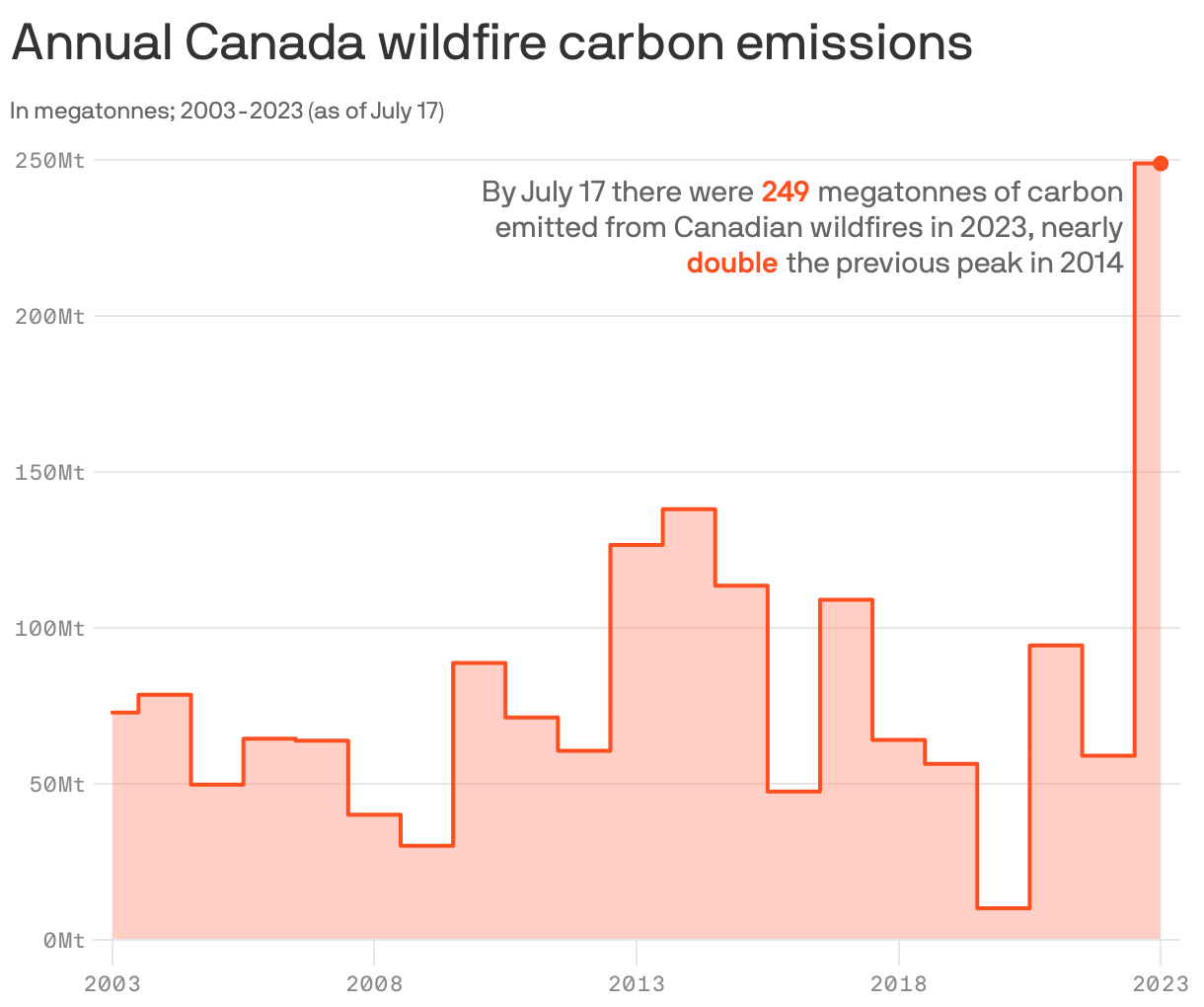
- According to Mark Parrington, a senior scientist at CAMS, the data shows this year will be "more than double" the previous highest annual total in 2014, with 249 million tonnes of carbon emitted through July 17.
- "We have just passed the mid-point of summer and fires in Canada typically peak in late July/August," Parrington tells Axios via email.
- He noted that the massive wildfires in the Far Eastern Federal District of Russia in 2021 emitted about 290 million tonnes of carbon.
- This year, Canada is on track to match or top that. In terms of carbon dioxide equivalent, its output so far this year is equal to about 914 million tonnes of CO2-equivalent.
The bottom line: Canada's wildfires are yet another warning sign of how quickly and clearly climate change is manifesting itself this summer.
2. Kerry cites "productive" talks in China

U.S. climate envoy John Kerry, left, greets Chinese Premier Li Qiang before a meeting Tuesday in Beijing, China. Photo: Florence Lo - Pool/Getty Images
John Kerry, the top U.S. climate diplomat, called negotiations with Chinese officials in Beijing "productive" but noted that other issues, including tensions over Taiwan and other matters, are obstacles in discussions, Reuters reports.
Why it matters: Cooperation between the world's two largest current emitters of greenhouse gases is essential to limiting global warming's severity and meeting the Paris targets.
The big picture: Kerry is trying to reset U.S.-China dialogue on climate ahead of COP28 in Dubai. This comes after a period of high tensions between the two countries over trade, Taiwan, manufacturing and other issues.
- "If we can come together over these next months leading up to COP28, which will be the most important since Paris, we will have an opportunity to be able to make a profound difference on this issue," he told Chinese vice president Han Zheng Tuesday night.
- "We're just reconnecting," he said. "We're trying to re-establish the process we have worked on for years."
- "We're focused on the substance of what we can really work on and what we can make happen," he told reporters in Beijing.
What they're saying: According to Li Shuo, senior advisor to Greenpeace East Asia, "People should see the visit as an effort to re-start dialogue. The way to evaluate a starting point is by what it starts, not what it concludes," he told Axios via email.
- Meanwhile, China's leader, Xi Jinping, who did not meet with Kerry, indicated in remarks made this week and reported in the official People's Daily Wednesday that China would determine its own pace of emissions cuts.
- “The pathway and means for reaching this goal, and the tempo and intensity, should be and must be determined by ourselves, and never under the sway of others,” Xi stated, per the New York Times.
3. Global heat waves: By the numbers
Illustration: Annelise Capossela/Axios
Astonishing record temperatures were set Tuesday across the Northern Hemisphere, with signs of more to come, write Axios' Rebecca Falconer and Andrew.
State of play: Tuesday marked the 19th straight day that Phoenix endured temperatures of at least 110°F, with a daily record high of 118°F.
- The city also recorded the most straight days with overnight lows at or above 90°F.
In Europe, cities across Spain recorded temperatures above 43°C (109°F) for the first time on record Tuesday.
- These included Girona, in the Catalonia region, which hit 45.3°C (113.5°F) in Figueres, according to AEMET, the state meteorological agency and weather record tracker Maximiliano Herrera.
Verdun, in France's northeast, reached 40.6°C (105°F) for the first time on record. The Alpine ski resort of Alpe d'Huez, at about 6,100 feet above sea level, hit a record 29.5°C (85°F), per Météo-France.
In Italy, Rome saw an all-time record for the city center, at 42.9°C (109.2°F). Further records were expected to be set on Wednesday; and again into early next week.
- The World Meteorological Organization warns Europe's hottest-ever temperature of 48.8°C, recorded on the Italian island of Sicily in 2021, could be broken this week.
Japan's Yokohama on Tuesday set a new record for its hottest July day when it reached 37.3°C (99°F) and Gotemba reached its highest-recorded temperature of 34.8C (95°F), per Herrera.
Of note: The heat wave in Europe and soaring temperatures elsewhere are likely costing lives. A study recently published in the journal Nature reported that about 61,000 people died in heat waves across Europe last summer.
4. A big, little nuclear reactor announcement

Illustration: Gabriella Turrisi/Axios
Energy Northwest and X-energy have announced a joint development agreement this morning for a large installation of up to 12 advanced, small modular reactors in central Washington state.
Why it matters: These reactors, if built to the full extent of the agreement, could generate up to 960 megawatts of electricity, with the first reactor slated to be online in Richland, Washington by 2030.
- This is another signal of the growing interest in small modular reactors for generating carbon-free electricity.
Between the lines: According to X-energy, if fully built as a 12-unit project, it will be larger than a previously announced project to provide power and steam for a Dow industrial facility in Texas.
- DOE awarded X-energy $1.2 billion in federal cost-shared funding to develop and demonstrate an advanced reactor and fuel fabrication facility by 2030.
5. When climate change became breaking news

Illustration: Victoria Ellis/Axios
It was long the case that climate reporters (including yours truly) struggled to find news pegs to describe the inexorable increase in global temperatures fueled by human-caused emissions.
Yes, but: Those days are over, for now, Andrew writes.
The big picture: The past few weeks since July 3, have brought a fusillade of breaking climate news like the world's hottest day, which was shortly eclipsed. Then more wildfires. Then simultaneous, compounding heat waves on at least three continents.
- Records fell, then ultimately shattered.
- Climate stories continue to make front-page news worldwide.
My thought bubble: Scientists have long predicted this outcome, though some of the impacts are arriving earlier than anticipated and at lower levels of warming. That is alarming considering our failure to bend the emissions curve downward.
- But this is not an "I told you so" moment.
- Instead, this collective focus on climate change, for however long it lasts (because like all news cycles, it will prove fleeting), has a "We're all in this together" vibe, along with accompanying side effects of exhaustion and foreboding.
- After all, the heart of hurricane season will be here soon...
Thanks so much for reading. If a friend forwarded you this email, please sign up! Thanks to Javier E. David for editing and Chris Speckhard for copy editing, along with the talented Axios Visuals team.
Sign up for Axios Generate

Untangle the energy industry’s biggest news stories