
Axios Generate

May 09, 2024

🧭 The weekend is appearing on the horizon. We'll travel light with 1,121 words, 4 minutes.
🦘 Situational awareness: Australia, a huge gas exporter, sees long-term supply investments under a major new strategy.
- It's the "latest shift by the center-left Labor government toward greater support for the fossil fuel," Bloomberg notes. Full document.
🎶 At this moment in 2002, Ashanti was well into a 10-week run atop the Billboard Hot 100 with today's beautiful intro tune...
1 big thing: The kids think Biden's all right (on climate)
Exclusive: A glowing new tally of President Biden's enviro record from a progressive coalition signals White House political progress on shoring up the climate movement's restive left flank.
Driving the news: The pro-Democratic group Climate Power's memo, co-released by over 20 groups, credits Biden with 320+ "climate, conservation, public health and clean energy actions."
Why it matters: Young climate-conscious voters are part of his base, but some activists have wanted a harder White House line on fossil fuels.
The intrigue: The youth-led Sunrise Movement, which years ago helped push the "Green New Deal" idea onto the national stage, is among the backers.
- The organization has warned that Biden risks alienating young voters and has decried steps including approval of the Willow oil project in Alaska.
- But it has also cheered steps name-checked in the new memo, like the pause on new LNG export licenses and creation of the American Climate Corps.
What they're saying: "President Biden has delivered critical climate action in his first term," said Sunrise Movement campaign director Kidus Girma in a statement alongside the memo.
- But Sunrise cautions that Biden must keep taking "bold" steps.
State of play: Other groups on the memo include Green Latinos, the League of Conservation Voters, Indivisible, and the Sierra Club.
- Climate Power tells Axios it plans to use the document as a persuasion tool.
- The analysis says the policies tallied have created over 270,000 jobs and are on a path to creating millions more.
Yes, but: While surveys show Democratic voters want strong steps on climate, what that means in states that will decide the election — and how much voters connect Biden's climate record to the economy — is unclear.
- For instance, Pennsylvania produces tons of natural gas, and its Democratic senators have misgivings about Biden's liquefied natural gas policy.
- Or consider writer Josh Barro bashing the "zombie idea" that Biden's vulnerability is among young activists who want Biden to move left on climate and Gaza.
- In reality, the problem is the "less-engaged, less-ideological voter who's upset about inflation," he writes.
The bottom line: The take-o-sphere has plenty of dueling analyses about whether climate will actually be salient in 2024.
- But if the kids think Biden's all right, it could help politically.
2. A deadly night of storms amid an extreme spring

The third straight day of a severe weather outbreak killed at least two people in the South Central states and Carolinas last night and knocked out power to more than 100,000 people.
Threat level: Multiple tornado and flash flood emergencies, the most dire type the National Weather Service uses, were issued for Tennessee last night.
- Tornadoes touched down in that state as well as Illinois, Kentucky and Missouri, among others.
- A rare long-lasting flash flood emergency was issued last night for two counties north of Nashville, lasting into this morning after more than 7 inches of rain fell.
- Climate change is increasing the odds and severity of heavy precipitation events, though its ties to tornado outbreaks are more complex.
The big picture: The spate of tornadoes seen across the U.S. since April 1 has hit areas from the Gulf Coast to the Plains states, with a concentration in the Plains and Central states.
What's next: Still more severe weather is on tap for today, with the region at greatest risk stretching from the southern Plains to the Southeast, and northward into the Mid-Atlantic states.
3. A renewable record — but not a victory lap
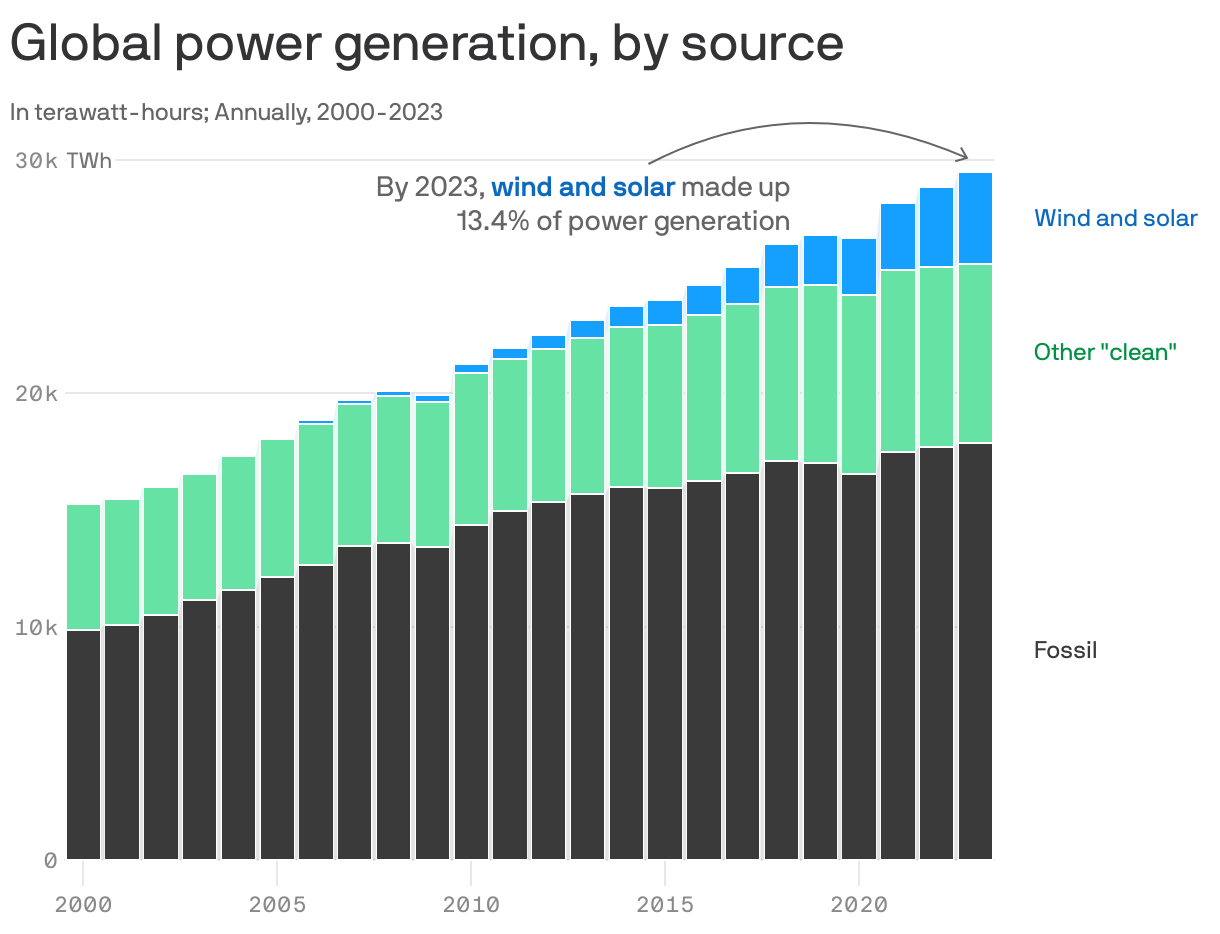
Growing solar and wind generation helped push renewables' share of global power output to 30% last year — yet carbon emissions from electricity still ticked up again, new data shows.
Why it matters: Historically, the rise of climate-friendly energy has been additive to fossil fuels, as overall demand has grown.
- But the climate think tank Ember's report sees an inflection point arriving now.
- "[T]he latest forecasts give confidence that 2024 will begin a new era of falling fossil generation, marking 2023 as the likely peak of power sector emissions," it states.
Yes, but: Even if that peak just happened, Paris Agreement targets or anything close require steep emissions cuts that aren't in evidence yet.
4. La Niña likely lurks just around the corner
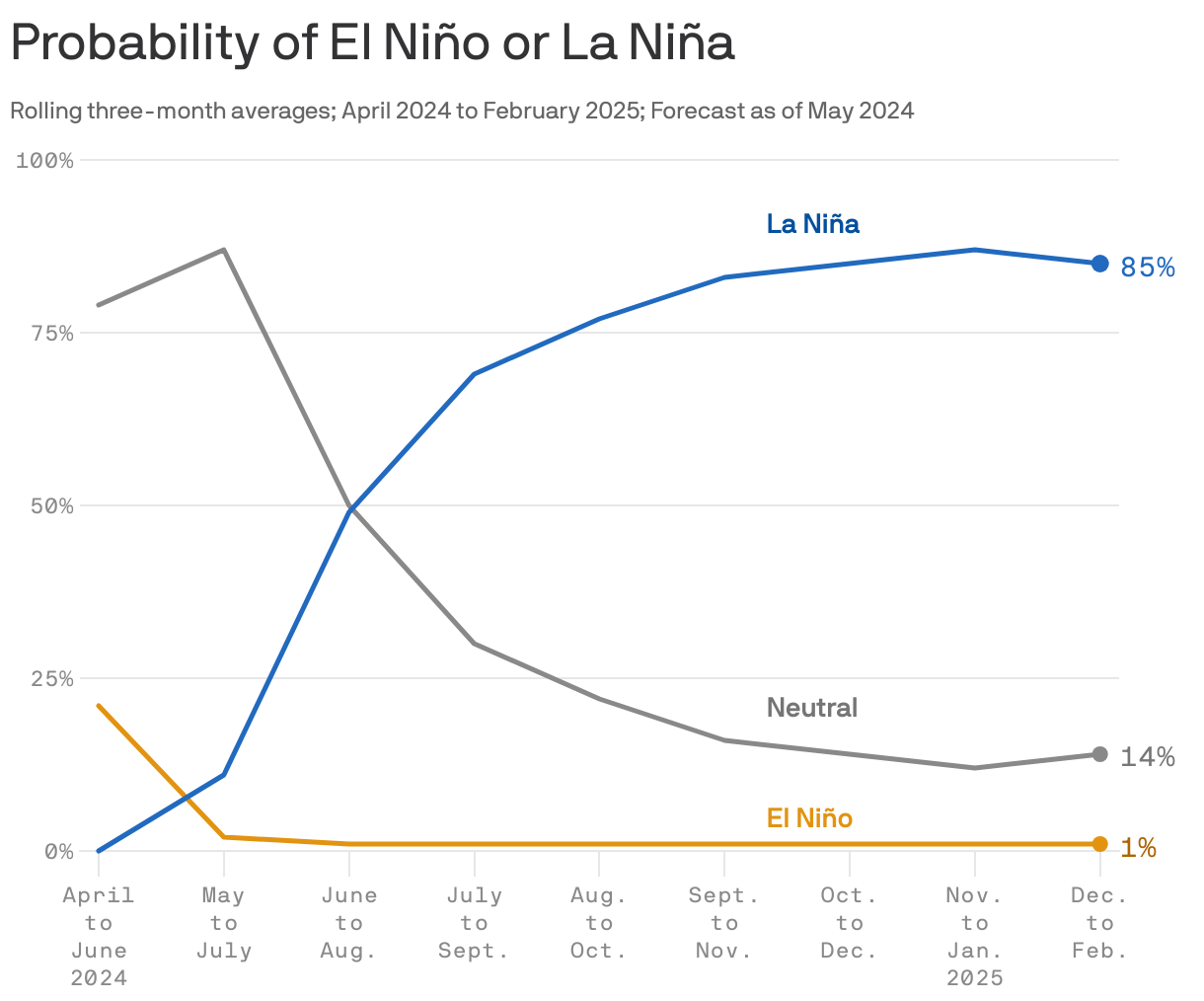
A once boisterous El Niño in the tropical Pacific is weakening and may give way to ENSO-neutral conditions as early as next month, according to new NOAA data.
Why it matters: A La Niña event is likely to take shape later this summer. The rapid transition would give a significant boost to the Atlantic hurricane season by lowering the wind shear across the Atlantic that can tear such storms apart.
- A La Niña occurring at the same time as record warm North Atlantic Ocean temperatures could make for one of the busiest Atlantic hurricane seasons on record, forecasters warn.
Driving the news: According to the latest update NOAA released this morning, the temperature anomalies in the equatorial tropical Pacific that are El Niño's hallmark are cooling. Soon, they will fall below the threshold for an El Niño to be formally declared.
Zoom in: The latest odds of La Niña show a sharp increase in probabilities from just 11% in May through July, to 69% in July through September.
What they're saying: "At this point we're still on target for a transition to La Niña during the summer or summer-ish season," meteorologist Michelle L'Heureux, who leads NOAA's ENSO forecasting team, tells Axios via email.
- Still, she said, the transition will take some time, noting the presence of a lot of unusually warm water in the equatorial Pacific Ocean.

5. On my screen: petro-state edition
⚔️ White House opposition to Ukraine's drone strikes on Russian refineries is misplaced, a Foreign Affairs essay argues.
- Why it matters: Biden officials fear it will tighten global energy markets, yet: "These strikes reduce Russia's ability to turn its oil into usable products; they do not affect the volume of oil it can extract or export," write Michael Liebreich, Lauri Myllyvirta, and Sam Winter-Levy.
- How it works: "In fact, with less domestic refining capacity, Russia will be forced to export more of its crude oil, not less, pushing global prices down rather than up." But the strikes help degrade Russia's financial and logistical ability to wage war, they say. Full essay.
🌡️ Several key oil-producing countries are among the major carbon emitters most threatened by global warming, per new Verisk Maplecroft analysis.
- Why it matters: Nations like Saudi Arabia, Brazil and the United Arab Emirates are at risk from extreme heat that could be a "pervasive drag on many types of economic activity."
- The big picture: The study estimates increases in the average and maximum number of days with temps above 35˚C (95°F) by 2080 under various emissions scenarios.
- The bottom line: "Our analysis reveals a clear overlap between those perpetuating global warming and the societies and economies set to face the harshest consequences," Verisk's James Lockhart Smith said.
📫 Did a friend send you this newsletter? Welcome, please sign up.
🙏 Thanks to Chris Speckhard and Javier E. David for edits to today's edition, along with the brilliant Axios Visuals team.
Sign up for Axios Generate