Axios Generate

March 06, 2025

🗞️ Good morning. We've got a newsy edition that's 1,279 words, 5 minutes.
🎸 Happy birthday to Pink Floyd guitarist and leader David Gilmour, whose transcendent skill summons animal spirits on today's intro tune...
1 big thing: No February heat record — but it was third-warmest
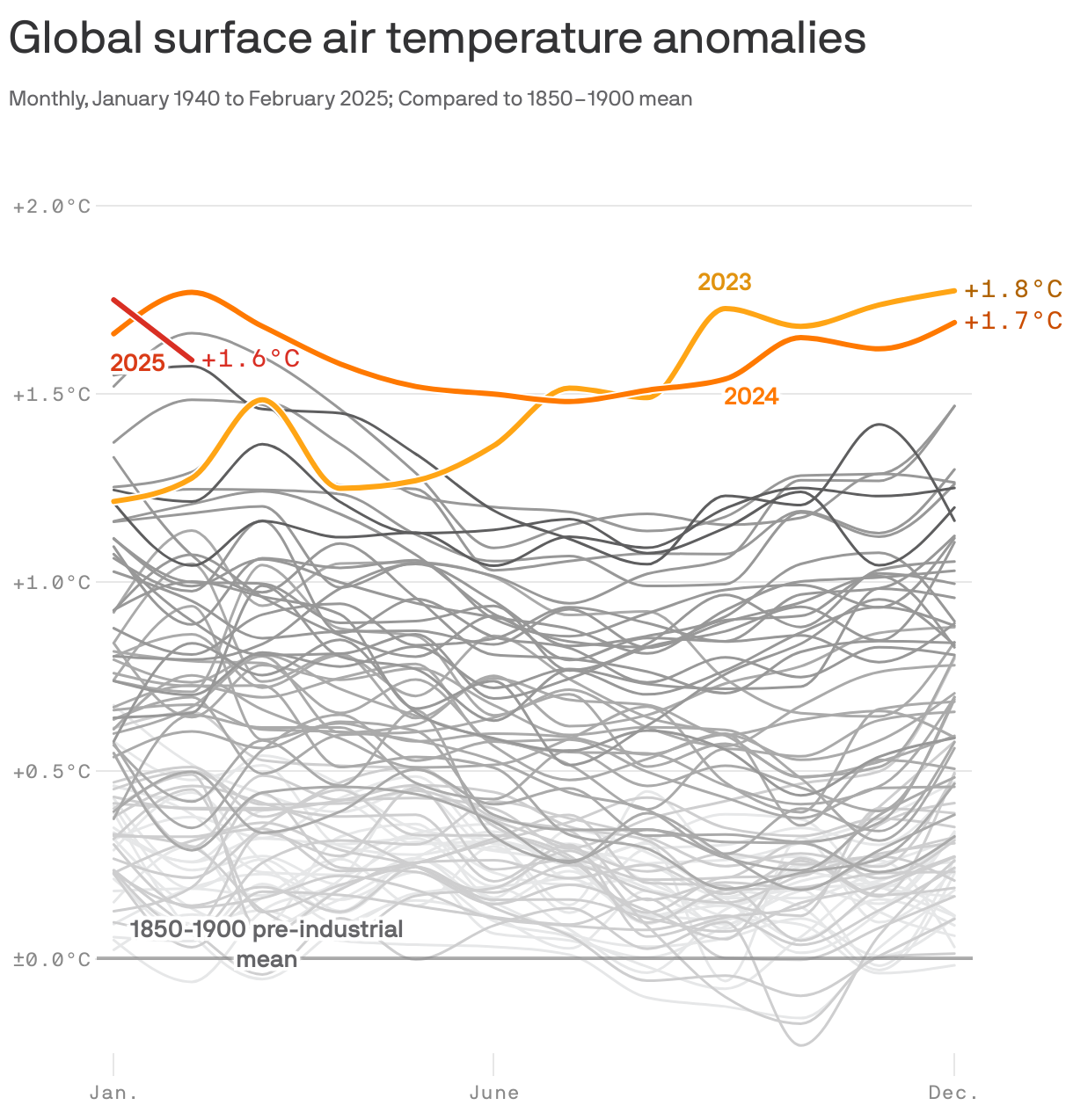
The planet had its third-warmest February on record, following a surprise record-hot January, new data shows.
Why it matters: This is the first month that's not the first or second-hottest on record since June 2023.
- It may indicate some slight cooling relative to the not fully explained, record-shattering heat of the past two years.
- Global sea ice extent hit a benchmark low, however.
Zoom in: The new data, from Europe's Copernicus Climate Change Service, shows the planet had a far cooler February compared to January, with the U.S. and Canada standing out as the most unusually cold regions.
- February had a global average surface temperature that was 1.59°C (2.86°F) above the preindustrial average.
- This made it the 19th month out of the past 20 to exceed 1.5°C above the preindustrial level.
The 1.5°C threshold is an aspirational temperature target under the Paris climate agreement.
- Studies have shown that should the climate warm beyond it, which is almost certain at this point, the odds of potentially disastrous climate change effects become more likely.
The intrigue: The persistent record heat, which began in 2023 and may only now be letting up slightly, hasn't been fully explained by known factors in addition to human emissions of greenhouse gases from burning fossil fuels.
- The other factors that may have contributed extra warming range from changes in marine shipping fuels to El Niño and La Niña and shifts in maritime cloud cover.
- Climate scientists are still studying the record warmth of the past two-plus years, with some buying into the possibility that global warming may have accelerated, at least in the short term.
Yes, but: February's dip in temperatures could be temporary, with more records resuming in coming months.
In the Arctic, where sea ice is nearing its seasonal maximum, the ice extent was its lowest on record for the third month in a row.
- Antarctic sea ice may have hit its lowest seasonal minimum extent on record, but that won't fully be known for another month, Copernicus stated.
What they're saying: "The current record low global sea ice extent revealed by the Copernicus analysis is of serious concern, as it reflects major changes in both the Arctic and Antarctic," Simon Josey of the U.K.'s National Oceanography Centre said in a statement.

2. 👀 Breaking: LNG player unveils major expansion
Venture Global LNG plans to expand its existing Plaquemines export facility in Louisiana with a roughly $18 billion investment, the company said.
Why it matters: This would raise the capacity of Plaquemines, which began initial shipments in December, by over 18 million tons annually to reach over 45 million, Venture said.
- It will be North America's biggest LNG facility, "supplying LNG to our allies while making a substantial impact on the U.S. balance of trade," CEO Mike Sabel said in a statement.
The big picture: Today's announcement is a clear sign of LNG's political priority in Trump 2.0.
- Both DOE boss Chris Wright and Interior Secretary Doug Burgum will give remarks later today at the plant.
Friction point: Climate activists oppose LNG expansion, while supporters say it helps displace coal abroad.
- Biden officials produced a report late last year warning that "unfettered" exports would raise domestic prices and worsen emissions.
- But the conclusions are highly contested — and disregarded by Trump's team. "We believe this will be the best regulatory environment in decades," Sabel said.
What we're watching: The market reaction and pending DOE permit decisions on Venture's separate CP2 project.
- Venture, which also reports earnings today, has seen its share price slide since going public in January.
3. ⛅ Google Cloud markets AI weather forecasts to energy firms

Google's Cloud division is taking a major step toward making operational recent gains in AI weather forecast models and marketing them for the energy industry, the company tells Axios.
Why it matters: This is a prominent example of a tech company that invested in developing AI models to make the transition from research to applications.
- AI weather models are in their infancy but have demonstrated remarkable accuracy. Those advances have come as certain extreme weather events are becoming more intense and frequent due to human-caused global warming.
Driving the news: Google Cloud is marketing two AI forecast models to its enterprise cloud customers.
- Both were developed by Google DeepMind and used historical weather data to make predictions about future conditions out to 10 to 15 days in advance.
- One model, previously known as GenCast, bested some of the world's most accurate modeling systems.
The big picture: The tech industry has largely led the charge on AI modeling given its expertise working with large datasets and access to significant computer resources.
- Google, Microsoft and Nvidia have each pursued the development of AI weather models despite none of them being a strictly weather and climate company.
- However, Google is now out in front when it comes to bringing its models to market.
What's next: Google Cloud is bringing two models, branded as WeatherNext, to its Cloud enterprise customers to try to help them plan for extreme weather.
- The energy industry is a key customer given companies' needs to plan for changing weather conditions, Pete Battaglia, director of research for sustainability at Google DeepMind, told Axios in an interview.
4. 😮 More Google! Tech giant boosts geothermal push
Breaking: Google, oilfield services giant SLB and the geothermal nonprofit Project Innerspace just unveiled joint work to help boost the tech's deployment.
Why it matters: Geothermal is a massive untapped source that today provides just roughly 1% of global electricity.
Driving the news: The new effort combines data from Project Innerspace's GeoMap tool, which is supported by Google cloud and AI services, with SLB's consulting services.
- The goal: Help speed the identification and deployment of resources worldwide.
What's next: The collaboration envisions a service that SLB will sell.
- They're planning talks with energy companies at the CERAWeek by S&P Global conference in Houston next week, said Kyle Jessen, the managing director for Google Cloud's energy sector.
5. ↔️ Big Oil's narrowing climate divide
Wood Mackenzie data illustrates how Big Oil's transatlantic strategy divide is narrowing as key European players boost focus on fossil fuels.
Why it matters: Oil majors have real influence — though easily overstated — on the pace of energy transition.
- Their strategies also reflect C-suite views on future demand, where they can best compete, and how to win shareholder love.
- "Current project economics heavily favour investment in upstream over low carbon," Woodmac analysts write.
The big picture: For years BP, Shell and some others had more aggressive transition strategies than U.S. giants. But Woodmac now sees a re-convergence.
- "The Euro Majors had committed an average of 40% of total investment to low carbon projects in 2024, but Shell, Equinor and now BP are rebasing around 15% to 20%," they write.
- "ExxonMobil and Chevron, going in the opposite direction, are now 15% and 10%, respectively."
Yes, but: TotalEnergies' strategy has been steadier, underpinned by expansion in integrated power markets, Woodmac's Tom Ellacott said.
- Low carbon should be roughly 26% of its 2025 net capital spending and roughly 30% through 2030, he said via email.
The intrigue: Low-carbon investments from state-owned giants — Aramco, Adnoc and others — have surpassed Western majors, Woodmac finds.
- But it remains a smaller portion of their free cash flow.
What we're watching: The take from execs at next week's big CERAWeek conference.
6. ⚛️ Quote du jour: Nuke waste edition
"That doesn't sound very interim to me."— Supreme Court Justice Neal Gorsuch at yesterday's argument about whether federal regulators can license long-term, private nuclear waste storage sites
Why it matters: Multiple justices appeared skeptical, per Reuters and others, noting the project in question would have a 40-year license that could be renewed.
- "Where is the incentive to go forward to do what Congress wanted to have done, which is to establish a permanent facility?" Justice Samuel Alito said.
- H/t AP on Gorsuch.
📧 Did a friend, colleague or an AI chatbot send you this newsletter? Welcome, please sign up.
🙏 Thanks to Chris Speckhard and Chuck McCutcheon for edits to today's edition, along with the brilliant Axios Visuals team.
Sign up for Axios Generate