
Axios Generate

December 18, 2024

🐪 Halfway there! We'll get over the hump with 1,344 words, 5 minutes.
🦖 This week in 1970, glam-rock pioneers T. Rex released a self-titled album that provides today's intro tune...
1 big thing: The gas and the fury
Yesterday brought a savagely competitive moment in the react-statement market as everyone (er, everyone in energy world) weighed in on DOE's long-awaited LNG report.
Why it matters: The outpouring shows the high stakes of the export analysis that offered a downcast climate and economic view of OK-ing many more projects.
👟 Catch up quick: DOE found that "unfettered" exports would raise domestic prices and worsen emissions, with gas displacing more renewables than coal abroad. Axios' Daniel Moore has more.
What's next: When he takes office, Donald Trump wants to quickly start approving more export permits.
- The big question is whether the report creates hurdles for deciding that permits are in the "public interest" — which was the norm until President Biden's team's "pause."
⚔️ Friction point: Public Citizen attorney Tyson Slocum says it instantly became a formal part of DOE permit proceedings.
- "[H]aving the DOE itself attest to the consumer impacts will make it far more difficult for Trump to approve these pending applications," he said via email.
- If Trump does, Slocum said that in court, "we can say that Trump ignored the peer-reviewed data showing how American families will see higher energy burdens."
The other side: "In all likelihood, the report will be withdrawn by the next administration to remove any patina of authoritativeness it might have," Bracewell attorney Scott Segal, whose firm works with LNG exporters, said in a statement.
- Segal said one lever for withdrawal of the study — which he and other critics call flawed — would be determining that it doesn't meet formal White House Office of Management and Budget data-quality guidelines.
- TD Cowen analysts, in a note, see Trump "structuring a new standard which presumes all LNG exports are in the public interest."
The big picture: The U.S. is the world's largest LNG exporter, and DOE notes that shipments are slated to double by 2030 with just existing authorizations.
- Going much further by allowing "unconstrained" exports could raise costs for the average U.S. household by well over $100 by 2050, the report finds.
- "A business-as-usual approach is neither sustainable nor advisable," Energy Secretary Jennifer Granholm told reporters.
Threat level: Shipments beyond what's already green-lit could bring emissions of 1.5 gigatons of CO2-equivalent annually in 2050 — about a fourth of the U.S. total, DOE said.
- That's an eye-popping stat! But it doesn't consider "market effects" of exported gas, like changes in energy demand and the sources used to meet it, which can displace dirtier fuels.
Yes, but: A new S&P Global study finds big U.S. economic benefits from LNG, and export growth having negligible effects on future domestic prices.
- The report concludes that under an "extended" halt to approvals, 85% of the "energy gap" comes from fossil fuels outside the U.S.
- The U.S. Chamber of Commerce, which opposed Biden's pause, supported the research.
🔭 What we're watching: How the report surfaces political, regulatory and legal battles ahead.
2. 🇨🇦 Bill Gates-backed fund gives carbon removal firm $40 million
Deep Sky, a Canadian developer of carbon removal projects, has landed a $40 million grant commitment from the Bill Gates-backed fund Breakthrough Energy Catalyst.
Why it matters: The investment signals the $1 billion-plus Breakthrough Energy Catalyst fund's interest in demonstration projects in the carbon removal sector.
Zoom in: The fund is aimed at filling financing gaps for clean tech projects and made its first investment in a sustainable aviation fuel project in West Texas.
- Deep Sky plans to use the money to build what it's now calling Deep Sky Alpha (previously known as Deep Sky Labs) in Alberta, with research, development, testing and deployment of new direct air capture technologies.
- According to a Deep Sky news release, this is Catalyst's first investment in Canada as well as first commitment to a direct air capture project.
The intrigue: Deep Sky is seeking to lower the cost of direct air capture technology, since it currently remains too expensive to be used at scale for reducing the amount of planet-warming carbon dioxide in Earth's atmosphere.
- In its most recent reports, the UN's top climate science panel found that direct air capture and other technologies to bring CO2 levels down once emissions reach net zero would likely be needed in large quantities.
- The financing for Deep Sky is in the form of a grant to help the company navigate the steeper costs of shepherding early-stage and risky technologies.
Deep Sky Alpha will be capable of testing multiple DAC technologies simultaneously.
- It's scheduled to deliver its first carbon removal credits by the spring of next year, and Damien Steel, Deep Sky's CEO, said the company is "unapologetically ambitious."
3. 😮 A mammoth — but tentative — data center nuclear deal
Sam Altman-backed reactor startup Oklo and data center developer Switch hope to deploy 12 gigwatts (!) worth of nuclear projects through 2044, they said this morning.
Why it matters: The headline number is the biggest of the deals emerging to supply data centers with nuclear power as AI energy needs grow.
Reality check: It's tentative.
- The plan "establishes a framework for collaboration, with the expectation that individual binding agreements will be finalized as project milestones are reached," the announcement states.
Go deeper: Our sister newsletter Axios Pro: Climate Deals has more.
- And I recommend subscribing for a steady diet of scoops and smart analysis.
4. 🎉 Bonus climate tech notes: big swings edition
💵 Speaking of carbon removal, the Frontier group of corporate giants brokered another $80 million worth of agreements with a pair of startups.
- Why it matters: The deals with CO280 and CREW Carbon underscore a wider trend we flagged in September — methods that integrate into big industrial sectors.
- Driving the news: Buyers will pay CO280 — which aims to pull carbon from pulp and paper mills — $48 million to remove 224,500 tons of CO₂ between 2028 and 2030. CREW's deal is for $32 million to remove 71,878 tons of CO₂ from wastewater treatment between 2025 and 2030.
- The bottom line: The overall volumes are small in the grand scheme of things, but these are important days for seeing if removal can scale into a real weapon against climate change.
⚛️ The dream of fusion is taking another step toward reality with Commonwealth Fusion System's announcement that it will "build the world's first grid-scale commercial fusion power plant" in Virginia.
- Why it matters: Fusion holds the promise of massive energy without the dangerous waste associated with fission reactors, but going from the lab to the real world remains a steep climb.
- State of play: If all goes well, Commonwealth — whose backers include Jeff Bezos and Bill Gates — sees the "ARC" plant coming online in the early 2030s. It would provide 400 megawatts — "enough energy to power large industrial sites or about 150,000 homes," the announcement states.
- What we're watching: That "if" part. Commonwealth aims to have its demo project in Massachusetts show net fusion energy in a couple of years. "We still have plenty of work to do, obviously," said CEO Bob Mumgaard tells the NYT.
5. 📊 Coal use keeps setting new records
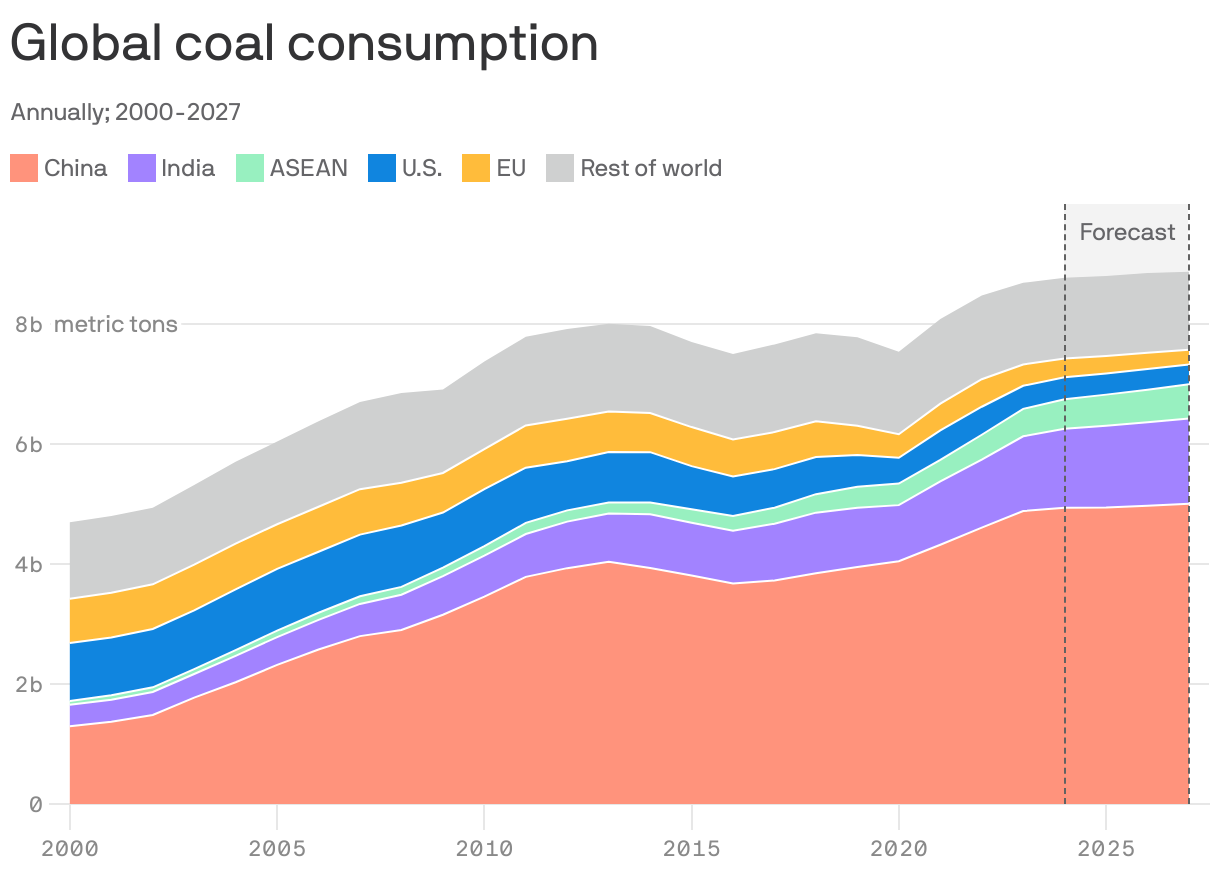
The world's appetite for coal is growing more slowly these days but still setting fresh records, new International Energy Agency data shows.
Why it matters: It's the most CO2-emitting fuel. That ☝️ chart is one reason why Paris Agreement climate goals are fast slipping out of reach.
🖼️ The big picture: Coal demand is falling in the U.S. and Europe, but the pace has "significantly" slowed, IEA's report finds.
- It's rising in emerging economies including India, where it grew 5% this year.
- As always, coal's path depends largely on China, the dominant consumer. Its power plants burn a third of all coal used worldwide.
- Electricity needs are rising there, but so is deployment of renewables.
What's next: Global use could plateau through 2027 as renewables growth helps meet rising energy demand, IEA finds.
6. 🧮 Power number of the day: 132 gigawatts
That's the projected rise in peak U.S. summer demand over the coming 10 years, per a new analysis from the North American Electric Reliability Corp.
Why it matters: The group, which works with federal regulators, says this 16% boost helps show the "critical reliability challenges facing the industry."
It sees risks of supply shortfalls in some areas during summer and winter demand peaks.
📨 Did a friend, colleague or even a frenemy send you this newsletter? Welcome, please sign up.
🙏 Thanks to Chris Speckhard and Chuck McCutcheon for edits to today's edition, along with the brilliant Axios Visuals team.
Sign up for Axios Generate


/2024/12/18/1734490407012.gif?w=3840)