No February heat record — but it was still Earth's third-warmest

Add Axios as your preferred source to
see more of our stories on Google.
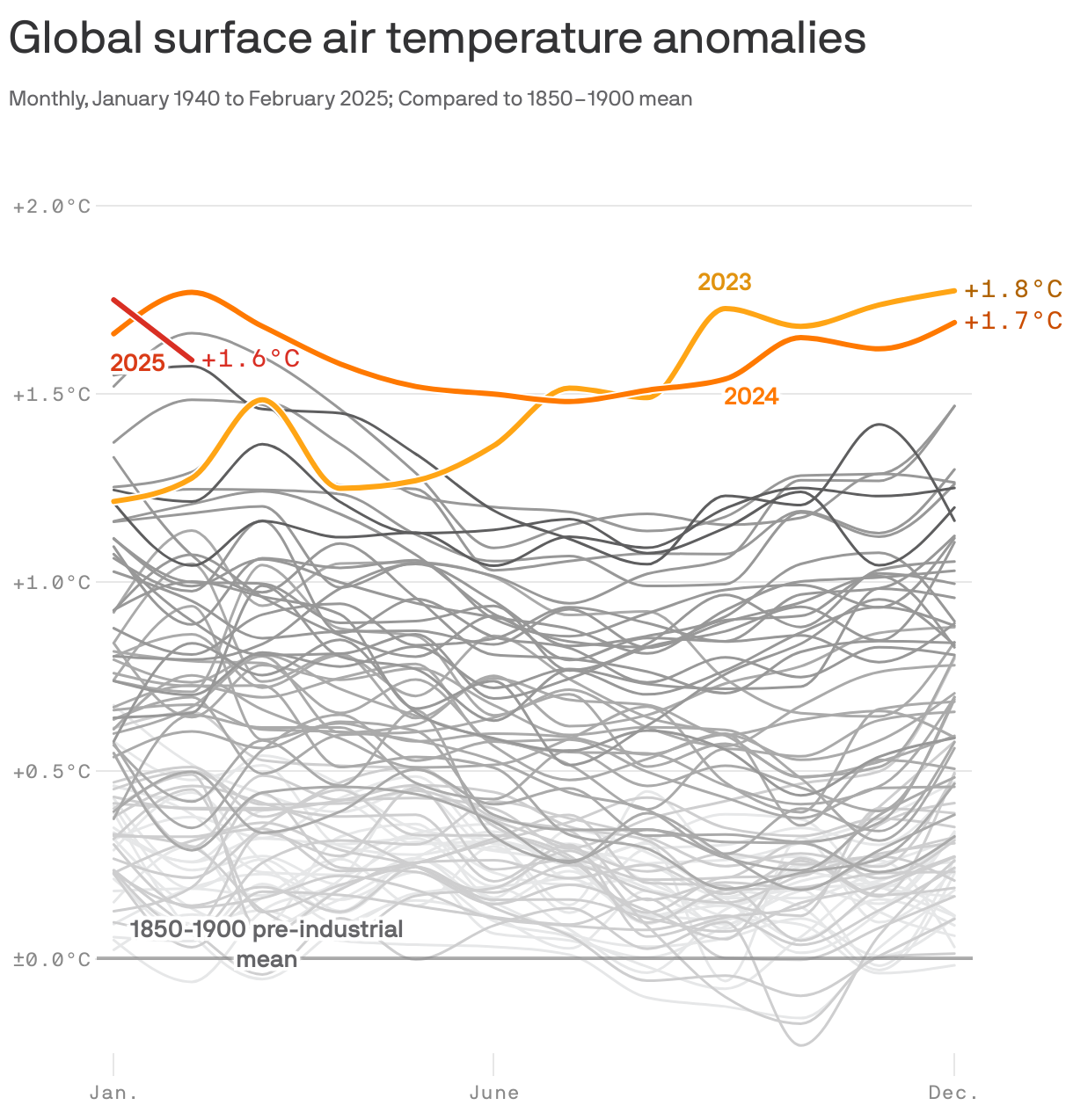
The planet had its third-warmest February on record, following a surprise record-hot January, new data shows.
Why it matters: This is the first month not to be the first or second-hottest on record since June 2023. It may indicate some slight cooling relative to the not fully explained, record-shattering heat of the past two years.
- Global sea ice extent hit a benchmark low, however.
Zoom in: The new data, from Europe's Copernicus Climate Change Service, shows the planet had a far cooler February compared to January, with the U.S. and Canada standing out as the most unusually cold regions.
- February had a global average surface temperature that was 1.59°C (2.86°F) above the preindustrial average.
- This made it the 19th month out of the past 20 to exceed 1.5°C above the preindustrial level.
The 1.5°C threshold is an aspirational temperature target under the Paris Climate Agreement.
- Studies have shown that should the climate warm beyond it, which is almost certain at this point, the odds of potentially disastrous climate change effects become more likely.
The intrigue: The persistent record heat which began in 2023 and may only now be letting up slightly, hasn't been fully explained by known factors in addition to human emissions of greenhouse gases from burning fossil fuels.
- The other factors that may have contributed extra warming range from changes in marine shipping fuels to El Niño and La Niña and shifts in maritime cloud cover.
- Climate scientists are still studying the record warmth of the past two-plus years, with some buying into the possibility that global warming may have accelerated, at least in the short term.
Zoom out: The Copernicus report is based on reanalysis data, specifically the ERA5 data set.
- Reanalysis involves taking billions of measurements from satellites, ships, aircraft and weather stations around the world to accurately estimate in near real-time global weather and climate conditions.
- Global sea ice extent, which combines the sea ice extents of the Arctic and Antarctic, set a new minimum for the month.
In the Arctic, where sea ice is nearing its seasonal maximum, the ice extent was its lowest on record for the third month in a row.
- Antarctic sea ice may have hit its lowest seasonal minimum extent on record, but that won't fully be known for another month, Copernicus stated.
Yes, but: February's dip in temperatures could be temporary, with more records resuming in coming months.
What they're saying: "The current record low global sea ice extent revealed by the Copernicus analysis is of serious concern as it reflects major changes in both the Arctic and Antarctic," said Simon Josey of the UK's National Oceanography Center, in a statement.
