
Axios Generate

February 08, 2024
⛵ Let's set sail into Thursday. There are only calm seas ahead — this edition has a Smart Brevity count of 1,179 words, 4.5 minutes.
🎸 This week marks 35 years since Elvis Costello released the album "Spike," which provides today's intro tune...
1 big thing: El Niño, we hardly knew you
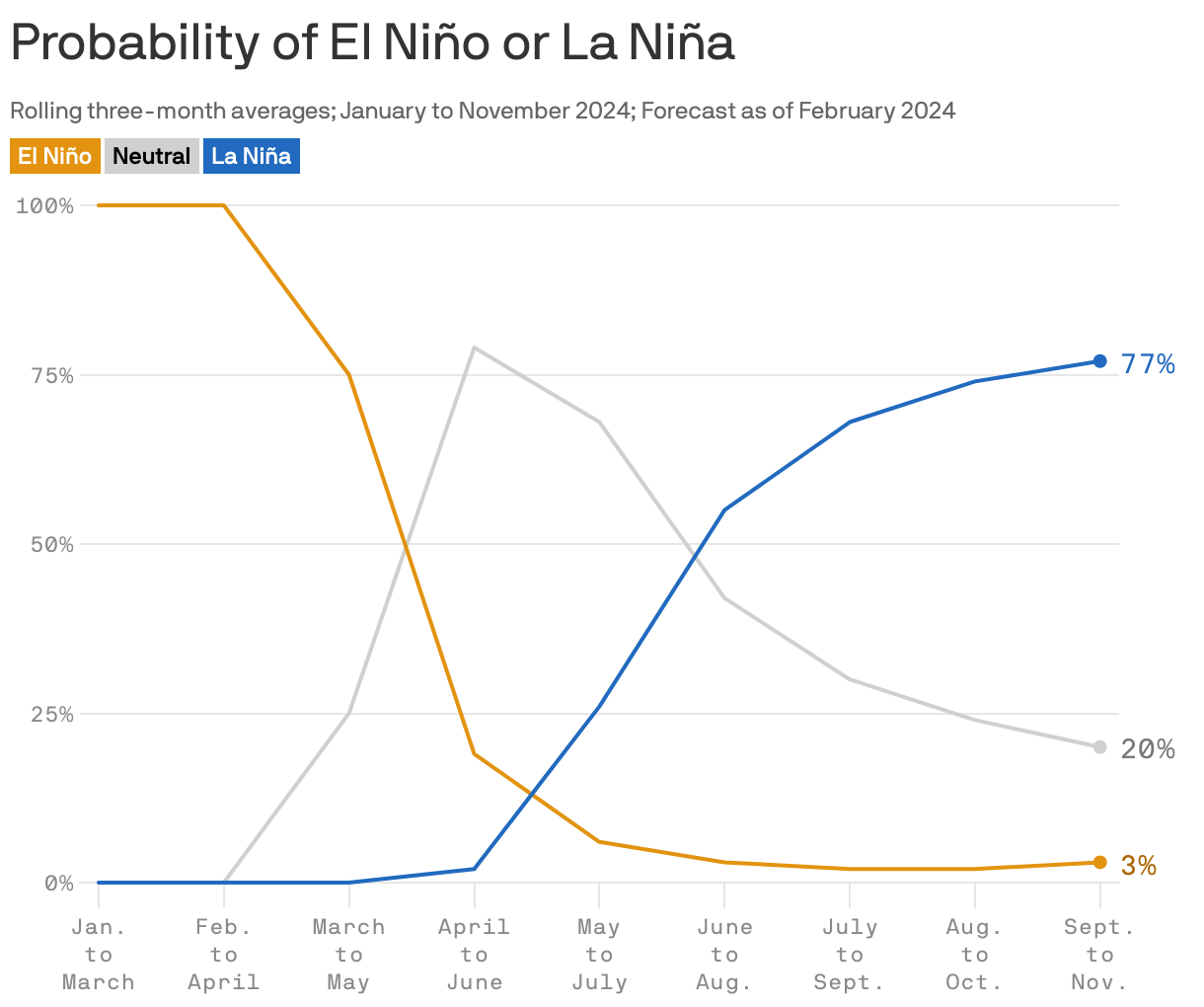
The National Oceanic and Atmospheric Administration (NOAA) issued a La Niña watch this morning, indicating that the current strong El Niño may be headed for the exits, Andrew writes.
Why it matters: If the tropical equatorial Pacific Ocean shifts into its cooler La Niña phase, a cascade of extreme weather and climate impacts could be touched off worldwide.
Zoom in: The El Niño still underway features milder-than-average ocean waters in the equatorial tropical Pacific Ocean and associated shifts in the atmosphere. There are increasing signs that a transition is afoot.
- A "watch" means that conditions are favorable for the development of La Niña within the next six months.
- In its new forecast discussion, NOAA states there is now a 79% chance that El Niño will shift to "ENSO-neutral" conditions (without either El Niño or La Niña) by the April through June period.
- And it notes "increasing odds" that La Niña will develop during the summer months of June through August, with about a 55% chance during that period.
Threat level: By the September through November period, the forecast calls for a 77% chance of a La Niña making an appearance.
- A potential La Niña developing during spring and summer is significant, because these events tend to create more favorable conditions for hurricanes to form and intensify.
- Specifically, they can reduce the prevalence of wind shear, which occurs when winds blow with different speeds and/or direction at different altitudes across the tropical Atlantic Ocean.
- Wind shear can disrupt the circulation of tropical storms and hurricanes.
The big picture: The added ocean heat and its release to the atmosphere associated with El Niño has provided an extra boost to global average temperatures, on top of the human-caused global warming trend.
What they're saying: "I think a La Niña event developing this summer would tend to suppress global temperatures during the last quarter of the year," climate scientist Zeke Hausfather told Axios, via email.
- "Either way, 2024 is going to be exceptionally warm, but if we have a La Niña develop it may end up a bit cooler than 2023's record."
2. Shell-backed tech player moves "Onward"

Illustration: Shoshana Gordon/Axios
A Shell-owned company with an unusual approach to developing climate tech is adding big-name advisers — and re-branding — as it broadens work with startups and researchers, Ben writes.
Driving the news: Studio X, which launched in 2020, is now Onward. A new advisory board includes...
- Anousheh Ansari, CEO of XPRIZE Foundation.
- Eric Drummond, CEO and founder of Innovation Corridor.
- Noel Kinder, Nike's chief sustainability officer.
Why it matters: While fighting climate change means faster uptake of mature clean tech, evolution and breakthroughs are also needed.
How it works: Onward, managed independently from Shell, looks to quickly tackle this need from several angles.
- An accelerator that backs — and often takes equity in — very young startups.
- Competitions with prize money where teams submit "data science solutions to energy industry problems." Onward helps them access datasets and work on real-world applications.
- Initiatives that tackle targeted tasks like generating and preparing data and creating code, while a "projects" division offers short-term paid opportunities for specialized expertise on specific problems.
- An "innovation lab" that brings together scientists, entrepreneurs and engineers to help move from discovery to the marketplace.
The big picture: Several through-lines connect all this as the company becomes more public-facing, CEO Jeff Allyn tells Axios.
- One is collaboration and crowdsourcing, which challenge people's existing biases (and can ease stretched R&D budgets).
- He said Onward can help break down huge problems — like "scope 3" emissions, for instance — and "help solve the smaller pieces along the way."
The bottom line: "The more people we have engaged with the community, the quicker we can create new and innovative solutions to the challenges we face," he said.
3. A 1.5°C target warning sign

Fresh data reveals the Earth reached a new, potentially ominous temperature milestone last month, Andrew writes.
Driving the news: January 2024 marked the first time that the global average surface temperature exceeded the 1.5°C Paris target during a 12-month period, according to the Copernicus Climate Change Service.
- The 12 months lasted from February 2023 through January 2024.
- Tracking 12-month global average surface temperatures clearly shows the large spike that began last year extending into 2024.
Why it matters: The running mean is used to track the near-term pace of climate change and is less sensitive to month-to-month variability. It is therefore more significant than individual monthly records or seasonal ones.
Zoom in: January was the warmest such month on record, Copernicus found, backing initial data from Japan.
- Copernicus found the global average temperature for the month was 1.66°C (2.98°F) above preindustrial levels.
- Keeping the 1.5°C Paris target viable is a central goal of UN climate summits, where many vulnerable countries see it as necessary for their survival.
- Yet scientific assessments consistently show that target is slipping out of reach amid ongoing greenhouse gas emissions.
Reality check: While exceeding 1.5°C in the 12-month running mean has some significance, the target contained in the Paris climate agreement refers to a long-term, 20- to 30-year average.
What they're saying: Stephanie Roe, an IPCC author who works as the head of WWF's global climate and energy program, called the new data a "seismic moment for the climate," in a statement to Axios.
- She emphasized the need to prevent "every additional increment of warming."
4. The first big showdown over Biden's LNG permit freeze

Illustration: Natalie Peeples/Axios
A Senate hearing today will give lawmakers their first chance to publicly grill the Biden administration over pausing LNG export approvals, Ben writes.
Why it matters: Deputy Energy Secretary David Turk's appearance before the Senate's energy committee could reveal details — thus far in short supply — about the freeze and review.
Two things on my radar ahead of the hearing...
🙅 There aren't enough dissident Senate Democrats to enable legislation to thwart the pause to pass that chamber, ClearView Energy Partners predicts in a note.
- They count a maximum of 57 Senate votes, absent a sea change in the landscape. But they don't rule out a legislative showdown if a measure is added to a must-pass bill.
💬 Via Bloomberg, Turk defended the decision yesterday at a meeting of state energy officials.
- He said that because DOE export authorizations last until 2050, "what we need to do is take into account the climate impacts of that additional natural gas that we would be exporting not only near-term, but medium- and longer-term," they report.
5. Bonus policy note: crypto energy drama

Illustration: Sarah Grillo/Axios.
Digital currency industry groups are pushing back against new Energy Department efforts to collect data on crypto miners' power use — and hinting a court battle could await, Ben writes.
What's new: The Chamber of Digital Commerce and the Texas Blockchain Council allege the Energy Information Administration has "overstepped its authority" with the new survey.
- In a statement, they're urging officials to reconsider, adding: "Until that time, we will be pursuing all legal recourses available to us."
H/t to Bloomberg, which has more on the tussle.
6. 🛢️ Number of the day: 1.2 million barrels per day
That's India's projected oil consumption increase from 2023-2030, Ben writes.
Why it matters: India is moving ahead of China as the world's largest source of demand growth, per new International Energy Agency analysis.
📬 Did a friend send you this newsletter? Welcome, please sign up.
🙏 Thanks to Chris Speckhard and Javier E. David for edits to today's edition, along with the brilliant Axios Visuals team.
Sign up for Axios Generate

Untangle the energy industry’s biggest news stories


