
Axios Generate

May 23, 2023
🚀 Off we go! Sorry for today's late arrival. Some breaking news delayed us, but this newsletter still has a Smart Brevity count of 1,335 words, 5 minutes.
🌀 Situational awareness: After rapidly intensifying, Super Typhoon Mawar is poised to make a direct hit on Guam as a Category 4 or 5 storm late Tuesday.
🎶 At this moment in 1996, Bone Thugs-N-Harmony were days into an eight-week run atop the Billboard Hot 100 with today's intro tune...
1 big thing: On course for "unprecedented heat"
Illustration: Brendan Lynch/Axios
Absent more ambitious climate policies, the world is headed for a magnitude of climate change that would expose about 2 billion people at risk of extreme heat by the end of the century, Andrew writes.
Why it matters: According to a new study in Nature Sustainability, limiting global warming to the Paris Accord target of 1.5°C (2.7°F) above preindustrial levels would yield a steep reduction in the population exposed to unprecedented heat by the end of this century.
- The nearly 1.2°C (2.16°F) increase in global average surface temperatures to date already has knocked more than 600 million people out of the "human climate niche" in which society has historically thrived.
How it works: Here's how researchers define that niche, according to Tim Lenton, study lead author and director of the University of Exeter's Global Systems Institute: "The human climate niche shows how human population density varies with average temperature and average precipitation."
What they're saying: The climate niche, Lenton told Axios, "Thus shows the temperature and rainfall levels we flourish most at, and how population density drops moving away from those peaks."
Between the lines: The researchers sought to shed light on the human toll of climate change.
Of note: The study, out Monday, found that if countries only meet existing emissions-reduction pledges based on current policies, and warming were to reach 2.7°C by 2100 (4.8°F), up to one-third of the global population would be outside the climate niche.
- The top 5 most vulnerable countries to unprecedented heat (based on the number of people exposed) would be India, Nigeria, Indonesia, the Philippines and Pakistan.
Yes, but: The heat would not hold off until the end of the century, but ratchet up noticeably over time.
- The study concludes that for every 0.1°C (0.18°F) increase in global average surface temperatures, another 140 million people will be exposed to dangerous heat.
The big picture: Extreme heat this week illustrates the challenges these countries are already facing, with temperatures in Delhi, India, reaching 46.5°C (115.7°F) on Monday.
- Heat waves already have toppled monthly and all-time records across swaths of Asia during April into May, which scientists have tied, in part, to human-caused climate change.
- Other studies have pointed to the dangers of temperatures hitting intolerable limits, which challenge humans' physiological abilities to withstand such conditions, with increasing frequency.
The bottom line: Unless nations take more stringent actions to rein in global greenhouse gas emissions, extreme heat will get only more dangerous and prevalent.
2. Atlassian co-CEO on climate guide, tech investments
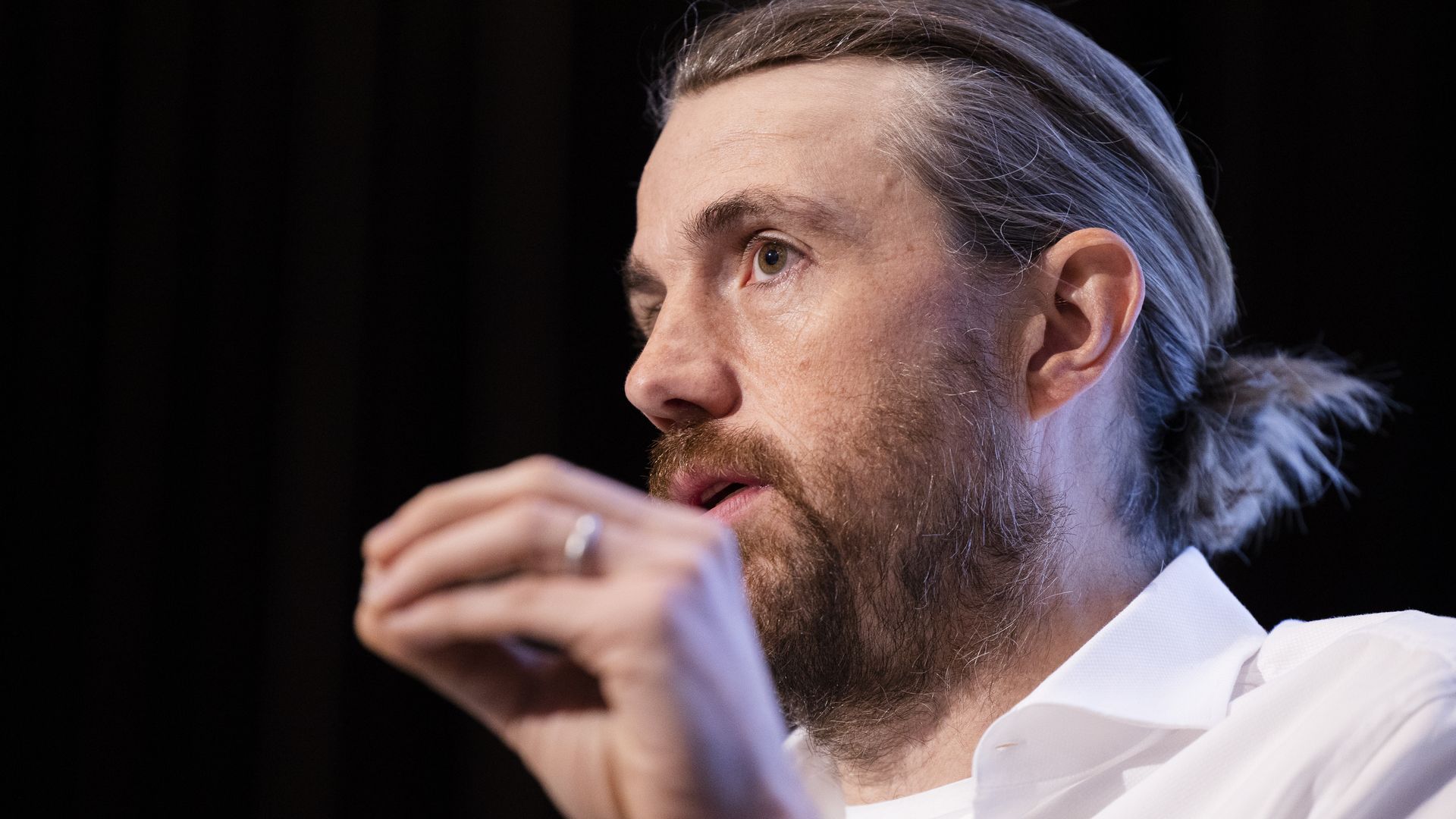
Mike Cannon-Brookes, co-founder and co-CEO of Atlassian, speaks in Canberra, Australia, in 2022. Photo: Hilary Wardhaugh/Bloomberg via Getty Images
Atlassian has a new guide for navigating the net zero economy, which is a how-to-book for business leaders looking to keep tabs on and report their climate impacts, Andrew writes.
Why it matters: The guide is the latest step by Mike Cannon-Brookes, the Australian enterprise software company's co-CEO, to back climate policies — this time by convincing other companies to follow in Atlassian's footsteps.
Zoom in: In a wide-ranging interview, Cannon-Brookes told Axios the guide — titled "Don't F@#$ the Planet" — may seem rudimentary for large companies that are progressing toward their emissions-reduction targets.
- But many firms, especially midsized companies, may not yet be far along on this issue.
- "I think the worst part about climate change for businesses of any size is to feel like there's nothing I can do here. What's gonna happen is gonna happen," Cannon-Brookes said. "And I don't think that's the case."
Context: Cannon-Brookes is pouring billions of dollars into renewable energy projects, and he and his wife have pledged to donate $1 billion alone to climate nonprofits and investments.
- He sounded skeptical about direct air capture projects, at least as they're currently designed.
- "Certainly in the energy system, if you look at the technologies that I believe will win, they are modular and replicable," he said, citing solar, wind and battery technologies.
3. These battery supply deals are a sign of the times

Illustration: Allie Carl/Axios
Two pieces of news make clear that when it comes to battery materials, the name of the game is location, location, location, Ben writes.
Driving the news, part 1: Ford Motor Co. signed new deals to secure lithium, a key material for electric vehicle batteries.
- They include an agreement with Albemarle Corp. to supply 100,000 metric tons of lithium hydroxide from 2026-2030.
- It's enough for roughly 3 million future batteries, Albemarle said.
- Other suppliers include Chile-based SQM, Canada's Nemaska Lithium, and U.S.-based Compass Minerals and EnergySource Minerals.
Why it matters: Consumer EV purchase subsidies in the climate law are tethered to cars with battery materials sourced domestically or from free-trade partners.
- The deals also reflect automakers' scramble for materials to meet EV expansion plans.
The intrigue: A Ford spokesperson said "several" of the agreements meet climate law requirements but didn't elaborate.
Driving the news, part 2: KPMG yesterday announced an alliance with Circulor, a firm that tracks raw material supply chains.
- They'll offer customers a "complete package" to monitor and trace battery materials.
- Circulor's “digital battery passport” can help automakers comply with climate law requirements, and forthcoming European Union rules, they said.
Yes, but: These supply chains are complicated and often opaque, so no system is perfect.
The bottom line: Tracing will be big business as EVs expand — and as companies navigate regulations and pressure on human rights.
4. Google's AI-enabled flood forecasting goes global

Illustration: Natalie Peeples/Axios
Artificial intelligence is increasingly being tapped to address the effects of climate change, Axios' Ayurella Horn-Muller reports.
Driving the news: Google's latest announcement is one example. Countries across Africa, the Asia-Pacific region, Europe, and South and Central America can now use its AI-enabled platform that displays flood forecasts.
The big picture: Starting Monday, governments, aid organizations and people in 60 countries across these regions can access Google's prediction information up to seven days in advance of an incoming flood.
How it works: Initially launched in 2021, Flood Hub displays forecasts for riverine floods — or floods that occur when streams or rivers overflow their banks into surrounding areas — showing when and where they are likely to occur.
5. Breaking: A big carbon removal plan

Illustration: Allie Carl/Axios
JPMorgan Chase today announced over $200 million worth of carbon removal deals or plans aimed at "durably" taking over 800,00 metric tons of CO2 from the atmosphere, Ben writes.
Driving the news: One is a $20 million-plus agreement with direct air capture company Climeworks for 25,000 metric tons of removal over nine years.
- It's one of the largest deals between a single corporate buyer and a DAC company, Climeworks said.
- JPMorgan's plans also include a "memorandum of understanding" with CO280 Solutions Inc., a carbon-negative project developer, with an "intent to purchase" up to 30,000 metric tons annually over 15 years.
The big picture: Removal purchases using various technologies are growing.
- A group of corporate heavyweights last week unveiled $53 million in removal contracts with Charm Industrial for 112,000 metric tons from 2024-2030.
- JPMorgan is also working with Charm Industrial, which uses waste biomass from farming to create "bio-oil" that's permanently injected underground.
Reality check: These volumes are tiny compared with what's needed for removal to really help slow global warming, and achieving multibillion-ton scale is hardly a sure thing.
- But right now it's all about creating a market.
- "The action taken by corporate buyers today is essential for CDR companies to bring to life the economies of scale that are needed by 2050," today's Climeworks announcement states.
6. U.S. renewable additions fall — but a rebound may loom
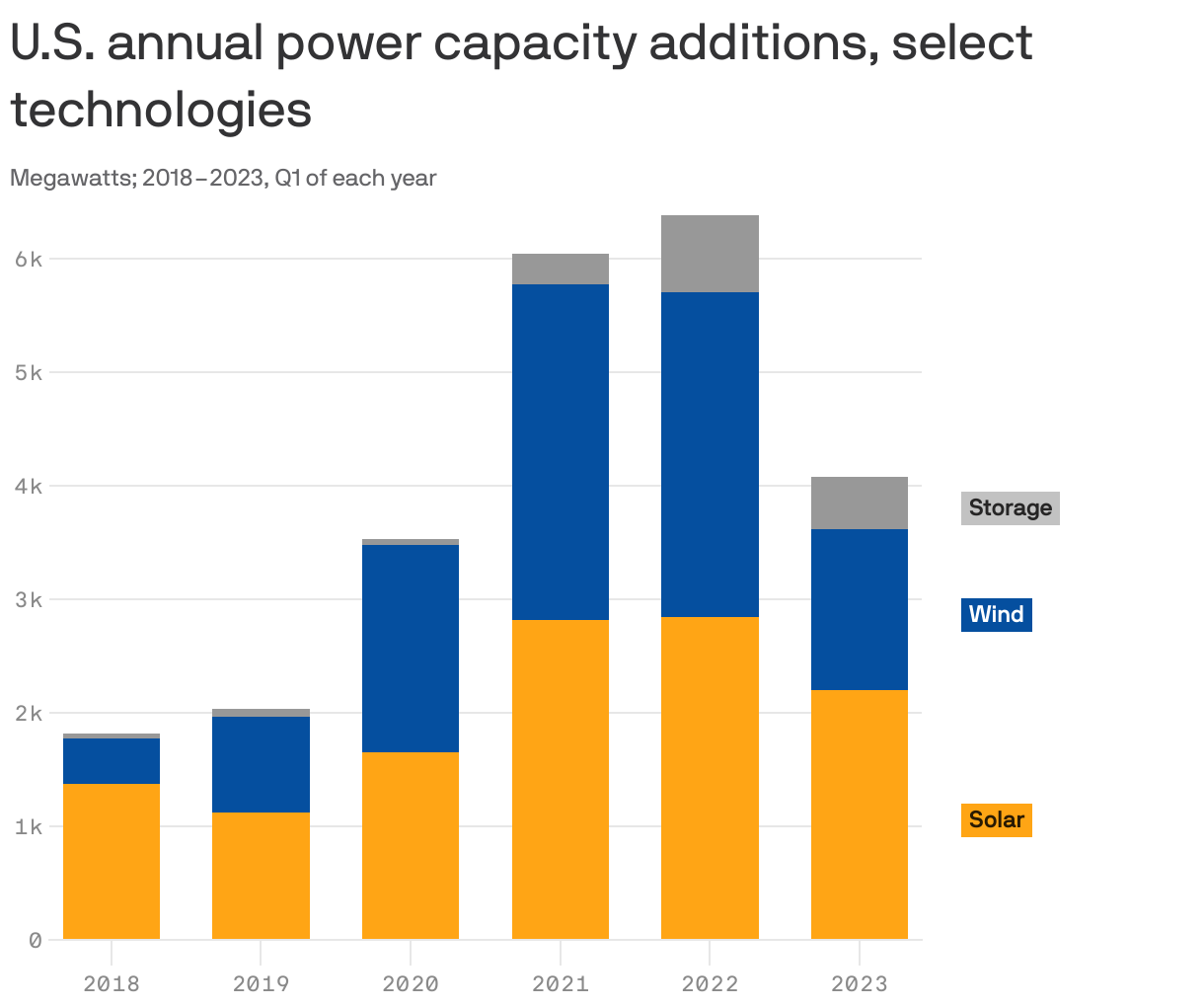
U.S. installations of wind, utility-scale solar and battery storage are off to a slow start this year, Ben writes.
Driving the news: Combined capacity additions fell 36% percent in Q1, compared with the same stretch last year.
- It's the slowest Q1 since 2020, per the American Clean Power Association.
Why it matters: ACP cited "lingering headwinds" that also brought a slowdown in growth last year.
- Troubles include "unclear permitting timelines," insufficient transmission and the clogged interconnection queue.
Yes, but: The climate law's expanded tax incentives are starting to show up in a swelling project development pipeline.
- That pipeline is almost 139,000 megawatts of capacity as of the end of Q1, up 11% from Q1 last year.
What they're saying: ACP CEO Jason Grumet urged Congress to ease siting, construction and transmission barriers.
📬 Did a friend send you this newsletter? Welcome, please sign up.
🙏 Thanks to Gail Hughes and Javier David for edits to today's edition, along with the talented Axios Visuals team.
Sign up for Axios Generate

Untangle the energy industry’s biggest news stories


