
Axios Generate

June 29, 2023
🌅 Happy Thursday! (Or as I sometimes call it, false Friday.) Ben is out again today, so I'll be guiding you. Today's newsletter has a Smart Brevity count of 1,286 words, 5 minutes.
🎶 All-4-One topped the U.S. singles charts on this day in 1994, with "I Swear." "Song’s got incredible chord structure," says Axios' Jael Holzman.
1 big thing: America's surprising energy views
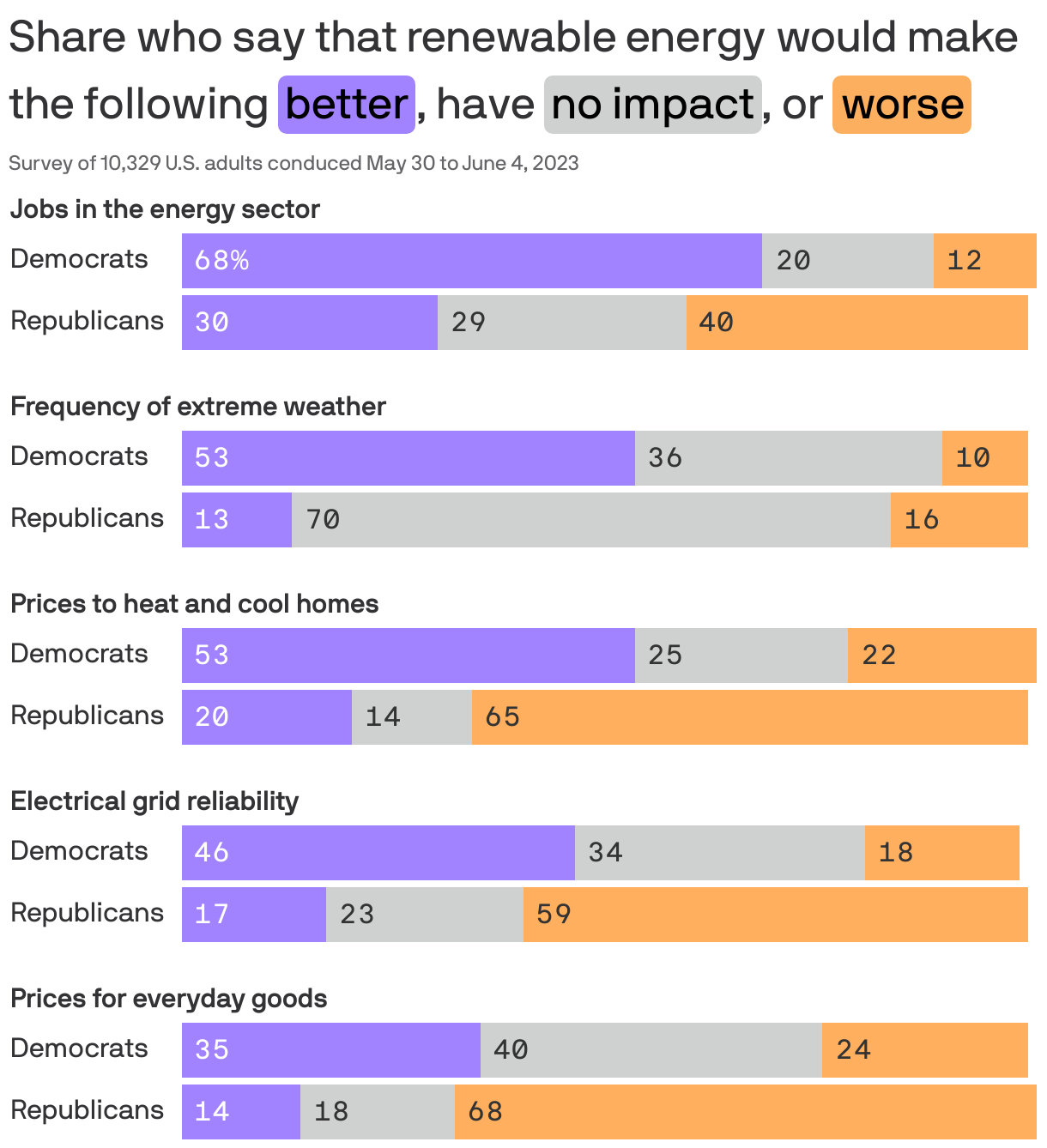
Americans aren't fully supportive of backing away from fossil fuels, and are not yet sold on an all-electric vehicle future starting in 2035.
The big picture: Those findings are part of detailed new Pew Research Center polling.
- Meanwhile, the data shows a large majority of those surveyed favor taking steps to combat climate change and prioritizing renewable sources like solar and wind power.
Why it matters: The polling offers granular, policy-specific data on how Americans view the energy transition, potential benefits and downsides, and where applicable, how these opinions have changed over time.
Zoom in: Based on a survey of more than 10,000 adults conducted this spring, Pew found that 74% of Americans support U.S. efforts to reduce the effects of climate change, though support among Democrats was stronger than from Republicans.
- The poll reveals widespread support for limiting methane emissions by "Having oil and gas companies seal off leaks from oil wells."
- It also found that a majority (or 61%) of Americans favor requiring power plants to eliminate their carbon emissions by 2040. The EPA announced proposed rules in May that would pursue a similar objective.
Yes, but: There's a limit to how far the public is willing to go. Only 31% of Americans favor completely phasing out fossil fuels like coal and natural gas.
- And 35% of Americans think the U.S. should never stop using fossil fuels for its energy needs.
Between the lines: The survey showed the clear differences between how Democrats and Republicans view the energy transition more broadly, and soft Democratic support for President Biden's climate policies.
- Republicans and Republican-leaning independents think transitioning to renewable energy would raise consumer costs, while Democrats see more benefits.
- Although Republicans think America's energy priority should be expanding fossil fuels, 67% still favored a business tax credit for developing carbon capture technologies, and 70% said they support more solar panel farms. Wind garnered less support, at 60%.
- Among the majority of Democrats who think Biden's policies are headed in the right direction, 59% said he "could be doing a lot more on climate change."
The intrigue: When it comes to the push to deploy electric vehicles, only 40% favor phasing out the production of gas-powered cars and trucks starting in 2035, a drop of 7 percentage points from two years ago.
2. MethaneAIR joins emissions-tracking efforts

Image: MethaneSAT LLC
The methane-tracking efforts of the Environmental Defense Fund and its offshoot, MethaneSAT, now extend to a high-flying, specially outfitted Learjet.
- The plane is designed to survey methane emissions across entire oil and gas fields.
Why it matters: Methane is a short-lived, potent contributor to global climate change. Reducing emissions offers a rare opportunity for a climate policy win/win.
- It is a way to reduce near-term global warming; and in many cases, can yield cost savings for the energy industry.
Yes, but: Funding to cut methane emissions lags, per Bloomberg.
The big picture: Flying at 40,000 feet, MethaneAIR's image spectrometers are designed to pinpoint methane emissions coming from oil and gas operations, as well as natural sources.
- The EDF subsidiary says the modified Learjet 35 will initially focus on surveying facilities in the Denver-Julesburg Basin in Colorado; the Haynesville Shale in East Texas and Louisiana; and the Permian Basin in West Texas and New Mexico.
- All told, MethaneAIR could map emissions from about 80% of U.S. onshore oil and gas production through the fall.
Zoom in: MethaneAIR is designed to serve as a precursor mission; it will eventually work in tandem with tracking satellite MethaneSAT, which plans to launch next year.
What they're saying: "These new data will allow easy comparison of emissions rates among regions and track how effective mitigation efforts are," Steve Hamburg, EDF chief scientist and MethaneSAT's executive manager, told Axios in a statement.
3. Clean energy factories face a challenge: rising costs
Illustration: Aïda Amer/Axios
As the U.S. sees a surge in new clean energy and battery factories, some companies building these factories are facing rising costs, writes Axios Pro's Climate Deals reporter Katie Fehrenbacher.
Why it matters: The U.S. is amid a new manufacturing boom around climate tech.
Driving the news: A Department of Energy spokesperson confirmed that some of the battery and EV mineral projects selected to receive grants to build facilities "have seen an increase in construction cost estimates during the negotiations of final awards."
- "There's definitely a lot higher costs in the industry in building right now," said Gene Berdichevsky, CEO of Sila Nanotechnologies, which received a DOE grant for a factory in Moses Lake, Washington.
What's happening: The Biden administration and the DOE are unlocking billions of dollars to support domestic EV and clean energy manufacturing projects.
- Because so many new factories are planned, supply chain issues around construction materials and labor could be having an effect.
- These factories are being built in an inflationary environment, and costs for some goods and services continue to rise.
What's next: Companies will be looking to find ways to alleviate supply chain challenges around construction materials and labor.
Subscribers to Axios Pro's Climate Deals can read the full story with exclusive details.
4. Tuvalu turns to metaverse to outlast rising seas
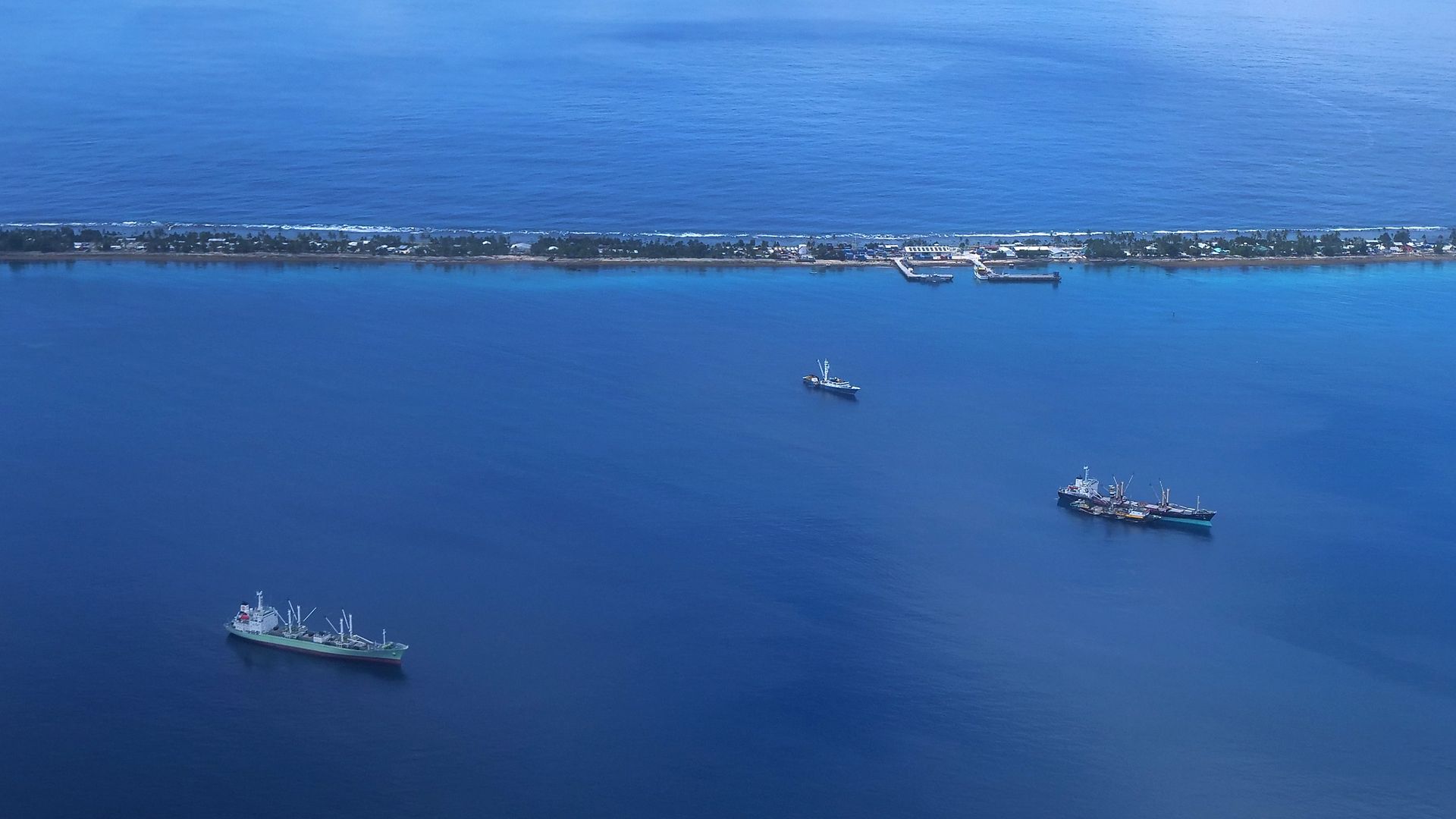
The foreign fishing motherships wait in the lagoon for their catch on August 15, 2018, in Funafuti, Tuvalu. Photo: Fiona Goodall/Getty Images for Lumix
A haunting new feature story details the decisions that leaders in the small South Pacific island nation of Tuvalu are facing due to increasing sea levels from human-caused climate change, Axios' Alex Fitzpatrick writes.
Driving the news: The island is slowly being overtaken by rising seas, with officials making plans for what happens if the country disappears.
- Tuvalu's leaders are working to create a "digital twin" of the country that can exist in virtual reality and on other platforms for generations, The Guardian reports.
Why it matters: The idea is to let future generations of Tuvaluans experience what the country was like before human emissions of greenhouse gases caused the Pacific to swallow it up — and to help connect the Tuvaluan diaspora.
What they're saying: “We have such a strong connection with our land and our oceans, our ancestors are buried here, so we have that spiritual connection as well,” Simon Kofe, Tuvalu’s minister for justice, communication and foreign affairs, told the Guardian.
- “We want to be able to capture our culture as it is today.”
The intrigue: The most ambitious version of the idea calls for a kind of digital Tuvaluan government that could theoretically exist after the country's land becomes uninhabitable.
- Yes, but: Nation-states have long been intertwined with geography, and it's unclear if such a notion would be compatible with today's international order.
5. U.S. plagued by extreme heat, smoke
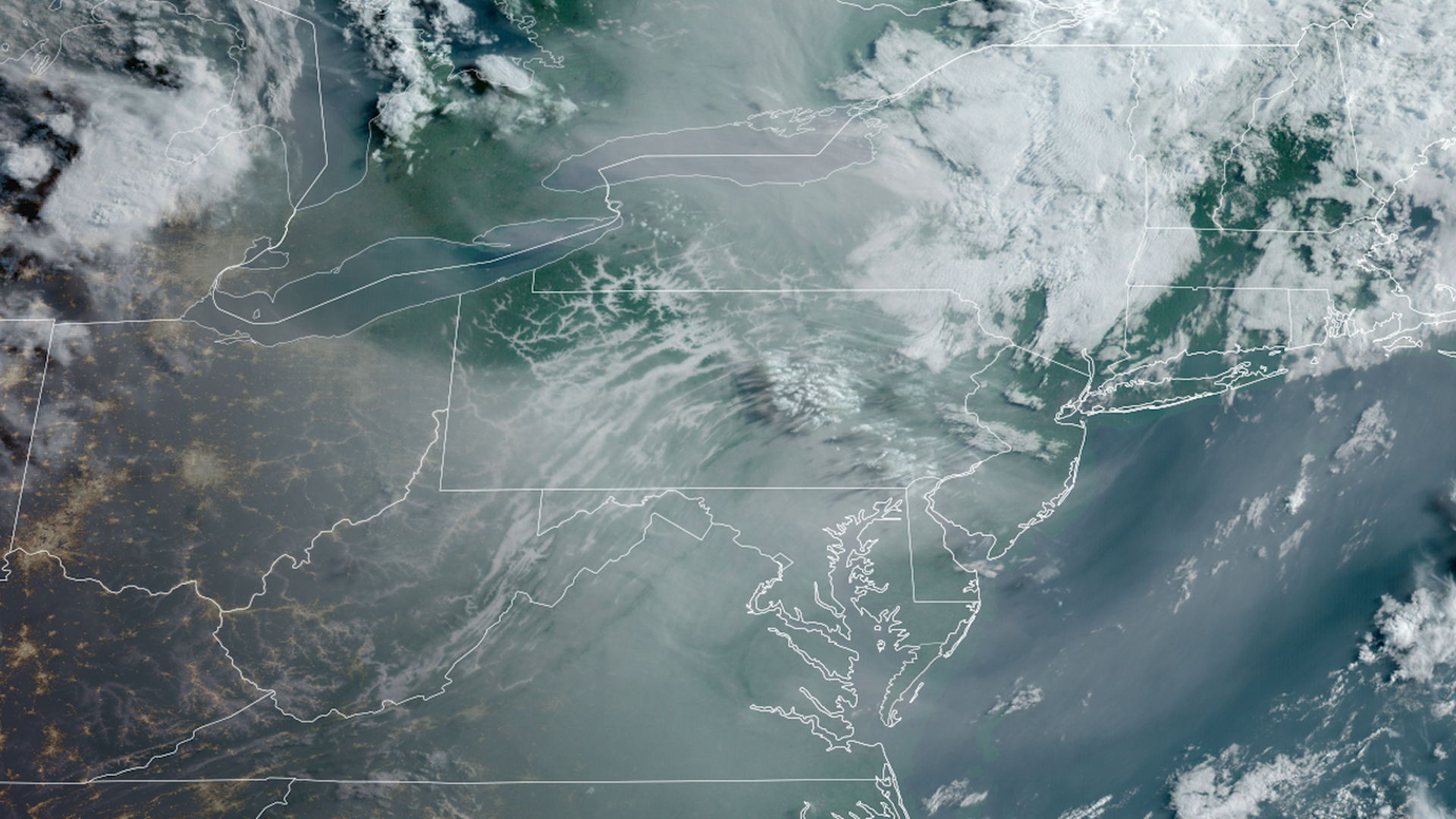
A veil of wildfire smoke covers the mid-Atlantic states shortly after sunrise on Thursday. Image: CIRA/RAMMB
More than 100 million Americans are under extreme heat warnings, watches and advisories Thursday, as the Texas heat dome expands into parts of the Mississippi Valley.
- Tens of millions more are under air quality alerts.
Why it matters: The combination of extreme heat and hazardous smoke poses threats to public health, and illustrates the grip that human-caused climate change has even on large industrialized nations.
Zoom in: Heat alerts stretch from parts of Texas to southern Illinois, southeastward to Alabama and Florida. In the Southwest, a separate heat dome is bringing dangerously hot temperatures across much of California and parts of Nevada and Arizona.
- As of Thursday morning, smoke from Canada's worst wildfire season on record caused parts of the Great Lakes, Ohio Valley, Northeast and mid-Atlantic to have some of the worst air quality in the world.
- In Washington, D.C., a "Code Red" air quality day is in effect Thursday, meaning the smoke is making it unhealthy for all groups, not just those susceptible to respiratory illness.
Between the lines: Climate change is making the heat more intense, longer lasting and likely to occur.
- Studies show human-caused climate change is a major driver of increased wildfire risk.
What's next: This is not likely to be the last time that thick smoke surges south from Canada into the U.S., as the wildfire season there typically lasts into October.
Thanks for reading, and thank you to editor Javier E. David and copy editor Gail Hughes for their help with today's edition. And thanks to the talented Axios Visuals team.


