Axios Generate

May 30, 2023
🍩 Welcome back! Today's newsletter has a Smart Brevity count of 1,271 words, 5 minutes.
📬 Did a friend send you this newsletter? Welcome, please sign up.
🎶 This week marks 40 years since Talking Heads released the album "Speaking in Tongues," which provides today's intro tune...
1 big thing: Why the debt bill's energy provisions are a BFD
Illustration: Aïda Amer/Axios
The debt ceiling deal is a monument to the messiness of a divided government — and it might cast a shadow over climate politics in 2024, Ben writes.
🏃🏽♀️Catch up fast: The tentative compromise between the White House and GOP leaders includes...
- Approval of the Mountain Valley Pipeline, a major gas project in Virginia and West Virginia.
- Efforts to speed permitting via new deadlines for environmental analysis under the National Environmental Policy Act, and some other changes.
- A new study of boosting regional power transmission capabilities.
State of play: Groups on the left and allied Democratic lawmakers are furious over MVP, and what some activists call weakening of NEPA.
- The Sierra Club called for rejection, while the Center for Biological Diversity's Jean Su said President Biden made a "colossal error" on climate.
🗳️What we're watching: The political fallout.
- It's one of several times the White House recently has angered climate activists over fossil fuel projects or policy, notably the March approval of ConocoPhillips' Willow oil project in Alaska.
- Activists want a much harder line against fossil fuels. But it's tough to know whether their disappointment will cost Biden more than a relative handful of climate-minded voters in 2024.
Yes, but: The White House is defending the debt ceiling plan in sales pitches to Capitol Hill Democrats and comments to reporters.
- The American Clean Power Association blessed the deal, but called it only a "down payment" on permitting and transmission needs.
The other side: Republicans face challenges preventing too many defections among conservatives, who say the deal fails to meaningfully restrain spending.
What's next: Votes in Congress are expected this week as the clock ticks toward the June 5 default date.
Andrew contributed to this article.
2. Southern Ocean stokes new climate fears
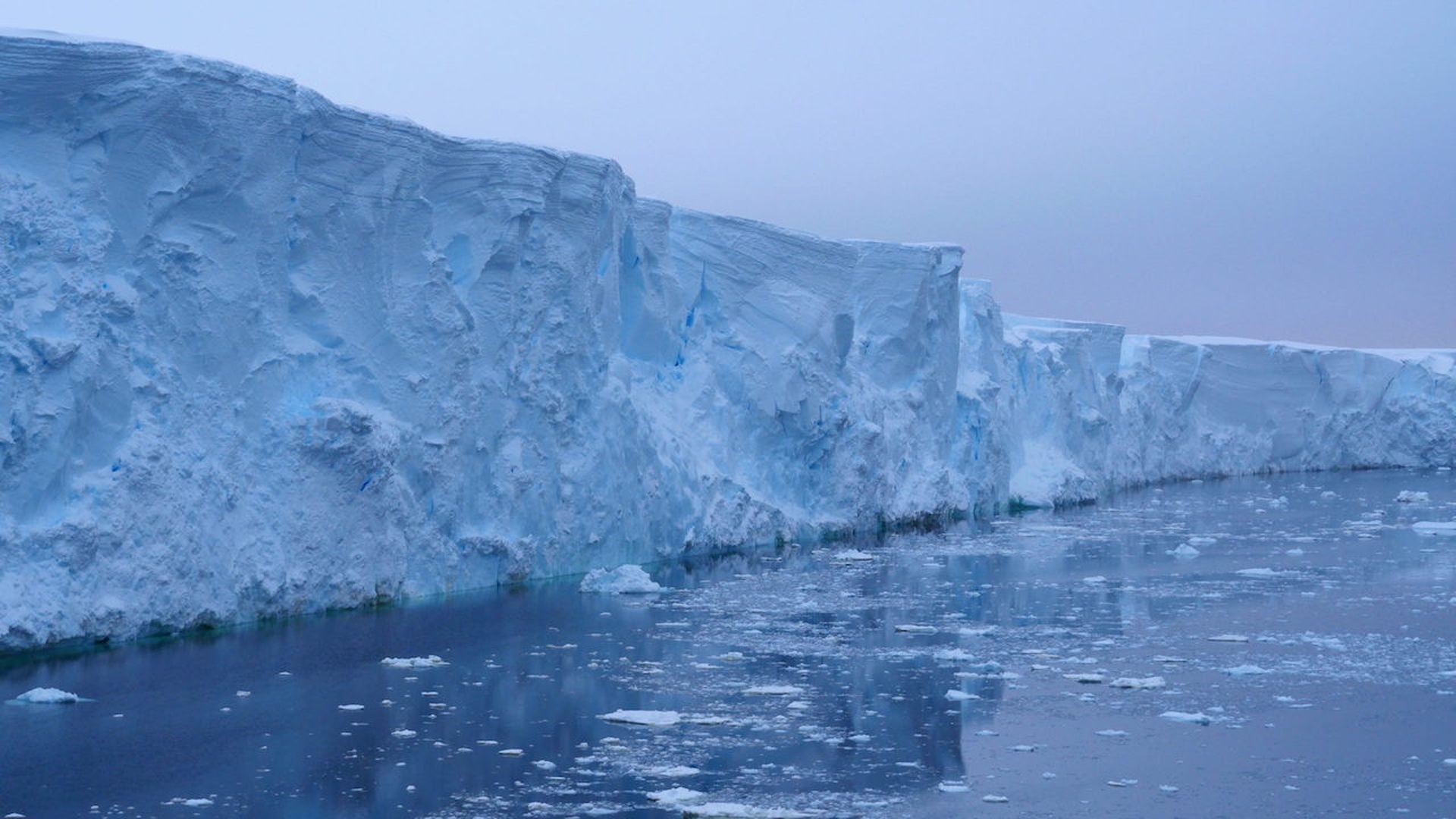
Ice cliff along Thwaites Glacier in Antarctica. Photo: Rob Larter, British Antarctic Survey.
Changes to circulation in the Southern Ocean are taking place faster than expected, with potentially profound implications for the global climate and marine life, Andrew writes.
Why it matters: The Southern Ocean is home to the engine that powers the world's deep ocean currents and regulates the climate. It governs the exchange of heat, carbon, oxygen and nutrients between ocean layers.
Zoom in: The new study, published May 25 in the journal Nature Climate Change, finds evidence that at least one area of the Southern Ocean that drives this cycle is changing faster than previously anticipated.
- Lightweight freshwater pouring into the upper ocean layers from the melting ice sheet is disrupting the formation of cold, dense Antarctic "bottom water," the study finds.
- Antarctic bottom water helps power what the late geoscientist Wallace "Wally" Broecker described as the Great Ocean Conveyor Belt.
- The results raise questions about the long-term vitality of this delicately interconnected series of ocean currents in the face of melting ice sheets.
Between the lines: Lead author Kathryn Gunn of the Australian science agency CSIRO and Southampton University told Axios that observations don't yet show the same rapid trends occurring in other spots around Antarctica.
- "This basin gives an indication for what could happen in other basins," Gunn said via email. "This is further motivation to reduce greenhouse gas emissions as fast as possible."
- She said widely used climate models show far slower consequences for deep ocean circulation than what is actually occurring.
What they're saying: Study co-author Matthew England of the University of New South Wales said ocean circulation changes could further speed Antarctic ice loss.
- "Dense shelf water overturning keeps the Antarctic continental shelves cold. If we lose that, we’d expect those shelves to warm," he told Axios in an email.
- "That’s bad news as it would drive further ice melt."
3. Native Hawaiians reclaim energy sovereignty

“Aunty” Lori Buchanan stands in front of stacks of donated, used solar panels. Photo: Hoʻāhu Energy Cooperative
On the Hawaiian island of Moloka‘i, a group of volunteers is working toward 100% locally owned clean energy, Axios' Ayurella Horn-Muller writes.
Why it matters: They are reclaiming energy sovereignty for the area's largely Native Hawaiian population.
How it works: Since launching in 2020, the Ho’āhu Energy Cooperative has installed rooftop solar panels on a handful of off-grid homes.
The latest: Last month, the volunteer organization submitted the Pālā‘au Solar and Kualapu‘u Solar projects contract to the Hawaii Public Utilities Commission, with a decision expected by year's end.
- Representatives of Ho’āhu told Axios that, if approved, these projects will serve around 1,500 households or 20% of the island's population.
What they're saying: "We can build the best project that has the least amount of harm to our environment, because we understand, as a people, how important our environment is. We depend on it," Ho’āhu Energy Cooperative's co-founder “Aunty” Lori Buchanan told Axios.
State of play: In 2014, Hawaii set a goal of 100% renewable electricity by 2045, becoming the first U.S. state to do so.
- Hawaii had the highest household electricity price among U.S. states last year, per 2023 Statista data.
4. Charted: The global battery race

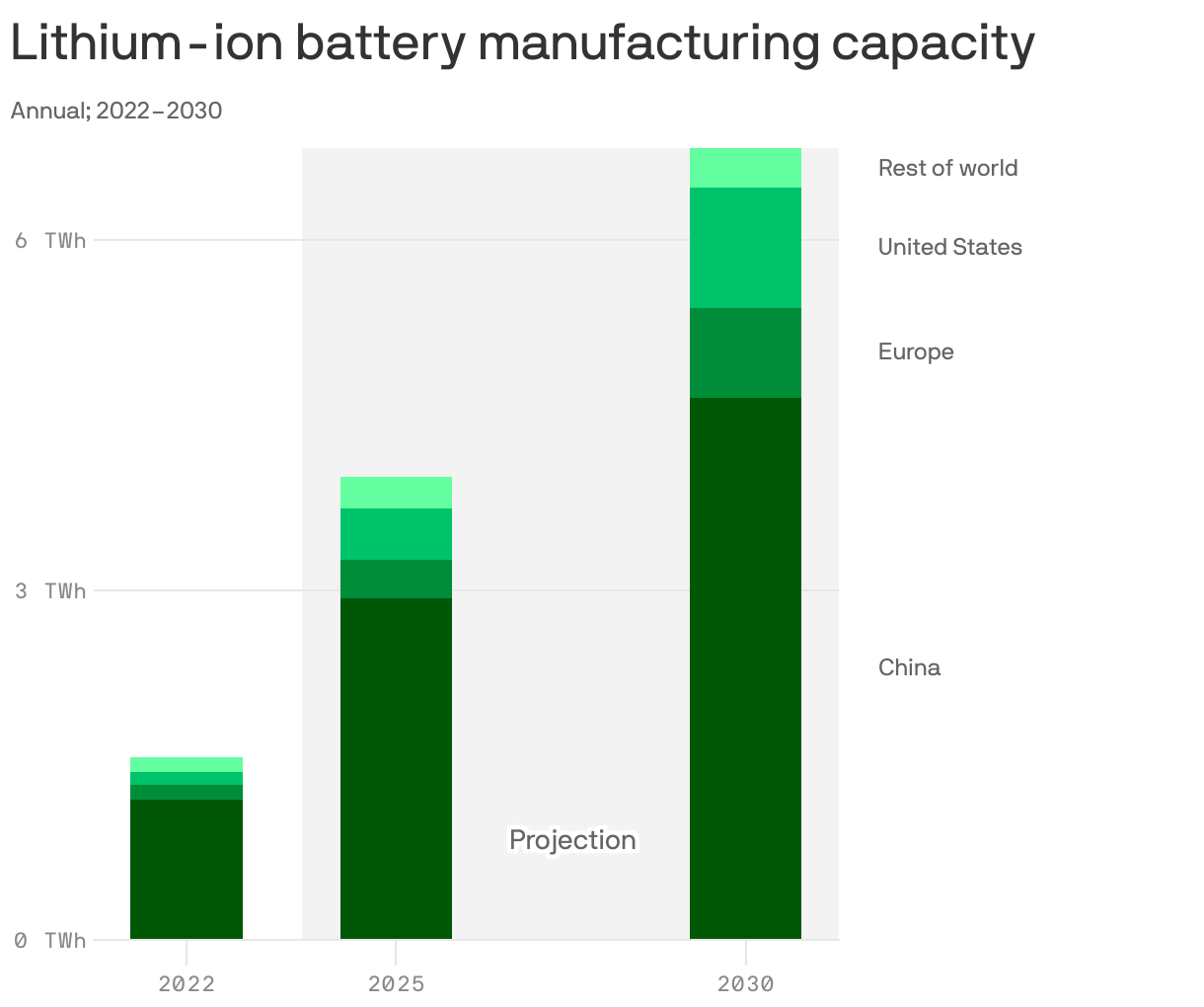
Hyundai and LG Energy Solution's joint investment of $4.3 billion to build a large battery plant in Georgia is part of a wider trend, Ben writes.
Why it matters: It's getting hard to keep up with all the U.S. plans.
- Companies are tapping manufacturing incentives in the climate law and looking to meet battery-sourcing requirements tethered to consumer EV purchase subsidies.
State of play: The day before Friday's announcement, the International Energy Agency released their latest look at global investment trends — including batteries, seen above.
- "Record sales of EVs, strong investment in battery storage for power ... and a push from policymakers to scale up domestic supply chains have sparked a wave of new lithium-ion battery manufacturing projects around the world," the agency says.
5.📡On our radar: Big Oil, COP28, OPEC+
Here are a few oil and oil-adjacent items we're watching this week, Ben writes.
🛢️Exxon and Chevron both hold their annual shareholders' meetings on Wednesday. We'll be watching for levels of shareholder support for resolutions seeking tougher climate policies and disclosures.
🌍The U.N. convenes the annual Bonn Climate Change Conference on June 5, but a week of "pre-sessional" meetings are underway.
- Why it matters: It's a key negotiating meeting ahead of the big global climate talks late this year in the United Arab Emirates, called COP28.
- The intrigue: The FT reports activists are watching for more info in Bonn about how Sultan Ahmed Al Jaber, the UAE official overseeing COP28, will approach the critical late 2023 talks.
🛢️OPEC+ meets in Vienna on Sunday to review joint oil output levels and plans.
- The intrigue: "Tensions are rising between Saudi Arabia and Russia as Moscow keeps pumping huge volumes of cheaper crude into the market that is undermining Riyadh’s efforts to bolster energy prices," the WSJ reports.
6. So hot right now: Insurance and climate change

Illustration: Aïda Amer/Axios
Two pieces of news illustrate how the insurance industry is grappling with climate change and the intense politics of ESG.
Driving the news, part 1: State Farm says it's no longer accepting homeowner insurance applications in California due to "historic increases in construction costs outpacing inflation" and "rapidly growing catastrophe exposure" to extreme weather events like wildfires, Axios' Rebecca Falconer reports.
Driving the news, part 2: More large insurers have abandoned the "Net-Zero Insurance Alliance," with last week's departures, including Swiss Re, Allianz and AXA, Ben writes.
- Nine companies have left the group — a subsector of the wider Glasgow Financial Alliance for Net-Zero that also works with the U.N. — in recent months, per multiple reports.
- GFANZ brings together the banking, insurance and asset management industries around setting targets and lowering portfolio emissions.
The intrigue: The departures follow GOP state attorneys general sending a May 15 letter to NZIA expressing "legal concerns," including potential antitrust violations.
What they're saying: "These political attacks are now interfering with insurers’ independent efforts to price climate risk, which will harm policyholders, main street investors and local economies," a GFANZ spokesperson said.
Editor's note: This item has been corrected with the name of GFANZ, the Glasgow Financial Alliance for Net-Zero.
🙏 Thanks to Gail Hughes and Javier David for edits to today's edition, along with the talented Axios Visuals team.
Sign up for Axios Generate

Untangle the energy industry’s biggest news stories