Axios Generate

October 27, 2023

🍺 Made it. Today's newsletter has a Smart Brevity count of 1,119 words, 4 minutes.
🎸 Today marks 10 years since Lou Reed passed away, and he's got this week's final intro tune...
1 big thing: The costly aftermath of Hurricane Otis
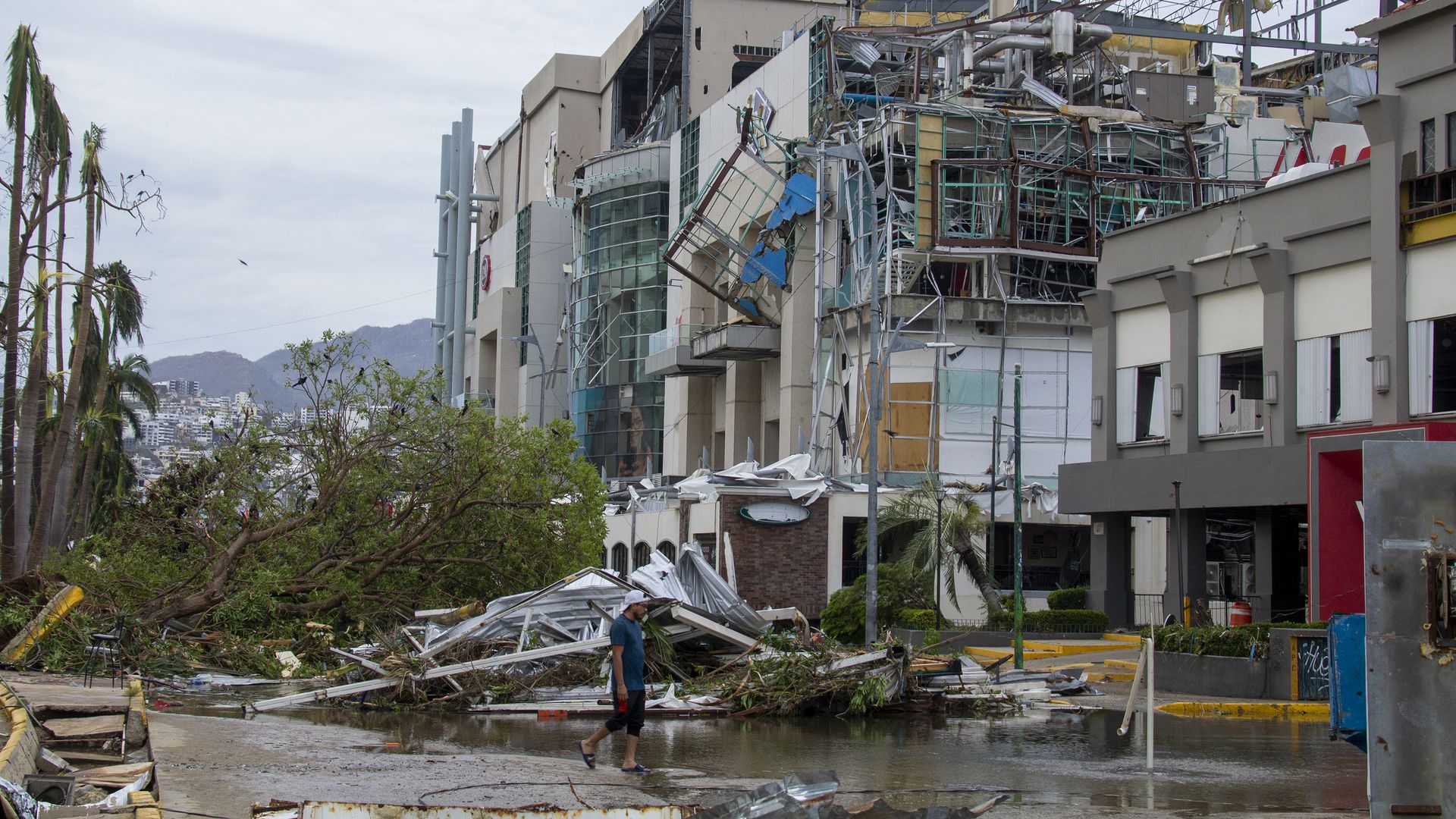
A shopping mall is destroyed after Hurricane Otis hit Acapulco on Wednesday. Photo: Oscar Guerrero Ramirez/Getty Images
The damage and death toll are becoming clearer in Acapulco, where Category 5 Hurricane Otis struck early Wednesday, Andrew writes.
Why it matters: The hurricane is likely to be one of the most expensive extreme weather disasters in Mexico's history.
Its unexpected and explosive intensification is causing some soul-searching in the risk management community and meteorology circles.
Zoom in: The storm killed at least 27 people, and Mexico has deployed 10,000 troops to help the region with storm recovery. However, their arrival has been slow.
- Walls were ripped off buildings, turning them into twisted metal hulks. Virtually every power pole was knocked down, and survivors had harrowing stories.
- According to Steve Bowen, chief science officer at reinsurer Gallagher Re, Otis' toll will be measured in the billions, given the high-end commercial and residential real estate damage.
- CoreLogic, a property insights company, estimates the insurable damage from wind hazards alone to be between $10 to $15 billion.
Between the lines: Bowen is taking notice of the growing risk from stronger tropical cyclones, including storms that ramp up quickly.
- "What remains most shocking and concerning is the rapid intensification occurring up to the point of landfall and subsequently affecting highly populated areas," he said.
- "As climate change research continues to conclude that we should expect more high-end tropical cyclones — and this research is being regularly validated — we need to be making smart decisions" readying for the growing risk, he said.
The intrigue: In the meteorology community, there is soul-searching going on about the forecast miss.
- "Every one of these events takes a toll and you take a piece of it with you going forward," Michael Brennan, the director of the National Hurricane Center in Miami, told Axios in an interview.
2. Bad vibes are rippling through the EV market

Illustration: Aïda Amer/Axios
Auto execs and analysts are getting less bullish on the pace of electric vehicle demand growth — and fretting more about tough economics of competing in the market, Ben writes.
Why it matters: Automakers have made expensive bets on an electric future, and the tech is a weapon against carbon emissions, too.
🗞️ Driving the news: Ford said Thursday it's slowing the pace of EV and battery manufacturing investments amid lower-than-expected demand.
- The company isn't changing the total spending target but will "push out" about $12 billion of those investments, CFO John Lawler told reporters.
🏃🏽♀️ Catch up fast: Among the growing bad vibes...
- General Motors this week scrapped its target to produce a cumulative 400,000 EVs from 2022 through the first half of 2024.
- CEO Mary Barra told analysts GM is "taking immediate steps to enhance the profitability of our EV portfolio and adjust to slowing near-term growth."
- Tesla CEO Elon Musk told analysts last week that he's worried about the effects of interest rates.
What we're watching: The next rounds of aggregate sales data from analysts.
- EVs were 7.9% of U.S. light duty sales in Q3, up from 7.2% in Q2, per Cox Automotive.
- And when the auto strike ends, how will the union agreement with Ford — and eventual deals with GM and Stellantis — affect their EV economics?
The bottom line: The EV transition is happening, but good luck predicting how fast it unfolds.
Joann Muller contributed
3. Bonus: what they're saying about the EV market
The U.S. EV market is "definitely seeing" slowing demand, iSeeCars.com executive analyst Karl Brauer said via email, Ben writes.
🖼️ The big picture: He cites general economic concerns and interest rates that affect large purchases overall.
- EV-specific factors include higher average costs than gas-powered models and many consumers' lack of familiarity with the tech.
- "I see EV sales plateauing and even falling over the next 6 months," Brauer predicts.
😬 Threat level: "Investors have been too optimistic about EV demand growth . . . slowing demand growth is coming sooner than expected, especially in the high-end EV market," Lee Hang-koo of Korea Automotive Technology Institute tells the Financial Times.
4. On my screen: Pipelines and the Russian price cap

Illustration: Rae Cook/Axios
🛢️ Is blocking oil pipelines an environmental win? The answer isn't obvious but points toward no, Ben writes.
- Driving the news: A University of Chicago paper explores what would have happened if the big Dakota Access Pipeline (DAPL) was thwarted.
- The big picture: They estimate that 81% of those pipeline flows moving by rail instead and 4% lower Bakken shale production.
- Yes, but: It's an "environmental justice dilemma." Rail brings a net air pollution increase, hitting people living near tracks. And from a climate standpoint, lots of thwarted Bakken production may occur elsewhere.
- The intrigue: There's a better way to address carbon dioxide, though maybe not a politically feasible one, the authors say, floating new taxes and other policies that would cut emissions.
👎 The price cap on Russian oil isn't working, Center for Strategic and International Studies analysts write in a new post.
- Why it matters: The policy, which the U.S. played a key role in crafting, seeks to curb Russian revenues while keeping its exports on the market.
- Yes, but: "Russia has found alternatives to G7 and EU support services, and refiners, shippers, and others have gamed the system by obscuring the real price of oil trades and filing dodgy paperwork."
5. One cool thing: A 2,000-mile-long eVTOL journey

The ALIA aircraft from Beta Technologies flies over Washington. Photo: Beta Technologies
A milestone in electric aviation took place Thursday afternoon, Andrew writes.
Driving the news: Beta Technologies landed its ALIA eVTOL aircraft at Duke Field, part of Eglin Air Force Base, for a deployment period with the U.S. Air Force.
The big picture: During its 2,000-mile journey from Burlington, Vermont, to Florida, the plane completed multiple short- and long-distance legs.
- Beta is working with the military to test the aircraft for resupply missions, cargo delivery and personnel transport, the company said.
- The company recently opened its factory at Burlington International Airport.
Zoom in: Beta says it charged the aircraft on its own charging station network during four of its stops, including at a new location near Boston.
- Beta has 14 deployed chargers, with another 60 under development, the company said in a statement.
- The aircraft flew over Washington, becoming the first electric aircraft to fly through the highly restricted airspace, before landing at Andrews Air Force Base in Maryland.
What's next: Beta and the Air Force will spend the next few months testing the ALIA eVTOL, with a simulator of the aircraft also on location at Duke Field.
- The company has firm orders from UPS, Bristow, Blade and United Therapeutics.
6. Charted: An energy giant's rough patch


Siemens Energy's stock price plummeted after news emerged that it's seeking financial guarantees from the German government, Ben writes.
The big picture: The energy company has been hobbled by technical problems with its wind energy unit that are affecting its wider finances.
- "Strong growth in order intake" in its gas and power business "leads to a rising need of guarantees for long-term projects," Siemens said in a statement confirming talks with the government.
Did someone forward you this newsletter? Welcome, and please sign up.
🙏 Thanks to Chris Speckhard and Javier David for edits to today's edition, along with the talented Axios Visuals team.