Axios Future of Defense
March 05, 2025

Another week, another newsletter!
- I'm moderating a "smart warfare" panel at the 2025 National Security Innovation Base Summit this afternoon. See me? Say hi.
🇾🇪 Situational awareness: The Trump administration on Tuesday designated the Houthis as a foreign terrorist organization, after the Biden administration pulled the Iran-backed militants from the list.
- My thought bubble: Red Sea belligerence propelled this move, which tightens the financial and diplomatic noose.
To come: In the woods with Primordial Labs, thousands of missiles for Ukraine and a Varda Space Industries glamour shot.
Today's newsletter is 1,624 words, a 6-minute read.
1 big thing: Production, production, production

There are few words as beloved in the defense-tech zeitgeist as "scale" and "mass." And it makes sense: As I've written before — when this newsletter launched, and just a few weeks ago — war is a numbers game.
- But today's defense industrial base is hurting, and not just by a single metric.
Why it matters: It's go big or go home for production lines, as a potential Chinese invasion of Taiwan haunts Beltway thinkers and a protracted war in Ukraine proves just how quickly stockpiles evaporate.
Driving the news: The Ronald Reagan Institute's third annual National Security Innovation Base report card, published Tuesday, paints an uncomfortable picture.
- "While China, America's pacing challenger, continues to outproduce the United States, Washington remains stuck in a self-perpetuating cycle of budgetary and appropriations dysfunction that is threatening its advantage."
- But, it offers, "This trend is not immutable."
Here are some of the study's findings:
- The U.S. blazes the innovation trail, earning an A- for leadership, a B+ for available cash and another B+ for the growing sense of competition. There were four consecutive quarters of defense-tech venture capital growth last year, from $4.4 billion to $14.7 billion.
- But the country struggles with modernization and capacity, with caches of "critical weapons" remaining "dangerously low." Both scored a D. Customer clarity — the coherence of conversation between buyer and seller — was slightly better at D+.
- International cooperation is middling at a C. The labyrinthine foreign military sales process is "interfering with core national security and foreign policy objectives."
What they're saying: "I feel like there's this bias or mindset that hardware is not valuable, hardware is not sexy. 'Why can't we just outsource this stuff?' And that's kind of the problem we've been in," Paul Kwan, who leads General Catalyst's global resilience team, told me.
- "This reindustrialization of America is not just critical, but necessary."
State of play: Defense contractors are erecting factories and expanding footprints. Others are inking their blueprints.
- The first products from Anduril Industries' Arsenal-1 are expected to roll off the lines next year. When the company announced Columbus, Ohio as its location, there were renovation and hiring hurdles to clear.
- Drone-boat maker Saronic wants to open the doors to its futuristic shipyard, Port Alpha, within five years. It still needs to find a location, secure incentives, put a shovel in the ground and attract a workforce.
- Helsing completed construction of its Resilience Factory, or RF-1, in southern Germany. It's expected to pump out more than 1,000 HX-2 attack drones per month.
- Saab plans to break ground for its Michigan munitions facility in April. It's expected to come online in 2026. The company also launched its Skapa initiative in San Diego.
- Bell Textron will support Future Long Range Assault Aircraft work with a recently selected 447,000-square-foot facility in Texas. The company won the FLRAA competition in late 2022.
- Kongsberg in September said it would build a state-of-the-art factory in Virginia, boosting capacity for Naval Strike and Joint Strike missiles.
My thought bubble: You can't build the future with tools of the past.
- Automation, robotics, and 3D printing are table stakes.
- And if you want a great example of spinning up quickly, look no further than Ukraine. Pressure breeds innovation. (The country is on track to build some 3 million military drones this year, according to the Kyiv Post.)
The bottom line: "We cannot fight wars unless our troops have the ammunition they need," Vice President JD Vance said Tuesday as he backed a Defense Department nominee on the Hill.
- "We cannot defend our own national security unless we have the tank shells, the artillery shells, and, increasingly, the drones and other advanced weapon systems that are necessary to actually fight battles when — God forbid — those battles are necessary to fight."
2. Say it with your chest
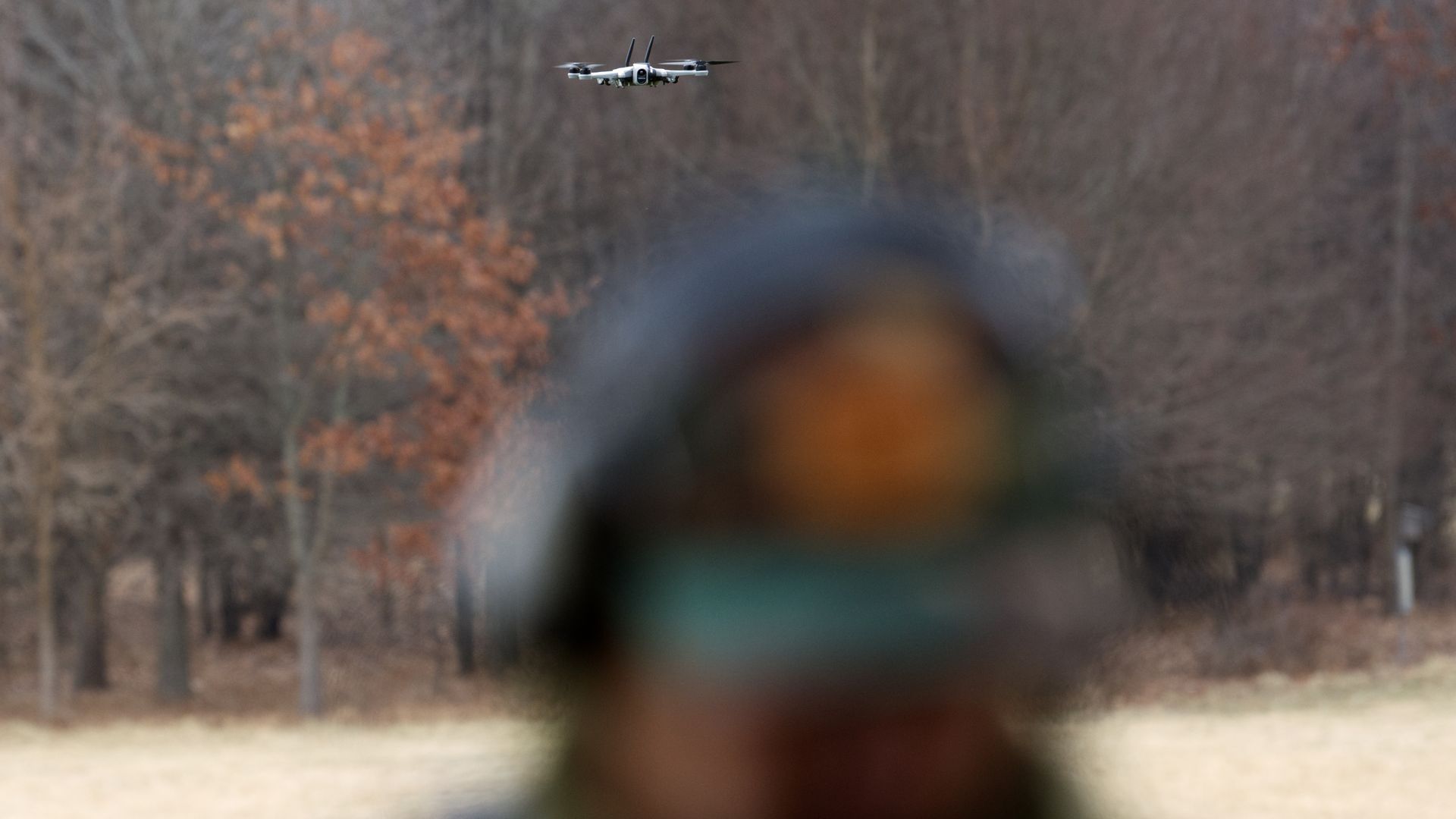
Primordial Labs is controlling handfuls of drones with simple, plain English commands: Follow me, go 100 feet left, look at the target, stop, etc.
Why it matters: Future battlefields will be replete with humans and their robotic partners, according to the Pentagon.
- A major hurdle, however, is exercising control over them as things pop off. Bullets, bombs and electronic warfare harry both man and machine.
Driving the news: The Connecticut-based company demonstrated its bedrock product, an interface dubbed Anura, during a Feb. 27 demo for reporters.
- In two hours, CEO Lee Ritholtz and senior product manager Jordan Dross showed how someone who can use Amazon's Alexa or Apple's Siri can also pilot unmanned aircraft.
Zoom in: Anura can be applied to radio chatter, sensors aboard larger vehicles, ground robotics and turrets.
- At last week's demo, Skydio and Teal drones were in the air. They responded to call signs to avoid confusion.
What they're saying: "When it comes to human-machine integrated formations," said Ritholtz, "what's most important is not so much making the machine more human, but making the mechanism of interaction with the machine more human."
State of play: Primordial's customers include U.S. Special Operations Command. It's also linked with the Army, namely the program executive offices for ground combat systems and aviation.
- The company launched in 2021. Its executives have roots in the military as well as Lockheed Martin's clandestine Skunk Works.
My thought bubble: I threw on the kit. So did other reporters.
- The drone responded quickly to my instructions. When my orders didn't make sense or didn't register, it hit me with a deflating little ping.
- Dross took field notes. First-time users and live feedback, he said, are key to improving Anura.
- The whole experience made me think of using voice commands in Rainbow Six 3: Black Arrow. This, though, was much more responsive.
What's next: Primordial is eyeing the Army's second iteration of transforming in contact. It's working with the service to supply thousands of Anura licenses this year.
3. Millions more for Epirus

Epirus plans to expand production of its directed-energy weapons and jump into overseas and commercial markets on the heels of a $250 million funding round.
Why it matters: Powerful lasers and microwaves are exploding in popularity as militaries scramble to more effectively — cheaply, quickly, sustainably — counter drones.
- Widespread adoption, however, is still lacking.
Follow the money: This latest funding round, led by 8VC and Washington Harbour Partners LP, pushes Epirus' venture account beyond $550 million.
- The company years ago won a $66 million prototyping contract with the U.S. Army Rapid Capabilities and Critical Technologies Office.
How it works: Epirus makes Leonidas, which can be towed or mounted to combat vehicles like the Stryker. It fries electronics with blasts of energy.
- This can bring down handfuls of drones and kill small motors.
- More than two dozen directed-energy initiatives are underway across the military, according to a study published by the Emerging Technologies Institute.
What they're saying: "A new era of threats mandates a shift from a 'one to one' mindset to a 'one to many' way of thinking for short-range air defense," CEO Andy Lowery said, "and we are primed to support the Department of Defense in this new way of warfare."
What's next: Epirus will open what it's calling an "immersive simulation center" later this year in Oklahoma, home to Fort Sill and the Joint Counter-Small UAS University.
Go deeper: Israel wants to deploy its Iron Beam within a year
4. Quick hits

🐕 Initial Department of Government Efficiency findings at the Pentagon total $80 million, including $1.6 million to study "social and institutional detriments of vulnerability and resilience to climate hazards in African Sahel" and $1.9 million for "wholistic DEI transformation and training," according to spokesperson Sean Parnell.
- Why it matters: DOGE's work has been controversial. The budget trawl at the Defense Department will be no different.
- 💭 My thought bubble: The Sahel is at a concerning crossroad of worsening weather, extremist-group recruiting and population displacement. (The tally above also amounts to pennies in the Pentagon couch.)
🇬🇧 The U.K. will provide Ukraine 5,000 lightweight multirole missiles, to be made by Thales in Northern Ireland.
- Why it matters: "My support for Ukraine is unwavering," said Prime Minister Keir Starmer. "I am also clear that national security is economic security."
- 💭 My thought bubble: The timing of the official announcement — post Oval Office blowout — cannot be ignored.
🪡 Lockheed Martin is embarking on a set of experiments that seek to demonstrate and improve a new counter-drone suite that stitches together command and control, sensors and a growing array of countermeasures.
- Why it matters: "If we just zoom out and think, 'What is driving Lockheed Martin into this space,' it's things like insufficient detection and tracking capabilities, like how we identify anything from Group 1 up to Group 5," Tyler Griffin, the company's counter-drone director, told me in an exclusive interview.
- 💭 My thought bubble: There are hints of Replicator 2 in here.
🔒 The U.S. Navy's Flank Speed effort achieved basic zero-trust cybersecurity — a first, and years ahead of a deadline set by the Pentagon, according to officials.
- Why it matters: "We are getting more aggressive with our adoption of commercial AI ... from large vendors and new entrants to cut unnecessary functions, steps and soon legacy networks," Justin Fanelli, the service's chief technical officer, said.
- 💭 My thought bubble: So many people told me the 2027 deadline for zero trust will be challenging to meet. Game on?
5. Check this out

A Varda Space Industries capsule, W-2, landed at the Koonibba Test Range in Australia after six weeks in orbit.
- It initially hitched a ride on a Transporter-12 with SpaceX.
- Above, its grand reentry at speeds greater than Mach 25.
Why it matters: Efforts like this bolster hypersonic and thermal-shielding research.
- W-2 carried, among other items, a spectrometer from the Air Force Research Laboratory.
Go deeper: Varda Space raises $9 million for manufacturing in space
Shoutout to Nicholas Johnston for editing and Matt Piper for copy editing.
👋🏼 Thanks, as always, for reading and sharing. Tell your friends to subscribe, here.
Sign up for Axios Future of Defense