Behind the Curtain: America's drone-swarm crisis


Add Axios as your preferred source to
see more of our stories on Google.
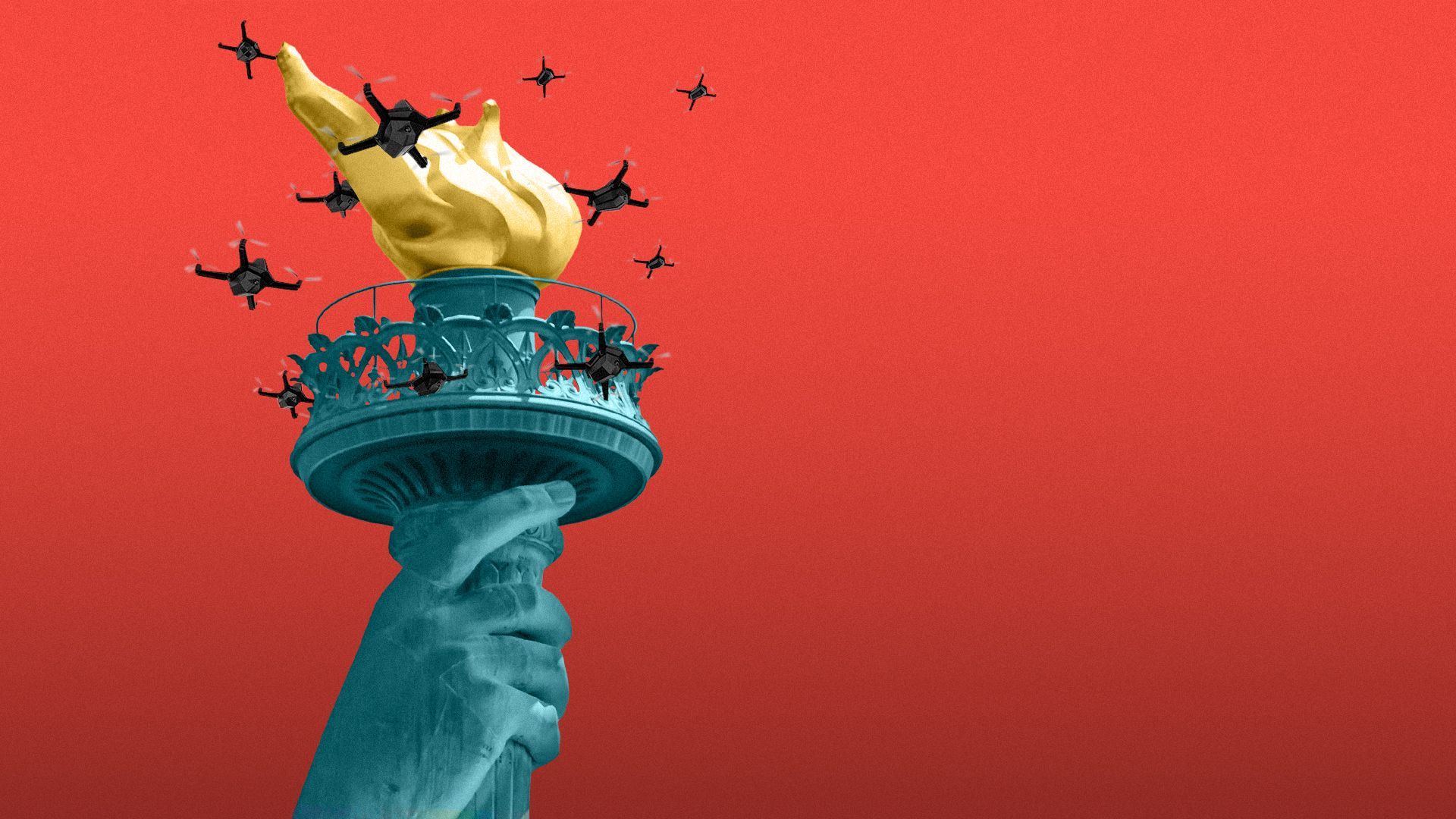
Illustration: Lindsey Bailey/Axios
Ask NFL executives their biggest fear, and it has nothing to do with fans, players or TV rights. It's drones — which are hard for authorities to track, and almost impossible to stop if ever unleashed on an open-air stadium.
- Ask U.S. intelligence experts their biggest fears, and you'll inevitably hear dire warnings of drone swarms — domestic or foreign — targeting American soil.
- Probe deeper, and you'll learn that the vast majority of these drones are made by China — and, therefore, conceivably controllable by America's greatest adversary. TikTok is accused of being a security threat — but it can't spy or drop bombs.
Why it matters: Look at the skies of Syria, Russia — or, many squinted and said, New Jersey — and the future of terrorism and warfare is on vivid display. Drones gather intelligence, guide artillery and shape battle plans.
Between the lines: The NFL's fear is based on gaps in authority among local, state and federal authorities. A league source calls the lack of coordination is "potentially dangerous and unsustainable."
- "Laws, regulations and enforcement mechanisms have not caught up with the technology and proliferation of these machines," the source said.
- "The general distrust in institutions, and general paranoia about the 'deep state,' makes unidentified flying objects that dwell over our communities particularly menacing. Are we being watched? If so, by whom? And they sound like swarms of insects."
State of play: White House press secretary Karoline Leavitt began her first briefing by confirming something that had long been apparent — last fall's feverish drone spottings in the Northeast were mostly sightings of ... airplanes.
- "After research and study, the drones that were flying over New Jersey in large numbers were authorized to be flown by the FAA for research and various other reasons," she said, citing news she'd been told "directly" by President Trump in the Oval Office, and echoing what the Biden administration had contended.
- The epidemic of coverage tailed off with the Christmas holidays, as people moved on and the planes kept landing. "Many of these drones were also hobbyists — recreational, and private individuals that enjoy flying drones," Leavitt added. "In time, it got worse, due to curiosity. This was not the enemy."
Reality check: Amid the goofy sightings, the true domestic drone threat is under-discussed, defense executives tell Colin Demarest, author of Axios Future of Defense.
- The Pentagon is spending big to dominate drone defense with drone-neutralizing technology, including "meaningfully improved" protections against small drones.
- Drones' bloody consequences are apparent in the Middle East, where the U.S. Army has deployed drone zappers in a rush to defend troops.
How it works: Dropping drones is no easy task. It requires spotting, identifying, tracking and intercepting, Colin explains.
- That last part can be accomplished with a multimillion-dollar missile (looking at you, Red Sea), bullets, electronic interference or something as primitive as a net or cage.
- Drone swarms only complicate this: What's a decoy? What's deadly? Who's the target? Which do you shoot?
What to watch: Jonathan Moneymaker, CEO of BlueHalo, a next-generation defense firm based in Arlington, Virginia, told Colin that as threats escalate from unmanned aircraft systems (UAS), as the FAA calls drones, "our legislation to protect the homeland has not kept pace."
- Moneymaker said there's a critical need to empower local authorities, through the Department of Homeland Security, to deploy countermeasures around airports, power stations, military installations and surrounding communities. "We have the technology to be ready," he said. "We need the legislation to catch up. We will either address this before we suffer a major drone attack in [the U.S.], or we will address it after — but we will address it."
Get Axios Future of Defense, Colin Demarest's weekly newsletter.
