Epirus CEO: Brace for "centaur warfare"

Add Axios as your preferred source to
see more of our stories on Google.
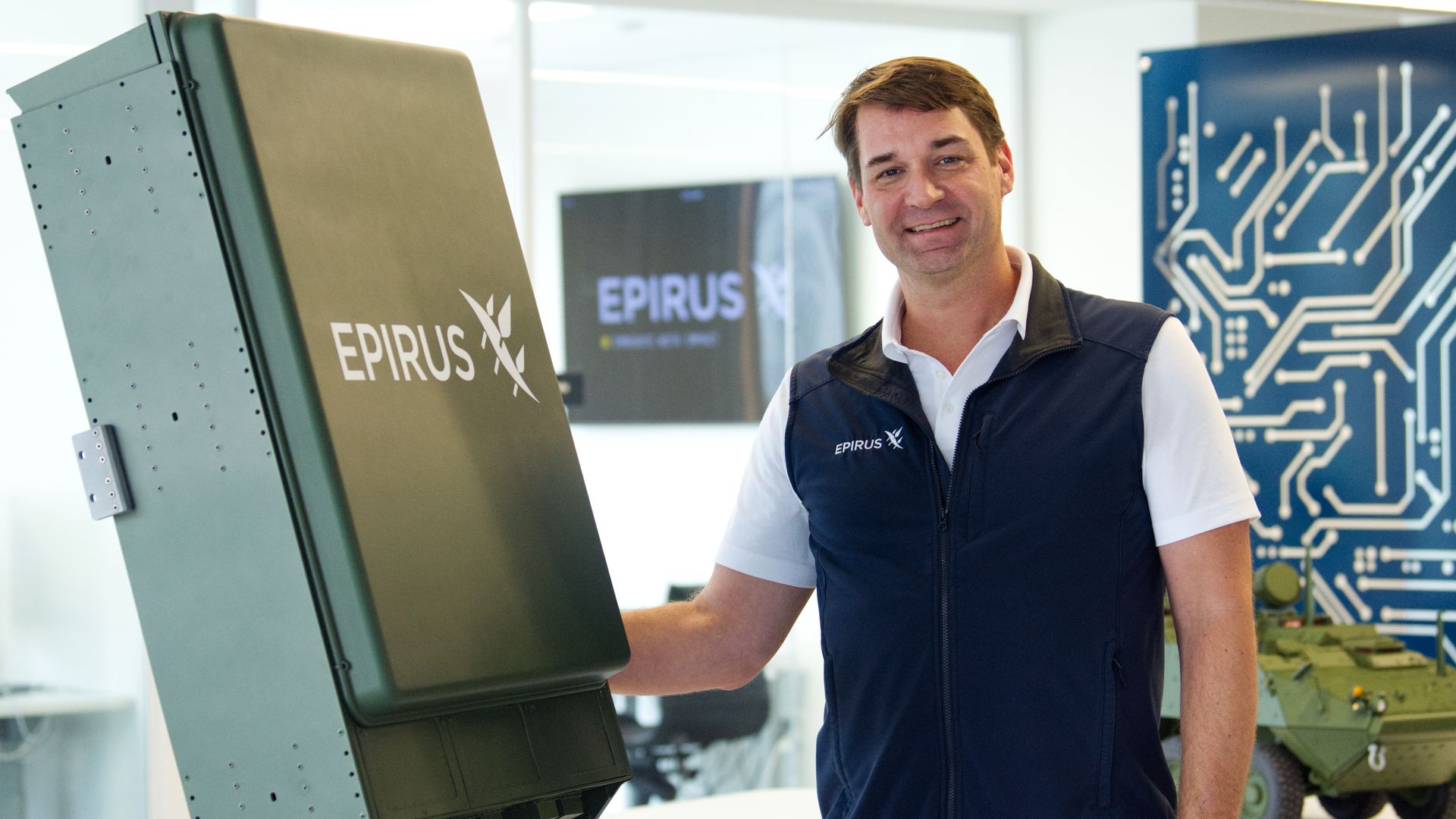
Epirus CEO Andy Lowery gets cozy with a model of the Leonidas HPM system. Photo: Colin Demarest/Axios
Ask Epirus CEO Andy Lowery about robots on the battlefield and he'll tell you about a mythical mix of human and horse.
- Lowery sees "full-on centaur warfare" — that is, humans and machines working intimately together — dominating the next decade.
- "You can actually optimize what humans are good at ... and then pair that with the best and most capable of machines that can be operated independently," he told Axios in an interview.
Why he matters: Lowery leads a company building weapons that fry electronics, drones and more. It delivered four high-power microwave systems to the U.S. Army as part of a $66 million deal.
Q: When you hear "future of defense," what comes to mind?
A: Irregular, asymmetrical warfare will become the regular, symmetrical warfare that we'll be fighting. And it's here to stay.
Q: What's the biggest challenge the defense industry faces at the moment? What can be done to alleviate it?
A: The biggest challenge that the defense industry is facing today is that they're built on a foundation of 50 or 60 years of a particular point of view, or point of perspective, of how the world would potentially go if warfare ended up happening.
- We don't have the right muscles today to be a country at war.
- I think it was Shyam from Palantir Technologies that said the DOD would be better off with half the budget being spent in half the time. I completely agree with that.
Q: What region of the world should we be watching? Why?
A: I don't really have a nontraditional answer for that. I think it's China.
- I have, in previous consumer positions, been through different cities in China. I've seen their prowess in consumer electronics, let's call it.
Q: How many emails do you get a day, and how do you deal with them?
A: I probably get around 50 or so legitimate emails that I should answer and respond to today, and I get probably 100 of some very enterprising, ambitious salesmen of various sectors. It could be anything from recruiters to people selling cardboard boxes.
Q: What's your secret to a successful overnight flight?
A: Not to take them. That's probably been said by someone. I used to take those all the time when I was younger.
- It is really, really, really tough. But if you get used to sleeping on planes, you can pull it off. If you're going to do it, make sure you schedule yourself two or three days on the backside and recover.
Q: What's a piece of gear or tech you can't go without?
A: I don't like gear or tech. I have no watch. Less is more.
Q: What advice would you give your younger self?
A: Learn to motivate yourself without using fear.
