Axios Future of Defense
July 10, 2024

Welcome to the first edition of our new weekly newsletter examining the trends upending defense and how powers large and small are adapting.
I'm Colin Demarest, a reporter who has covered everything from $500 exploding drones to multibillion-dollar Cold War nuclear cleanup.
- We're planning events to explore these topics, as well as to hear from military leaders and their suppliers. Our first is tomorrow with retired Gen. Mark Milley! Come hang out.
- This is a two-way street. Reply to this email and share your thoughts.
We're kicking off with a 30,000-foot view of the beat — what some of you consider an OV-1. Plus, an exclusive look at a hush-hush aircraft made by Northrop Grumman.
Today's newsletter is 833 words, a 3-minute read.
1 big thing: Understanding the next era of warfare
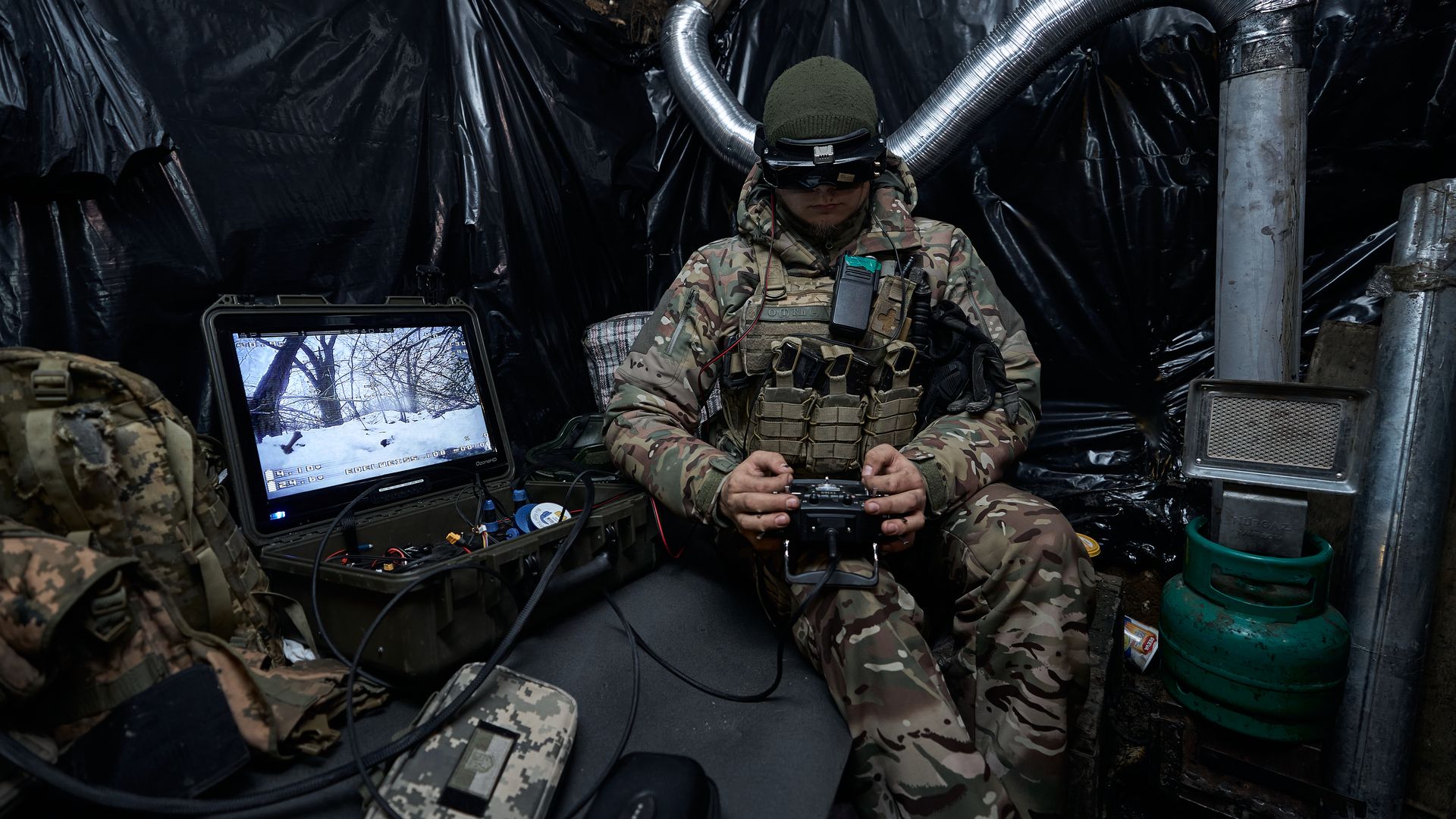
Conflicts abroad and defense-contract competitions at home illuminate in real time the future of America's war machine.
- Cheap, abundant drones are devastating far more expensive systems in Eastern Europe. In waters off Yemen, they embroil the U.S. Navy in fighting so intense it's been compared to World War II.
- Disinformation campaigns shape international perceptions, including in Africa, where Russia's playbook colors a U.S. withdrawal from Niger.
- Directed-energy weapons that fry electronics from afar and intercept overhead threats are leaping from sci-fi to reality. Powerful lasers and microwaves are headed to the greater Middle East.
- Data is currency — or ammunition, depending who you ask. And artificial intelligence is parsing it all to aid maintenance, targeting and every application in between.
- Increasing access to overhead imagery empowers commanders on the front lines and hobbyists at home to keep tabs on movements halfway across the globe. You are always being watched.
- Nuclear arsenals are growing as transparency shrinks. While the U.S. and Russia boast by far the largest numbers, other players such as China and North Korea are inching upward.
Why it matters: Today's closely watched fights are shaping those of tomorrow, and the pace of battlefield innovation is only accelerating.
So what are the trends driving this revolution?
2. Over the horizon
/2024/07/09/1720534362004.gif?w=3840)
These themes will feature regularly in our coverage:
- The unmanned obsession. With advances in drones, robotics, wayfinding and more, militaries are increasingly deploying uncrewed technologies. What's next, and where is the line drawn when time comes to kill?
- Transparent battlefields. Hiding is becoming impossible. Infrared imaging, deep sensing, satellite photography, open-source intelligence and more all betray troop positions.
- Industry disruptors. A consolidated defense industry, long dominated by a handful of household names, is being rattled by small, scrappy competitors and Silicon Valley speed. (I'll be digging into this next week.)
- The digital and physical confluence. Cyber, electronic and information warfare are having a hot moment. Coupled with high-fidelity simulation and gaming and software-defined hardware, the digital world is turning the physical tide.
- AI boom or bust. AI is reshaping daily lives. Its military applications promise to be far more radical. One question stands out: What does global governance look like?
- Seamless connectivity. The Pentagon wants all its forces interlinked — a multibillion-dollar push to outwit the People's Liberation Army known as CJADC2. Reaching that nirvana, though, is complicated by cost and collaboration, as well as a history of networking blunders.
- A new space race. A global surveillance and communications competition is underway, abetted by a booming commercial sector and a hunger for faraway insights. As one expert told me: "Space capabilities are the difference between being a regional power and being a global power."
- Munitions, munitions, munitions. Conflicts chew through stockpiles that then demand replenishment. Those who control the requisite resources and maintain healthy supply lines will have an upper hand.
- Workforce woes. The U.S. military is struggling to recruit enough people. How can the all-volunteer force survive, and how do recruiters connect with Gens Z, Alpha and beyond? (One Army leader has suggested the metaverse.)
The bottom line: Governments and militaries that grasp these challenges and master the changes will dominate the future.
What trends did I miss? Hit reply and let me know.
3. The future foretold

Our take on how war is changing is old hat to the Defense Innovation Unit, the group launched years ago as the Pentagon's liaison to Silicon Valley.
Why it matters: Viewed initially with suspicion, the group is now central to the Pentagon's planning, especially when it comes to countering China with masses of readily available tech.
Driving the news: The group's success story is detailed in a new book,"Unit X," by Raj Shah and Christopher Kirchhoff. They recount red-eye flights, Pentagon showers, canceled credit cards and an agency founded on "folding card tables" and "4G hotspots bought at Best Buy."
- They had to explain themselves to the Valley, too. Invitations to DIU's christening in California included a dress code: formal attire. It was an immediate red flag. "Did this mean 'East Coast' formal — a suit and tie? No, we assured them."
They were prescient when it came to the weapons influencing today's world:
- "Modern warfare — whether against sophisticated militaries or crafty insurgents — is no longer just about multibillion-dollar battleships, aircraft carriers, and stealth bombers."
- "The DIU ecosystem is having real impact. By one count, thirty new products created by startups, mostly in California, were being used on the Ukraine front lines."
Related: How the Air Force is helping clear the path for electric air taxis
4. Check it out: Northrop's new aircraft
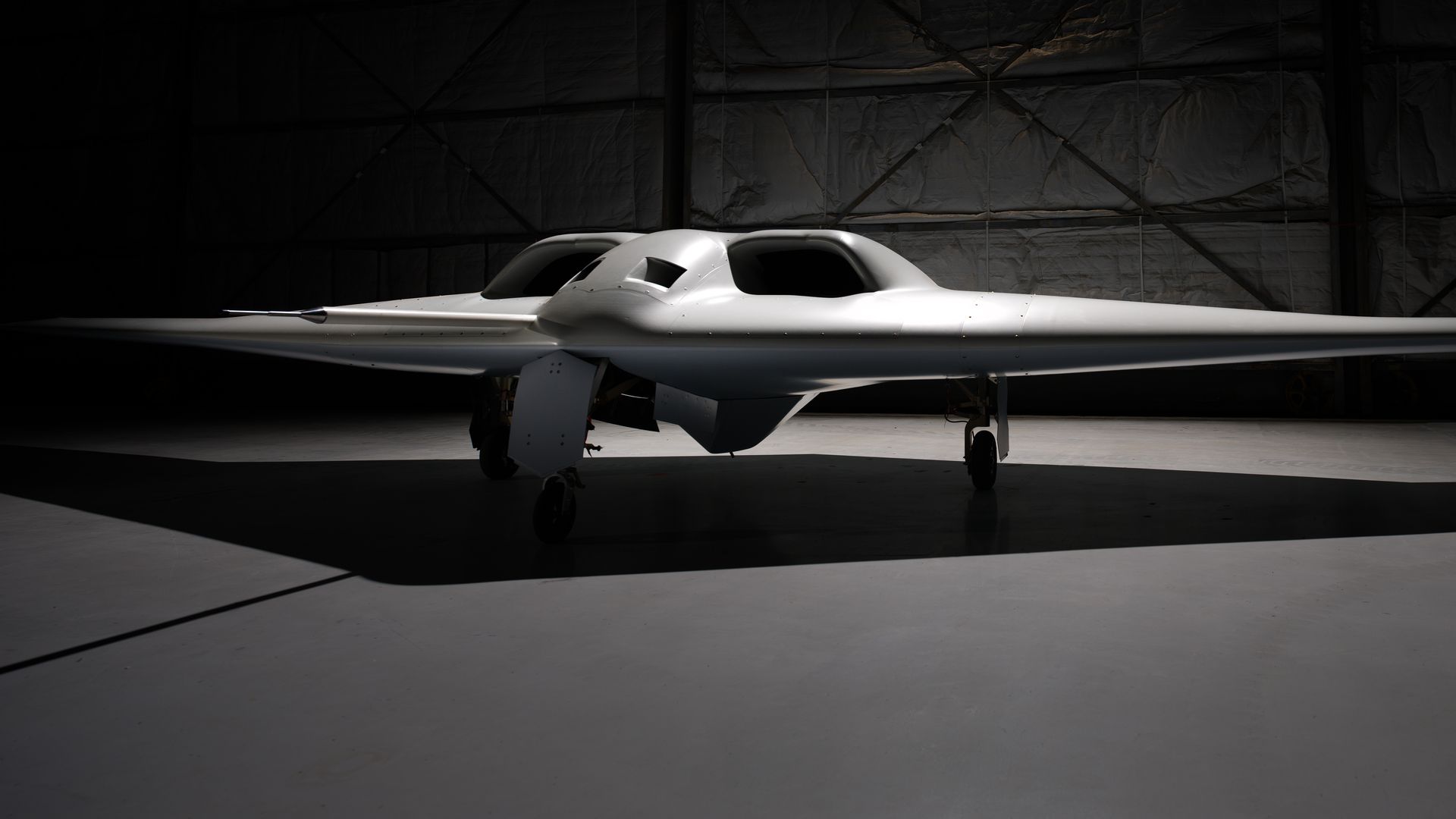
Northrop Grumman has built an experimental uncrewed aircraft, recently crowned XRQ-73. It's pictured above, in a photo first shared with Axios.
Zoom in: Until now, much of the hybrid-electric drone's actual appearance was kept hidden.
- The body, air intakes and landing gear can be seen in the image. It's thought to be designed for super-quiet reconnaissance operations.
- The Defense Advanced Research Projects Agency put its weight at roughly 1,250 pounds.
What's next: DARPA last month said it expects first flight by the end of 2024.
Shoutout to Nicholas Johnston for editing and Matt Piper for copy editing.
Did I miss something? What did you like or dislike? Hit me up!
Sign up for Axios Future of Defense